Sorrell warns UK stock market is facing slow crushing after Brexit
The liquidity crisis hollowing out the City of London
Sir Martin Sorrell, the executive chairman of S4 Capital, presents a stark warning for the London Stock Exchange. The UK equity market is no longer the titan it once was, currently suffering from a severe lack of liquidity that marginalizes domestic firms. Sorrell points to a disturbing trend where Apple can trade more volume in a single day than the entire London market combined. This isn't just a statistical quirk; it's a systemic failure. Institutional investors have fled UK equities in favor of bonds to meet defined benefit obligations, a shift accelerated by the disastrous fiscal policy maneuvers seen during the Liz Truss administration.
Brexit remains the elephant in the room. The promise of a "Singapore on steroids" has failed to materialize, leaving the UK isolated and unattractive compared to European hubs like Paris and Amsterdam, which now frequently post higher daily market values. For a global leader like Sorrell, the UK has become a secondary concern, representing a mere fraction of S4 Capital's revenue. The market is increasingly dominated by passive management and bureaucracies that favor executive enrichment over shareholder performance. Without radical reform to make equity attractive again, the UK risks becoming little more than a bargain bin for Private Equity firms looking to scoop up undervalued assets.
Geopolitical fragmentation and the death of global uniformity
The era of easy globalization has ended, replaced by a complex, geographically fragmented landscape. Running a global company today requires a surgical approach to geographic placement rather than a broad-brush expansion. Sorrell identifies a clear pivot toward North America and South America as the primary powerhouses for growth. While Europe is increasingly viewed through a lens of cost-cutting and efficiency, the Americas offer a dynamic revenue engine. This shift is driven by a realization that the world is no longer a single, unified market but a collection of regional blocs with diverging interests.
In South America, Sorrell highlights the immense technical and creative talent in Argentina and Colombia. Despite political volatility, the human capital in these regions is world-class. However, this optimism is tempered by the rise of Chinese influence through the Belt and Road Initiative. China is aggressively expanding its soft power in the Global South, creating a tug-of-war with US interests. For entrepreneurs, the lesson is clear: follow the GDP growth. The top economies by 2050 will likely be China, the US, India, and Indonesia. Ignoring these shifts or relying on legacy markets like the UK is a recipe for stagnation.
The inevitability of Xi Jinping's move on Taiwan
Geopolitics is often a matter of taking leaders at their word, a lesson the West learned too late with Vladimir Putin. Sorrell argues that Xi Jinping is a figure more akin to Mao Zedong than his immediate predecessors. While leaders like Deng Xiaoping focused on socialist capitalism, Xi is focused on building China into a dominant world power that directly challenges US hegemony. This ambition makes a move on Taiwan feel somewhat inevitable. If you read Xi's speeches, the intent is clear: Taiwan will come under the aegis of the mainland.
This creates a precarious situation for global businesses. Those already large in China must reconsider further expansion, while smaller players might still find opportunities in the massive domestic market. The broader implication is a more dangerous world where tech sectors are critical for national defense. The conflict in Ukraine War has demonstrated that modern warfare is a technology war—a drone war. In this environment, having a strong tech sector isn't just about economic growth; it's a matter of national security. Business leaders must now be amateur diplomats, constantly weighing security threats against market potential.
AI as a net destroyer of legacy structures
Artificial Intelligence is not just a trend; it is as fundamental as the invention of the smartphone. Sorrell identifies five key areas where AI and AGI will transform the marketing and business landscape. First, it collapses the time required for voice and visualization from weeks to hours. Second, it enables hyper-personalization at a scale previously thought impossible. Third, it will revolutionize media planning and buying, a sector that currently employs hundreds of thousands of people whose roles are now at risk. Fourth, it drives general organizational efficiency, and fifth, it democratizes knowledge within companies.
The democratization of knowledge is perhaps the most profound change. In large organizations, information is often siloed in vertical departments. AI allows for the creation of "human bots"—a system where every employee has instant access to the collective wisdom and data of the entire firm. This level of alignment is the holy grail of corporate management. However, this efficiency comes with a price. Sorrell describes AI as a "net destroyer," particularly for established holding companies with bloated staff counts. The industry must prepare for a massive reduction in headcount as automation takes over routine tasks.
The psychological burden of the widget maker
Despite the potential for AI to grant us more leisure time—a promise made since the invention of the washing machine—Sorrell is skeptical about the four-day workweek. While the West may be moving toward a more relaxed schedule, the "Global South" and nations like Vietnam and China maintain a different level of hunger and motivation. The 996 work culture (9 am to 9 pm, six days a week) in China remains a formidable competitive advantage that the West ignores at its peril.
On a personal level, Sorrell identifies with the "widget maker"—the entrepreneur who continues to build and create until their final day. For many high-achievers, retirement is not a reward but a source of unhappiness. The drive to solve problems and ignite markets is what keeps visionary leaders engaged. Whether it's through S4 Capital or his new venture capital efforts, Sorrell exemplifies the restless spirit required to navigate a world in constant flux. The future belongs to those who can synthesize macro trends with granular execution, never stopping to rest on yesterday's successes.
- China
- 17%· places
- S4 Capital
- 10%· companies
- South America
- 7%· places
- Apple
- 3%· companies
- Argentina
- 3%· places
- Other topics
- 59%
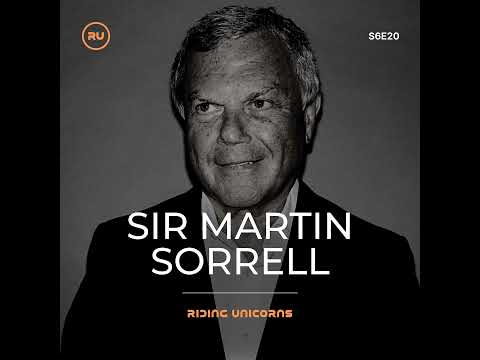
Sir Martin Sorrell, Executive Chairman @ S4 Capital (Follow Up Episode)
WatchThe Riding Unicorns Podcast // 46:23

A podcast featuring the world's best minds from venture and startups. Hosted by James Pringle & Hector Mason.