Joe Rogan and Roger Avary: Cinema, Conspiracy, and the Simulation of Reality
The Lost Art of the Cinematic Moment
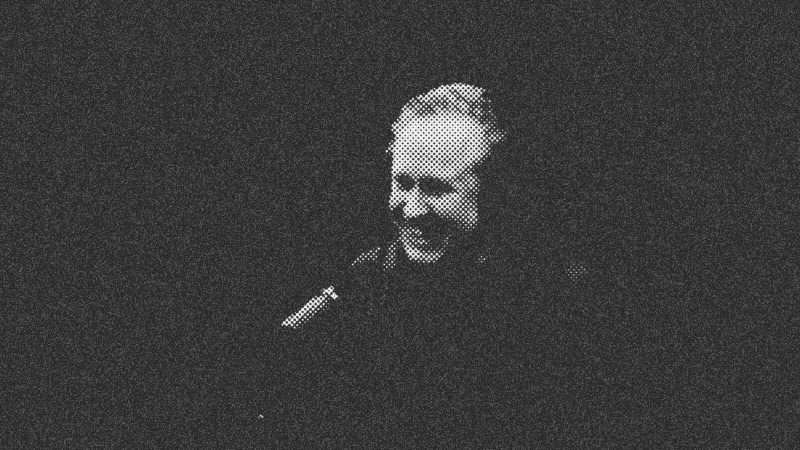
Roger Avary and Joe Rogan began their sprawling dialogue by dissecting the mechanical soul of filmmaking—a craft that has transitioned from the physical to the ethereal. Avary, an Academy Award-winning screenwriter for Pulp Fiction, argues that the shift from film to digital has fundamentally altered the creative energy on a movie set. When cameras ran on actual celluloid, every second had a literal price tag. This "burning of money" created a tension that demanded preparation and presence. Actors and crew members sought to "capture lightning in a bottle" because the physical medium was finite.
Today, the digital era has replaced that urgency with a "let it roll" mentality. Producers and executives now crowd around high-definition monitors in "Video Village," a luxury that did not exist when Orson Welles was hacking through studio concrete with a pickaxe to get the camera lower to the ground. Avary posits that while digital technology is a different kind of paint—watercolor versus oil—it lacks the depth and "unseen electricity" of film. Digital sensors catch light and bounce it back into the glass, creating a flatter image that modern directors try to mask with artificial lens flares and post-production filters. We are living in a cinematic landscape where the faults of old media—the dust, the scratches, the gate weave—are nostalgically simulated to give soul to a medium that has become increasingly sterile and analytically driven.
The Algorithm and the White Paper
Content creation has moved toward a standardized "white paper" approach, particularly within streaming giants like Netflix. These companies provide technical and narrative specifications that strip away individualistic flair in favor of audience retention metrics. Avary and Rogan note that the "inciting event" must now occur by a specific page number or minute mark because the modern audience, influenced by the "mind control device" of the smartphone, has a fractured attention span. This industrialization of storytelling has effectively marginalized the eccentric visionary in favor of the competent technician who can hit the required beats.
The Haunting of Modern Horror and Sci-Fi
Turning toward genre history, the conversation explored how modern remakes are often "haunted" by their predecessors. Avary highlighted the lineage of Nosferatu, tracing it from F.W. Murnau to Werner Herzog, and finally to the contemporary vision of Robert Eggers. Each iteration carries the ghosts of the previous one, reflecting the cultural anxieties of its time. Herzog’s version, for instance, was influenced by a post-war Germany that had no immediate cinematic fathers to look back to, forcing a jump back to the grandfather generation of expressionism.
Contrast this with the current state of franchises like Star Trek. Avary, a self-described Trekkie whose household cycles through every series chronologically, expresses deep frustration with the "corporate propaganda" of current iterations. He argues that legendary creators like Gene Roddenberry and Rick Berman understood how to weave complex social commentary into the fabric of human storytelling. Modern "dweebs"—as Avary colorfully refers to showrunners like Alex Kurtzman—prioritize the message over the narrative, resulting in clunky dialogue and characters that lack the internal faults necessary for compelling drama. The "personal propaganda" of the auteur has been swallowed by the corporate directive.
Beyond the Veil: Cartels, Power, and Hidden Files
One of the most intense segments of the discussion involved Ridley Scott and his film The Counselor, written by Cormac McCarthy. Avary suggests that this film was a disaster upon release because it revealed a world that audiences were not yet ready to accept: a world where power is a singular, inescapable cartel. This cynical view of global systems transitioned naturally into a discussion regarding the Jeffrey Epstein files and the perceived apathy of the public.
Avary referenced a viral video of a man in an Atlanta airport shouting about the files, noting that most people simply wanted to go about their lives. This "zombification" of the populace is, in his view, a result of both a sensory overload of information and a literal cognitive decline possibly linked to modern medical interventions. The mention of Epstein ordering 330 gallons of sulfuric acid immediately following his indictment served as a pivot point for a deeper exploration of "darker hypotheticals." While skeptics point to desalination plants, Avary finds the timing too coincidental, leaning toward the idea that we live in a reality where horrific acts are often masked by mundane industrial explanations.
Predictive Programming and the 9/11 Anomaly
Avary introduced the concept of "predictive programming," the idea that media prepares the public for future events or conditions them to accept specific realities. He pointed to Fight Club, produced by self-admitted Mossad agent Arnon Milchan, which depicted the collapse of financial skyscrapers just two years before the 9/11 attacks. The duo spent significant time analyzing the collapse of World Trade Center Building 7, which fell into its own footprint at free-fall speed. Rogan and Avary noted the "whoopsies" of data loss involving the SEC and IRS files housed in that building, suggesting that the official narrative requires a degree of "faith" that contradicts the testimony of the eyes.
The New Chronology and the Falsification of History
Perhaps the most radical idea discussed was the work of Anatoly Fomenko, a Russian mathematician who posits that the historical timeline has been artificially lengthened by roughly a thousand years. According to this "New Chronology," much of what we consider ancient history—Rome, Greece, Egypt—actually took place between the years 800 and 1600 AD. Avary explained that this manipulation served the land claims of various Eurasian powers and the Vatican, effectively erasing a massive civilization known as Tartaria from the collective memory.
This theory suggests that history is a "cartoon" painted by those in power to justify the present. Rogan countered with the biological and astronomical records that seem to support a longer timeline, but Avary maintained that the "flatline" of progress during the Dark Ages is a suspicious narrative convenience. This thread of the conversation underscored a central theme of the episode: that nearly every foundational "fact" of our civilization, from the date on the calendar to the shape of the planet, is something we accept on faith rather than direct observation.
The Simulation, Gravity, and the Return of Faith
The dialogue eventually reached the edges of the universe, touching on the simulation theory championed by figures like Elon Musk. Avary argued that even "science" is frequently a naming convention for things we don't truly understand. He cited the Richard Feynman perspective that we can measure gravity but we cannot explain what it is. In Avary’s experiential worldview, the earth is flat because he cannot see the curvature from a plane, and he views the scientific insistence on a globe as a potential tool to make humanity feel insignificant and disconnected from a creator.
While Rogan defended the scientific method and the data supporting a globular earth, Avary’s stance was more philosophical than literal. He is interested in the "provocateur" role—upsetting the consensus to find deeper truths. This search for meaning has led him toward faith-based media, such as the series The Chosen. He praised the show for its "punk rock" portrayal of Jesus, focusing on forgiveness in a Hollywood ecosystem fueled by wrath and revenge.
Conclusion: The Auteur in the Age of AI
Despite his skepticism of global institutions, Avary is embracing the next technological shift. He revealed that he is currently in production on three feature films using a proprietary AI technology stack. He noted the irony that while traditional studios are harder than ever to navigate, investors are eager to fund anything with the "AI" label. For Avary, AI is simply another tool in the visual effects arsenal, a way to reduce a million-dollar-a-minute process to a fraction of the cost. He believes this will empower a new generation of independent filmmakers to tell massive, epic stories outside the control of the "Pharisees of Hollywood."
The conversation between Rogan and Avary serves as a reminder that we are living in a period of profound transition. As the lines between reality, simulation, and history continue to blur, the role of the storyteller becomes even more critical. Whether through the lens of a film camera or the algorithms of an AI, the goal remains the same: to find a flicker of truth in the dark.
- Alex Kurtzman
- 4%· people
- Anatoly Fomenko
- 4%· people
- Arnon Milchan
- 4%· people
- Atlanta
- 4%· places
- Citizen Kane
- 4%· movies
- Other topics
- 81%
Joe Rogan Experience #2452 - Roger Avary
WatchPowerfulJRE // 3:05:55
