The AI Capex Paradox: Navigating Market Dislocation and the Software Purge
The High Stakes of Hyperscale Ambition
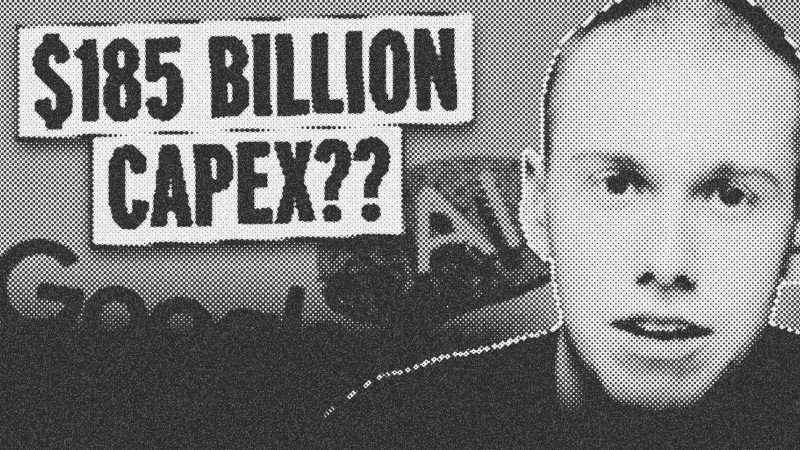
Global markets are currently wrestling with a profound contradiction: record-breaking revenues met with investor skittishness. Google recently reported annual revenue exceeding $400 billion, a historic milestone fueled by a 48% surge in cloud services. Yet, the narrative quickly shifted from celebration to scrutiny as the company announced a massive capital expenditure (capex) forecast of $175 billion to $185 billion for the coming year. This aggressive "front-footed" growth strategy represents an attempt to secure dominance in the generative AI era, but it requires investors to stomach a multi-year digestion period before realizing meaningful returns.
We have exited the 2023 "year of discipline" and re-entered a heavy investment cycle. While the market initially reacted with a 7% after-hours selloff, the recovery suggests a growing, albeit nervous, acceptance that these expenditures are the entry fee for the next decade of technological relevance. The infrastructure build-out validates the astronomical valuations of hardware providers like Nvidia, but for the hyperscalers themselves, the next three years represent a steep hill to climb before reaching the "harvest mode" where stock performance typically peaks.
The Software Sector Purge: Real Threat or Market Panic?
The enterprise software sector is currently the epicenter of market dislocation. In a single week, a brutal selloff erased $300 billion in market value across stalwarts like Salesforce, ServiceNow, and Workday. The catalyst? A fear that AI is not merely an enhancement but a fundamental displacer of the seat-based licensing model. If Anthropic's Claude can automate domains ranging from legal work to customer support, the traditional SaaS value proposition appears vulnerable.
However, history suggests this "sell everything" mentality is often premature. We saw this exact pattern with the arrival of ChatGPT, when analysts prematurely declared the death of search. Instead, AI integration boosted Google to new heights. The current software rout likely represents a cleansing process. We will see "Macy's or Circuit City" equivalents in the software world—companies that weren't robust to begin with—fall away, while high-quality firms that successfully integrate AI into their product stacks will emerge stronger. This is a period of "sorting the rubble" to identify Dislocated High-Quality (DHQ) companies.
The Divergent Paths of GLP-1 Dominance
In the pharmaceutical sector, the battle for the obesity market has revealed a startling divergence between Eli Lilly and Novo Nordisk. Despite both companies navigating the same regulatory and pricing pressures, Eli Lilly saw its stock climb 10% on the back of massive volume growth, while Novo Nordisk cratered 18%. The market is increasingly viewing Eli Lilly as the ultimate winner of the injectable race, even as it prepares to enter the oral medication market.
Novo Nordisk is suffering from "first-mover friction." While they have successfully transitioned hundreds of thousands of patients to oral therapies, the financial profile is less attractive due to lower price points and significant market share erosion. The stock is currently trading near 2021 levels, effectively erasing the gains of the GLP-1 craze. This suggests that in high-growth sectors, early innovation is insufficient; one must also maintain the pricing power and volume scale required to offset inevitable legislative and competitive headwinds.
Antitrust and the Streaming Hegemony
On Capitol Hill, the proposed merger between Netflix and Warner Bros. Discovery has faced a chaotic reception. While senators frequently diverted the discussion toward political bias and content "wokeness," the underlying antitrust concerns remain centered on the consolidation of the streaming landscape. The companies argue their true competition isn't each other, but the attention-grabbing algorithms of TikTok and YouTube.
This argument represents a strategic shift in how tech giants define their markets to evade regulatory blocks. By positioning themselves as underdogs against the "short-form" giants, Netflix and Warner Bros. Discovery hope to justify a mega-merger that would otherwise look like a monopoly. While the Senate hearing serves as a symbolic artifact, the real determination lies with the Department of Justice, where the ideological battle between anti-consolidation and global competitiveness will ultimately decide the fate of traditional media.
- Eli Lilly
- 13%· companies
- Novo Nordisk
- 13%· companies
- 9%· companies
- Netflix
- 9%· companies
- Warner Bros. Discovery
- 9%· companies
- Other topics
- 48%
Google Doubles Down on Spending as AI Fear Returns | Prof G Markets
WatchThe Prof G Pod – Scott Galloway // 29:59

NYU Professor, best-selling author, business leader and serial entrepreneur Scott Galloway cuts through the biggest stories in tech, business, and investing with unfiltered insights, bold predictions and thoughtful advice. Podcasts include Prof G Markets with co-host Ed Elson, Prof G Conversations and Office Hours with Prof G.