Andrew Yang: Fixing government waste requires business logic and better incentives
The disconnect between fiscal policy and operational reality
Public discourse often treats government waste as a moral failing rather than a structural byproduct. Andrew Yang notes that while business leaders often enter politics promising to run the state like a private enterprise, they quickly encounter a friction point: the IRS. In a corporate setting, an entity with a high return on investment (ROI) receives more funding. Conversely, the federal government often starves the very agency responsible for collecting its receivables. A truly business-oriented approach would prioritize the efficiency of tax collection and fraud prevention to stabilize the national balance sheet before seeking further levies from the compliant public.
Incentive structures drive the use-it-or-lose-it cycle
One of the most persistent drains on public capital is the budgetary incentive to spend entire allocations regardless of need. Andrew Yang highlights a systemic flaw within the Department of Defense where personnel are incentivized to exhaust fuel supplies or equipment budgets to prevent future cuts. This "use-it-or-lose-it" mentality ensures that efficiency is punished rather than rewarded. Because military spending is distributed across 435 congressional districts, any attempt to prune this bloat runs into the political reality of local job preservation. The result is a self-perpetuating cycle of expenditure that prioritizes political optics over tactical readiness.
Radical transparency through a public spending database
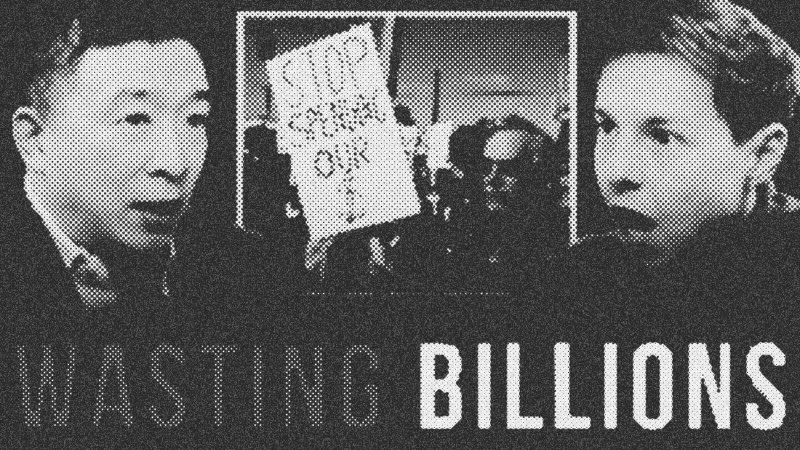
To break the cycle of bureaucratic opacity, there is a growing case for a centralized, line-item registry of all government spending. Such a database would allow citizens and independent journalists to audit expenditures in real-time, identifying everything from overpriced office supplies to redundant regional projects. Transparency serves as a disinfectant for the "barnacles" of inefficiency that attach themselves to large-scale public contracts. By making every dollar traceable, the government can shift the burden of proof back onto the agencies requesting funds.
Managing the humane transition of displaced workers
Fiscal prudence must be balanced with social stability. Many government inefficiencies translate into livelihoods for thousands of families. Andrew Yang argues that as Artificial Intelligence and fiscal reforms eliminate redundant roles, the state must provide humane transitions—such as income buyouts—rather than abrupt terminations. True wealth management on a national scale involves pruning waste while ensuring the resulting economic shifts do not decimate communities. The goal is a resilient system that values efficiency without discarding the individuals caught in the machinery of change.
- Andrew Yang
- 30%· people
- Air Force Academy
- 10%· organizations
- Artificial Intelligence
- 10%· technology
- Bill Clinton
- 10%· people
- Department of Defense
- 10%· organizations
- Other topics
- 30%
The Truth About Government WASTE... | Andrew Yang
WatchThe Iced Coffee Hour Clips // 13:52

Official Clips Channel of the Iced Coffee Hour Podcast. All of the Iced Coffee Hour Clips are posted here for your enjoyment! Podcast hosted by Graham Stephan and Jack Selby. Jack Selby: https://www.instagram.com/jlsselby/ Graham Stephan: https://www.instagram.com/gpstephan/