The Surgeon-Entrepreneur: Decoding the Economic Dysfunction and Future of U.S. Healthcare
The professional arc of Niral Shah defies the traditional silos of modern career paths. As a trauma surgeon and serial entrepreneur, Shah has navigated the high-stakes environment of the operating room and the equally volatile Silicon Valley startup scene. His journey, beginning with a search engine startup during the dot-com boom and evolving into a sophisticated critique of the medical-industrial complex, provides a rare vantage point on where human health meets market dynamics. In an era where the United States spends nearly a fifth of its GDP on healthcare without achieving superior outcomes, Shah’s insights offer a roadmap for the necessary reckoning facing the industry.
The Dot-Com Crucible and the Value of Integrity
Shah’s entry into entrepreneurship was a trial by fire. At the age of 19, while most medical students were burying their heads in anatomy textbooks, he took a sabbatical to launch NetGopher. This search engine venture, born out of a personal frustration with the lack of filtered medical information for patients, eventually transitioned into an enterprise software company focusing on dynamic predictive caching. Operating in the eye of the dot-com storm, Shah learned that the most critical assets in a startup aren't always technical; they are relational.
When the liquidity crunch of the early 2000s hit, NetGopher faced an existential choice. Unlike many founders who burned through their remaining capital in a desperate bid for survival, Shah and his team opted for Chapter 7 bankruptcy while they still had cash in the bank. This decision to return remaining funds to creditors was not merely a legal maneuver but a profound exercise in fiduciary responsibility. The move cemented his reputation with Nokia Ventures and other investors, proving that the way a founder handles failure is often more predictive of future success than how they handle victory. This ‘organ donation’ of capital allowed investors to redirect resources toward more viable world-changing ideas, earning Shah a rare standing letter of intent for future investments.
The Economic Disconnect: Why Healthcare Costs Trillions
The fundamental pathology of the U.S. healthcare system lies in its broken economic incentives. Shah points out a glaring anomaly: in almost every other sector, the end-user is the buyer. In healthcare, this relationship is severed. Whether it is a Cardiac Stent or a pharmaceutical prescription, the patient (end-user) rarely selects the product, and the physician (decision-maker) rarely pays for it. This decoupling removes the downward pressure on costs that typically governs a healthy market.
Currently, the U.S. healthcare sector consumes between 18% and 21% of the national GDP. Despite this massive expenditure, the Human Development Index and life expectancy outcomes in the U.S. often lag behind OECD nations that spend half as much. Shah characterizes the current state of the system as a dam held together by band-aids. Trillions of dollars are lost in the ‘fat’ of transactional costs and bureaucratic friction. The rise of CVS Health, which has integrated insurance (Aetna), pharmacy benefits, and retail delivery, represents a massive experiment in vertical integration to capture these transactional efficiencies. However, whether such consolidation improves patient outcomes or merely shifts profit centers remains a question that will take decades to answer.
Strategic Disruption: Deskilling and Disintermediation
For entrepreneurs looking to make a ‘dent in the universe,’ Shah identifies specific avenues where the system is ripe for collapse and reconstruction. The first is deskilling—moving high-level medical functions into the hands of the patient or lower-cost providers. He cites Goreina, a startup developing at-home cervical cancer screening tools, as a prime example. By allowing a patient to perform a screen that previously required a specialized office visit, the company bypasses the insurance-payer bottleneck and reduces the barriers to care for the uninsured.
Another frontier is the use of multi-omics and large-scale data sets. Shah is currently involved in drug discovery projects that treat aging as a treatable condition, akin to arthritis. By leveraging data sets from PubMed and beyond—including ‘failed’ studies that didn't reach statistical significance but contain valuable signal—AI can identify mitochondrial and cellular pathways that were previously invisible to human researchers. The goal is to move from generalized medicine (which works for 85% of people) to precision medicine that understands exactly why a drug fails for the remaining 15%.
The Neo Philosophy: Inversion and Derisking
Shah reframes the role of the CEO through the lens of The Matrix. Rather than a heroic figure charging through barriers, a successful founder is more like Neo, constantly dodging existential ‘bullets’ that threaten to kill the company. He advocates for the principle of inversion: instead of asking how to take risks, a founder must ask how to systematically remove them.
Starting a company is the only true risk; every step afterward should be an exercise in derisking through Patent, network effects, and validated business models. This requires a shift away from the current hype surrounding AI ‘wrappers.’ Many current AI startups face a linear cost basis due to compute requirements, meaning they fail to achieve true economies of scale. Shah warns that simply adding an ‘AI’ suffix to a company name does not substitute for solving a fundamental workflow problem or removing a layer of the 18% GDP fat.
Implications and the Future Outlook
The coming decade will likely see a forced reversion to the mean for U.S. healthcare. As political will to fund the current inefficiency evaporates, the system will be forced to adopt the leaner models Shah describes. We are currently in a ‘travel agent’ moment for many medical intermediaries; much like the internet made travel agents obsolete by 2000, digital-heavy, real-time health evaluations will likely displace traditional gatekeepers.
However, the ‘human-in-the-loop’ remains a non-negotiable requirement. While AI can find patterns in biomarkers and genomic data that human cognition might miss, it cannot account for the nuance of a patient’s life—such as the safety implications of treating a trucker for narcolepsy. The future of medicine lies in the synthesis of this machine-led pattern recognition with the ethical and clinical oversight of the practitioner. As Shah continues his humanitarian work in conflict zones like Ukraine, he remains a proponent of using these advanced tools to empower even the most underserved populations, proving that innovation, when grounded in integrity, can indeed change the world.
- NetGopher
- 8%· companies
- Aetna
- 4%· companies
- AI
- 4%· products
- Apple Watch
- 4%· products
- Cambodia
- 4%· places
- Other topics
- 76%
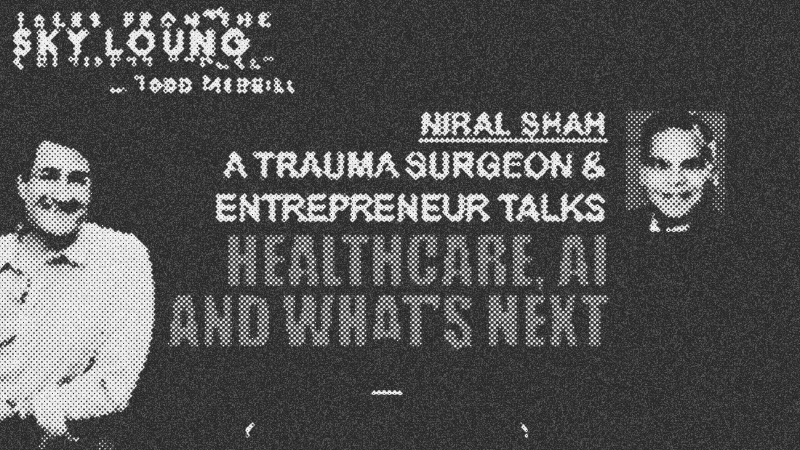
Ep44 Niral Shah: A Trauma Surgeon & Entrepreneur Talks Healthcare, AI and What’s Next
WatchTales From The Sky Lounge // 1:01:31

FROM THE HOST: Welcome to Tales From the Sky Lounge! As an experienced Software Executive who meets a lot of interesting people every week I hear a lot of compelling stories from a variety of businesses in the High Tech community. My goal for this podcast is to find interesting guests, ask questions that allow them to tell compelling stories and maybe to impart some of their hard-earned wisdom. I’m honored that you are tuned in and hope that you are benefiting from your time here in the Sky Lounge. We will do our best to keep it entertaining and to bring unique perspectives to the Venture, Consulting and Investing community. Enjoy! –Todd Merrill, Host Follow “Tales From The Sky Lounge “on Social Media @TFTSkylounge Spotify: https://podcasters.spotify.com/pod/show/tales-from-the-sky-lounge Apple: @tales-from-the-sky-lounge Amazon: https://podcasters.amazon.com/podcasts/4ba289a5-0d33-4589-95c7-83416731a864 Production/Design: James Liebman