Steph Smith reveals five hidden industries set for massive disruption
The Silver Tsunami Sparks an Assisted Living Gold Rush
The most lucrative opportunities do not require predicting the future; they only require looking at the demographic math. While tech founders obsess over algorithms, a demographic shift of historic proportions is quietly unfolding. Steph Smith, the resident data sleuth on My First Million, highlights a generational defining statistic: the US Bureau of Labor Statistics projects nursing as the fastest-growing occupation, set to add 275,000 jobs.
This isn't just an American phenomenon. Japan serves as the early case study for this demographic cliff, witnessing a 50% surge in nursing homes over the past decade. The imbalance has become so severe that Japan is practically giving away empty properties, known as "Akiyas," to combat rural decline.
For builders, the real play lies in premium elder care. The median price of assisted living in the United States has surged to $54,000 annually, rising 31% faster than inflation. Half of the operators in this space clear profit margins of 20% or more. The current crop of facilities is dismal, offering institutional, depressing environments. A massive opportunity exists to build premium, high-end assisted living brands where wealthy families will gladly pay five times the average rate for exceptional care and dignity.
Air Quality Monitors and the Search for Clean Oxygen
We are facing a massive awareness gap in what we breathe. Air pollution stands as one of the leading global risk factors for death, yet it remains invisible. Data from Patrick Collison's research pages reveals that 3.7 billion people are regularly exposed to hazardous PM 2.5 particulate levels. Extreme cases, like New Delhi breaching 450 on the air quality index, expose residents to the equivalent of smoking 25 to 30 cigarettes a day.
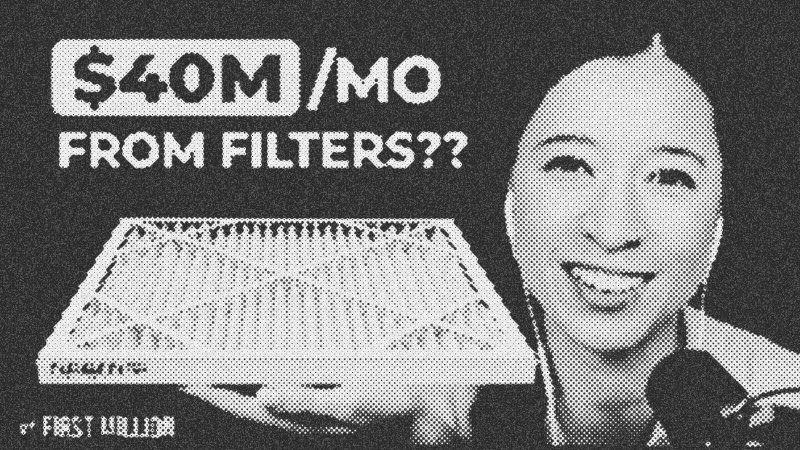
This is not just a health crisis; it is a cognitive drain. High PM 2.5 levels directly correlate with lower GDP, poor decision-making under pressure, and decreased productivity. This reality is sparking a massive consumer hardware boom. On Amazon, monthly sales of air filters, furnace filters, and monitoring devices have exploded. Jungle Scout data reveals that the top four entries for furnace filters and air monitors pull in over $40 million in monthly revenue combined.
Hardware giants are already moving in. The Dyson Zone, a hybrid air-purifying mask and headphone set retailing for $700, represents early-stage experimentation. The product was widely mocked, but the underlying consumer demand is real. Winning this market will not require scientific breakthroughs; it will require expert marketing. The first company to design an intuitive, aesthetically pleasing air monitor that effectively scares consumers with real-time toxicity data, and then provides a seamless remediation solution, will dominate the domestic wellness space.
The Anti-Fitness Movement of Suburban Triathlons
While ultra-endurance events and hardcore fitness regimes capture the attention of a vocal minority, a counter-trend is bubbling among middle-aged, out-of-shape men. There is an enormous, untapped market for social "athletic" events built around leisure and moderate indulgence rather than punishing physical exertion.
Enter the "suburban triathlon." The concept is brilliant in its simplicity: a half-mile walk to a local bar, chugging two beers, and playing nine holes of golf. It is an exercise in branding rather than athletics.
Think about the massive success of Tough Mudder, but engineered for the non-fit crowd. This is a lifestyle franchise waiting to be built. By structuring localized, low-stakes tournaments that combine minor physical activity with food, drink, and heavy social interaction, operators can tap into a demographic starved for community, competition, and an excuse to get out of the house on a Saturday morning.
Cashing In on the High Cost of Heartbreak
Heartbreak is a reliable, recurring consumer catalyst. Statistics show that the average individual spends roughly $1,500 in the immediate aftermath of a romantic breakup. Yet, almost no consumer brand explicitly targets this emotional transition.
This is an open invitation for viral product creation. A nimble marketer could launch a highly profitable, self-funded brand simply by leaning into post-breakup tropes. Consider a dedicated "revenge body kit" containing a rapid detox, wellness juices, and motivational materials. Or look at "breakup boxes" where users mail in their ex's leftover belongings, receiving a dramatic video of the box being destroyed in return.
By leveraging high-distribution meme accounts like FuckJerry for organic reach, a dedicated breakup brand could easily scale to $10 million in annual sales. It is an emotionally charged niche with zero dominant players, high sharing potential, and a constant stream of new customers.
Designing the Future by Copying Natural Systems
Millions of years of evolutionary trial and error have already solved our toughest engineering problems. The field of biomimicry is the ultimate untapped R&D department, and databases like Ask Nature are bringing these solutions to the mainstream.
Consider the African darter bird, which possesses feathers that are perfectly water-resistant, or the complex, highly efficient search algorithms inspired by the collective foraging patterns of ants. Forward-thinking companies are already building massive moats by translating these biological hacks into consumer products. Mischief, an art and product collective known for viral releases, created "Gobstopper" sneakers that change colors as the outer layers wear down, mimicking the physical properties of candy.
Whether it is designing advanced insulation textiles based on sea otter fur or engineering athletic wear inspired by camel hide, the narrative power of nature-inspired design is a marketer’s dream. It offers an immediate, compelling hook that stands out in a crowded marketplace.
- Japan
- 17%· locations
- Amazon
- 8%· companies
- Ask Nature
- 8%· products
- Dyson
- 8%· companies
- FuckJerry
- 8%· companies
- Other topics
- 50%
9 Killer Business Ideas The Internet Hasn't Caught Up To in 2026
WatchMy First Million // 38:34

two guys, talking about business. we've done it (sold our companies), and now we talk about new ideas, opportunities, and investments. hosted by Shaan Puri & Sam Parr -- produced by Hubspot. sometimes we bring on guests ranging from billionaires to stay at home moms who've got side hustles that are bringing in $10k a month. we like to have fun, and talk about business stuff.