Aerodynamics trump weight on flat terrain for road cyclists
Somerset levels test scenario
To isolate the impact of mass on flat-ground performance, Global Cycling Network (GCN) presenters Ollie Bridgewood and Connor Dunne conducted a controlled experiment on the Somerset levels. The trial compared power output against speed across two distinct runs. In the baseline run, the riders maintained a steady 200 watts in a standardized hood position. The second run introduced a 20 kg weighted vest to simulate dead weight, testing the hypothesis that while gravity is the enemy on climbs, inertia and rolling resistance dictate the flat-land struggle.
Mechanical drag and rolling resistance
Physics dictates that extra weight on the flat doesn't just slow you down via gravity; it increases the normal force on your tires. This leads to higher rolling resistance as the rubber deforms under the load. While Bridgewood noted that optimized tire pressure from Pirelli can mitigate some of this friction, the energy cost is real. However, the largest penalty for larger riders isn't the weight itself, but the increased frontal area. Larger riders typically possess more surface area, creating greater aerodynamic drag which requires more wattage to overcome at cruising speeds.
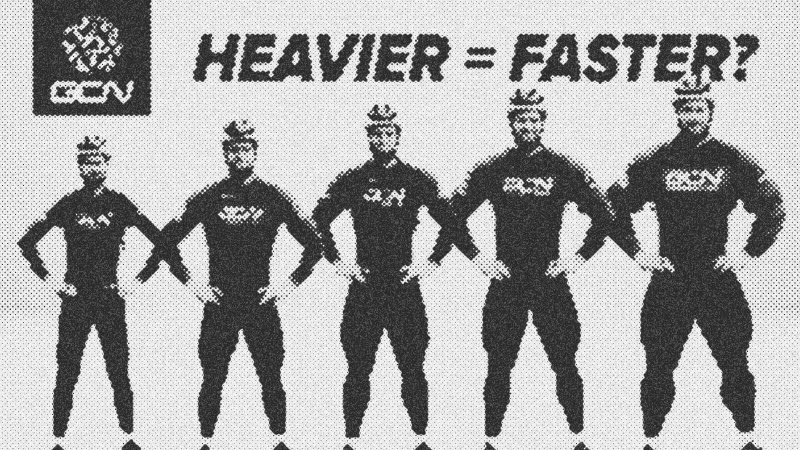
Acceleration and inertia breakdown
The most tactical impact of weight occurs during phase shifts. In the 0–40 km/h standing start tests, mass proved catastrophic. Dunne saw his acceleration time suffer significantly, struggling to reach top speed under the added 20 kg load. This reveals that in criteriums or races with frequent cornering, a heavier rider consumes far more
- Connor Dunne
- 25%· people
- Global Cycling Network
- 25%· companies
- Ollie Bridgewood
- 25%· people
- Pirelli
- 25%· companies
We Tested How Much Weight Matters On The Flat. The Results Surprised Us.
WatchGlobal Cycling Network // 13:18

The Global Cycling Network puts you in the centre of the action: from the iconic climbs of Alpe D’Huez and Mont Ventoux to the cobbles of Flanders, everywhere there is road or pavé, world-class racing and pro riders, we will be there bringing you action, analysis and unparalleled access every week, every month, and every year. We show you how to be a better cyclist with our bike maintenance videos, tips for improving your cycling, cycling top tens, and not forgetting the weekly GCN Show. Join us on YouTube’s biggest and best cycling channel to get closer to the action and improve your riding! Welcome to the Global Cycling Network!