Modern wide tires beat vintage RockShox suspension by five minutes
The brutal reality of the cobbles
Victory at Paris-Roubaix isn't just about who has the biggest lungs; it’s about who can endure 50 kilometers of "pave" without their equipment or their spirit shattering. These aren't just bumps; they are inhospitable farm tracks that demand mechanical solutions. In the early 90s, the RockShox Paris-Roubaix SL fork promised to revolutionize the race with 30mm of travel. It was a bold move that briefly dominated the podium, proving that some form of isolation from the terrain was essential for peak performance. However, as tech evolved, the heavy mechanical approach was shelved for something more elegant.
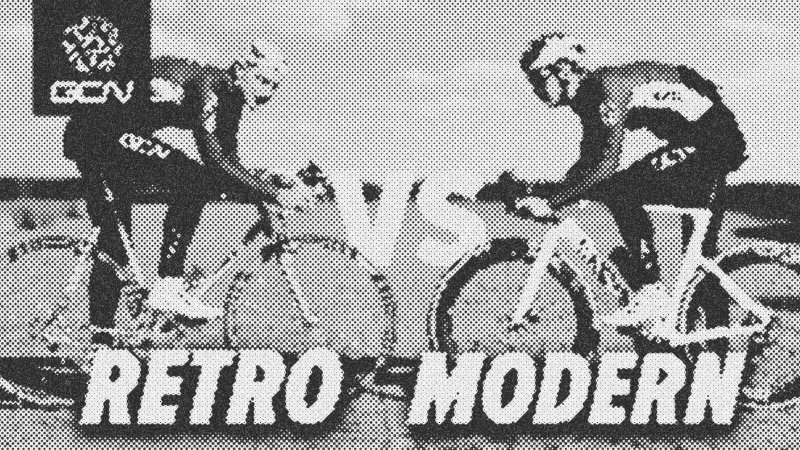
Mechanical travel versus pneumatic volume
The RockShox Paris-Roubaix SL featured an air spring and an oil damper, remarkably sophisticated for 1991. Compare that to a modern Canyon Aeroad equipped with 32mm Pirelli P Zero Race RS tires. We are looking at two different philosophies of damping. The vintage fork attempts to move the wheel vertically to maintain contact, while the modern high-volume tire uses pneumatic suspension to absorb high-frequency vibrations before they ever reach the frame. On paper, the mechanical fork offers more travel, but it comes with a weight penalty and aerodynamic drag that the modern aero bike simply doesn't suffer.
Data proves modern tech dominates
Testing these machines on the four-star cobbles of the Royal Crescent reveals a staggering gap in efficiency. A rigid vintage Bottecchia was predictably the slowest, forcing the rider to fight the bike. The Greg LeMond era replica with the RockShox fork managed to be 1 km/h faster for the same power output—a clear win for suspension. However, the modern Canyon obliterated them both, clocking in at 2 km/h faster than the suspended vintage bike. Over the full 50km of cobbles, that modern advantage saves a rider over five minutes. That isn't just a marginal gain; it’s a different sport.
Why the forks vanished
If the suspension worked, why did it disappear after 1994? Part of it was cycling politics; legends like Ernesto Colnago reportedly banned his riders from using them, believing they compromised the purity and handling of his frames. But the real killer was the realization that Paris-Roubaix is still 200km of fast road racing. Suspension forks are heavy, expensive to maintain, and aerodynamically inefficient. Modern 32mm tires provide the "happy medium"—enough compliance to survive the cobbles without sacrificing the speed needed to win the sprint in the velodrome. The mechanical fork was a brave experiment, but the tire has won the war of attrition.
- Paris-Roubaix
- 17%· places
- Bottecchia
- 8%· products
- Canyon
- 8%· companies
- Canyon Aeroad
- 8%· products
- Ernesto Colnago
- 8%· people
- Other topics
- 50%
How Much Faster Is A Modern Superbike At Paris-Roubaix?
WatchGlobal Cycling Network // 17:43

The Global Cycling Network puts you in the centre of the action: from the iconic climbs of Alpe D’Huez and Mont Ventoux to the cobbles of Flanders, everywhere there is road or pavé, world-class racing and pro riders, we will be there bringing you action, analysis and unparalleled access every week, every month, and every year. We show you how to be a better cyclist with our bike maintenance videos, tips for improving your cycling, cycling top tens, and not forgetting the weekly GCN Show. Join us on YouTube’s biggest and best cycling channel to get closer to the action and improve your riding! Welcome to the Global Cycling Network!