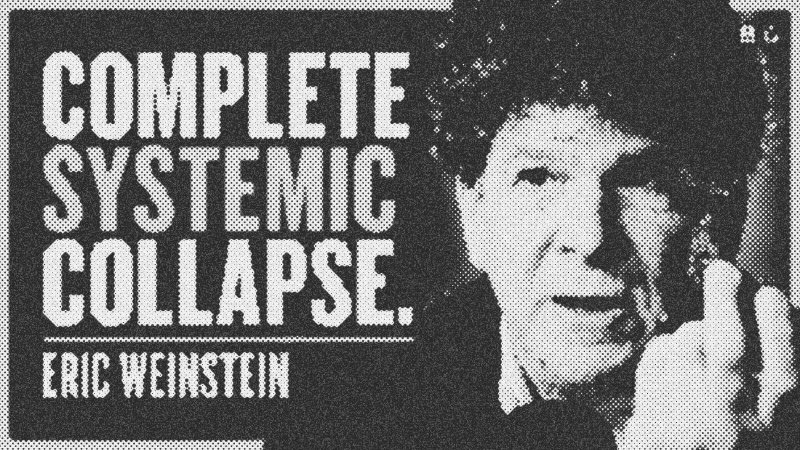
Eric Weinstein warns the duopoly will break us without radical agency
The architecture of a managed reality
We are currently navigating an era defined by what Eric Weinstein calls "managed reality." This isn't merely about bias or a specific political lean; it is an interlocking series of agreements and tacit understandings designed to maintain a specific international order. According to Eric Weinstein, the primary role of the American two-party system is to prune the field of populist candidates so that regardless of who wins, the "rules-based international order" remains intact. He describes this as a "magician’s choice"—the illusion of democracy where the options provided have already been pre-vetted by the intelligence community, the State Department, and major defense contractors.
This system functioned reliably until 2016 when Donald Trump broke through the primary structure. Eric Weinstein argues that the institutional panic following Donald Trump's victory led to a "full court press" to regain control. This involves the use of "retconning"—retroactive continuity—where the media and institutional powers rewrite historical narratives in real-time to align with current political needs. A stark example is the sudden shift in how Kamala Harris was portrayed by major outlets, effectively erasing her previous unpopularity or specific policy failures from the public record to suit a new electoral requirement.
The two concepts of democracy in conflict
At the heart of our current societal tension is a fundamental disagreement over what the word "democracy" even means. Eric Weinstein identifies two distinct and overloaded concepts. The first is "Type A" democracy: the will of the people expressed through plebiscites and elections. The second is "Type B" democracy: the preservation of the institutions that originally sprang from democratic roots—the State Department, the courts, and the scientific establishment. The paradox of our time is the attempt to protect "Type B" democracy by suppressing "Type A" democracy. When institutional leaders claim they are "saving democracy," they often mean they are protecting their institutions from the unpredictable will of the voters.
Scientific stagnation and the string theory distraction
Eric Weinstein, a theoretical physicist himself, draws a chilling parallel between the management of politics and the management of science. He posits that theoretical physics has been at a dead end for over forty years, not because we lack brilliant minds, but because the field has been intentionally or emergently "derailed." He points toward String Theory as a primary culprit—a "shiny distraction" that has consumed the vast majority of funding, talent, and institutional attention while producing zero experimental evidence.
He suggests a more provocative possibility: that actual progress in physics is being suppressed because it is too dangerous. He cites "deemed exports" and "restricted data"—concepts where certain mathematical insights are "born secret" because they might impinge on nuclear weaponry or other existential risks. If a breakthrough in general relativity could lead to a new form of energy or weaponry, the government has a vested interest in ensuring that physics remains "boring and safe." This leads to a situation where physicists are incentivized to pursue irrelevant theories like String Theory while those attempting original, potentially "dangerous" work are marginalized or mocked as amateurs.
The sociology of anti-science
This institutional control manifests as a specific sociology that Eric Weinstein labels as "anti-science." He critiques figures like Leonard Susskind and Sean Carroll for maintaining a rigid orthodoxy that punishes dissent. The goal of "The Science™"—as opposed to the actual scientific method—is to protect funding streams and professional reputations. In this environment, peer review becomes a tool for gatekeeping rather than quality control, ensuring that no theory truly challenges the status quo. Eric Weinstein calls for a "long science, short The Science™" trade, suggesting that the most valuable breakthroughs will come from the edges where people are willing to be disagreeable and independent.
Navigating the traps of criticism capture
In the digital age, being a public intellectual or a content creator involves navigating a minefield of "audience capture" and a more insidious phenomenon Eric Weinstein calls "criticism capture." While audience capture forces you to tell your followers what they want to hear, criticism capture occurs when you allow your most unhinged detractors to define your behavior. It is the "wojak" face—trying to appear calm while boiling with rage underneath. Eric Weinstein notes that many public figures overcorrect their messaging to avoid blowback or, conversely, become caricatures of themselves by leaning into the fevered pitch of their enemies.
To combat this, Eric Weinstein proposes the concept of an "accuracy budget." No human being is 100% consistent or accurate. If we torch everyone who exhibits a self-serving opinion or a slight inconsistency, we will destroy all our best people. He argues for a "good faith" allowance, where we judge individuals on the totality of their contributions rather than a single "peak hate" moment. We need a return to "Queensberry Rules" for intellectual debate—where we can fight hard over ideas but maintain personal civility and avoid the "character assassination" that currently passes for criticism.
The Chihuahua effect and digital entropy
Much of the online discourse is dominated by what Eric Weinstein calls the "Chihuahua effect"—loud, annoying voices that yap all day because they have nothing productive to do. These voices create a form of digital entropy, exhausting the energy of creative and agentic people. To survive in this environment, one must learn to block on the basis of incivility rather than disagreement. Cultivating the ability to ignore "poisoned" criticism is essential for anyone trying to build something meaningful in a world obsessed with hypocrisy-hunting.
The path toward high agency
If the world is a series of managed realities and institutional dead ends, the only viable path forward is through radical personal agency. Eric Weinstein defines agency not just as the ability to act, but as the commitment to find the "cheat codes" in any given system. He uses the example of his son, who bypasses traditional educational bottlenecks by taking graduate-level exams as a high schooler. This is "macgyvering" life—refusing to accept the standard "no" and looking for the "Panic Room" in the system that everyone else assumes is a solid wall.
High agency is fundamentally about non-acceptance. It requires a certain amount of "trait disagreeability"—the refusal to accept the consensus simply because it is the consensus. Eric Weinstein encourages people to find their own inner voice, noting that most people die never having heard it because they are too busy running the "innovation packets" of their social class. Whether it is in physics, politics, or personal romance, the most transformative moments happen when we stop trying to fit in and start seeing the world through our own eyes.
Breaking the duopoly of thought
On the political front, Eric Weinstein sees the breaking of the "duopoly" as the ultimate test of American agency. He believes that both major parties have abandoned the working class, leading to a surge in deaths of despair and a loss of national meaning. He speaks highly of the sincerity he sees in Robert F. Kennedy Jr. and Nicole Shanahan, as well as the genuine concern for the "Hillbilly" population expressed by JD Vance in private. His argument is that we must support third-party movements not necessarily because they are perfect, but because the alternative is a continued descent into a managed decline. Breaking the duopoly is about reclaiming the right to an unburdened future—one that isn't pre-written by the ghosts of World War II architects.
- Eric Weinstein
- 42%· people
- Donald Trump
- 6%· people
- String Theory
- 6%· organizations
- Central Intelligence Agency
- 3%· organizations
- Chris Williamson
- 3%· people
- Other topics
- 39%
Something Very Strange Is Happening at the Top - Eric Weinstein (4K)
WatchChris Williamson // 3:29:15
