Alain de Botton warns smart people against over-intellectualizing their emotional pain
The Cerebral Shield That Keeps Us From Feeling
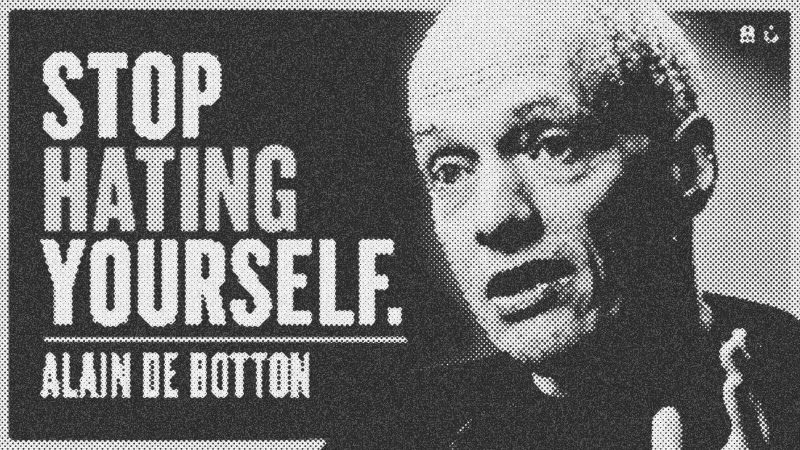
Highly analytical minds suffer from a unique and elegant curse. They use cognitive horsepower as a shield against raw feeling. When a difficult emotion arises, the immediate reflex of the intellectually curious is not to feel it, but to study it. They read psychological journals, listen to dense philosophy podcasts, and categorize their suffering into neat conceptual bins. This instinct looks like self-investigation. In reality, it is often a highly sophisticated flight from vulnerability.
In a deep exchange, writer Alain de Botton and host Chris Williamson explore this exact defense mechanism. People who excel at intellectual pursuits frequently use their cognitive architecture to ward off overwhelming situations. It starts in childhood. A bookish child surrounded by instability learns that books are safe. Ideas do not reject you; they do not erupt in volcanic anger. Decades later, that same child, now an adult, treats a therapy session like an academic essay rather than a personal inquiry.
This intellectualizing acts as a prophylactic against actual experience. It is much easier to analyze the evolutionary biology of anxiety than to sit quietly with a racing heartbeat. We gather headlines about ourselves—"I have tension with my father" or "I am anxious-avoidant"—and assume the work is finished. But a headline is not the story. Knowing the name of your pain is not the same as letting it move through you. To grow, we must eventually put down our dictionaries and feel the weight of our lived experiences.
The Silent Syntax of Our Internalized Whispers
Our minds do not develop in a vacuum. The inner voice we hear when we fail is never entirely our own; it is an outer voice that we internalized during our most porous years. As infants, we arrive in the world speaking no language, yet we effortlessly absorb complex grammatical rules while playing or drawing. In the exact same way, we absorb an invisible emotional syntax. We learn what happens when we show vulnerability, what happens when we say no, and how much affection we must earn to feel safe.
This internalized grammar operates throughout our lives. It remains incredibly stubborn to change. If you try to learn Italian after a lifetime of speaking English, you expect a long, slow process. Yet, when we try to alter our emotional patterns, we read a single book or attend three therapy sessions and grow furious when we do not immediately achieve fluent self-expression. We need to cultivate a sense of modesty regarding our emotional maturation. Emotional evolution is a slow, iterative translation process.
Our capacity to put feelings into words is a life-saving human skill. Sigmund Freud speculated that the very origin of human language lies in our ability to bear frustration. If a child has the words to tell themselves that comfort will return, they can survive temporary absence. Translating a chaotic internal storm into concrete words tames and narrows the spread of difficult emotions. It squeezes a vast, terrifying fog through a tiny aperture of meaning. However, we must remain careful. The capacity to compartmentalize and distance ourselves from the full force of reality is also required for sanity. As George Eliot famously observed in her novel Middlemarch, if we fully registered the intense sounds of ordinary life, we would perish of the roar on the other side. Health requires a delicate dialectic between association and dissociation.
Dissecting the Relational Crucible of Childhood
We do not love freely as adults. The way we seek intimacy carries the permanent, indelible imprint of how we were loved in childhood. This dynamic explains why we are consistently drawn to partners who present us with familiar, painful challenges. We do not choose partners out of pure perversity; we choose them because they hold out the subconscious promise of a different ending to our oldest stories. An anxious partner does not seek out an avoidant one by accident. They are trying to solve a puzzle that began in their infancy.
An avoidant person is often someone raised on an emotional calorie-controlled diet. To survive a childhood characterized by absent or indifferent caregivers, they learned to hunker down and get by on almost nothing. When an adult partner offers them abundant, overflowing love, they do not feel happy; they feel engulfed. Their very identity feels threatened. Conversely, the anxious person has usually experienced intense love followed by sudden, traumatic disruption. They know what closeness feels like, but they also know the terror of its loss.
This mismatch creates a toxic cycle. The anxious partner tests the connection by acting out, seeking to prove that the avoidant partner will not abandon them. The avoidant partner, feeling overwhelmed, pulls away, which triggers the anxious partner's primal fear of abandonment. To break this loop, both partners must learn to explain the architecture of their wounds. They must move from reactivity to conscious translation. Instead of slamming doors or retreating into icy silence, they must learn to say, "I am carrying a past disaster into our kitchen right now, and I need your help to put it back where it belongs."
Rewriting the Mind through Radical Simplicity
To heal our internalized patterns, we must embrace a style of attention that defies our fast-paced culture. Modern Western thought is highly impatient; it demands complex, dense, and immediate answers. We value thinkers who write in impenetrable jargon because it makes us feel that our suffering is sufficiently complicated. But when we look to Eastern philosophy, we find a different model of depth: the simple Enzo circle or a brief poem by medieval Japanese writer Baso.
In the East, a simple poem or symbol is not a completed thought; it is a collaboration between the creator and the reader. If you look at a simple circle and see nothing, it is because you have not brought enough of your own experience to the page. We must learn to apply this patient, repetitive meditation to our own lives. When we journal, we must resist the urge to write intellectual essays. We need to allow our experiences to expand, giving them the physical space to assume their proper shapes.
This developmental arc mirrors the transition from childhood innocence to earned wisdom. In his trilogy His Dark Materials, author Philip Pullman tells the story of Lyra, a young girl who can read a complex truth-telling device immediately and instinctively because she is an unencumbered child. When she hits puberty, she loses this effortless ability. To read the device again, she is told she must spend a lifetime of hard study, but her new understanding will have a depth and richness that her childhood instinct could never match. This is the path of self-authorship. We begin in unconscious competence, pass through painful awareness of our flaws, and finally arrive at an earned, conscious competence. It is a journey of repatriation, much like the path in The Alchemist by Paulo Coelho, where the protagonist travels the world only to find his treasure buried precisely where his story began.
Honoring the Heroic Defenses of Your Younger Self
Many of our most annoying adult habits—such as people-pleasing, emotional numbness, and obsessive perfectionism—started as brilliant survival strategies. A child with a volcanic, unpredictable parent cannot afford to have independent needs. They must become a genius at reading the room and pleasing others. That strategy keeps them safe and allows them to survive. The problem arises when that same strategy outlives its usefulness. At age thirty-five, pleasing everyone at your own expense simply alienates your colleagues and ruins your relationships.
Instead of turning a tyrant's whip upon ourselves for these flaws, we must learn to treat our younger selves with compassion. We should thank our five-year-old self for finding such an ingenious way to survive a difficult situation. Only then can we gently say goodbye to that defensive strategy. When we stop shaming ourselves, we create room for change. Change does not come from self-flagellation; it comes from understanding the logic of why we do what we do.
We must also reclaim the value of melancholy, which is best defined as tragedy well-handled. Our culture is obsessed with toxic positivity, yet some of our deepest relief comes from a healthy dose of pessimism. When the stoic philosopher Seneca asked why we weep over parts of life when the whole of it calls for tears, he was not trying to depress us. He was offering us the beautiful relief of lowered expectations. The pessimistic insights of Arthur Schopenhauer or the aristocratic struggles described by Friedrich Nietzsche help us realize that we are not uniquely cursed. We are simply human, flailing in the dark with everyone else. By accepting our fundamental foolishness with a gentle smile, we remove the paralyzing pressure to be perfect, finding the confidence to step back into the arena of life.
- Alain de Botton
- 7%· people
- Arthur Schopenhauer
- 7%· people
- Baso
- 7%· people
- Chris Williamson
- 7%· people
- Friedrich Nietzsche
- 7%· people
- Other topics
- 67%
The Cycle You Don’t Realise You’re In - Alain de Botton (4K)
WatchChris Williamson // 1:52:21
