The OpenAI Strategy: How to Build and Invest Without Being Steamrolled
The Conviction to Scale the Impossible
OpenAI didn't emerge from a vacuum; it was born from a radical bet on two factors that much of the tech world initially dismissed: deep learning and the predictive power of scale. Sam Altman notes that while he was interested in AI since childhood, the actual conviction to launch the venture seven years ago came from seeing that bigger was consistently better. The industry was skeptical. Many viewed the project as a binary risk—it would either work spectacularly or fail completely. This skepticism didn't deter the founding team; it motivated them. They pursued an attack vector rooted in the belief that if they could keep doing things previously thought impossible, they were on the right track.
Brad Lightcap, who joined as the company's first business-minded hire, saw a unique property in the research. Unlike other moonshots like nuclear fusion or quantum computing, OpenAI showed a trajectory of incremental, predictive improvement. This wasn't just a blind leap of faith. It was a data-driven pursuit of a technological revolution. Today, that revolution has manifested as the fastest-scaling company in history, reaching over $2 billion in revenue in a timeframe that has left traditional SaaS benchmarks in the dust.
The Anatomy of a High-Octane Partnership
The relationship between Sam Altman and Brad Lightcap provides a blueprint for leadership in high-growth environments. Sam Altman, despite his role, identifies as a non-operator. He prefers the strategic, long-term orientation of an investor, focusing on the "one to three things" that act as the fastest accelerants to the future. His role is to maintain a maniacal focus on the horizon, ensuring the company doesn't lose its innovative edge as it scales.
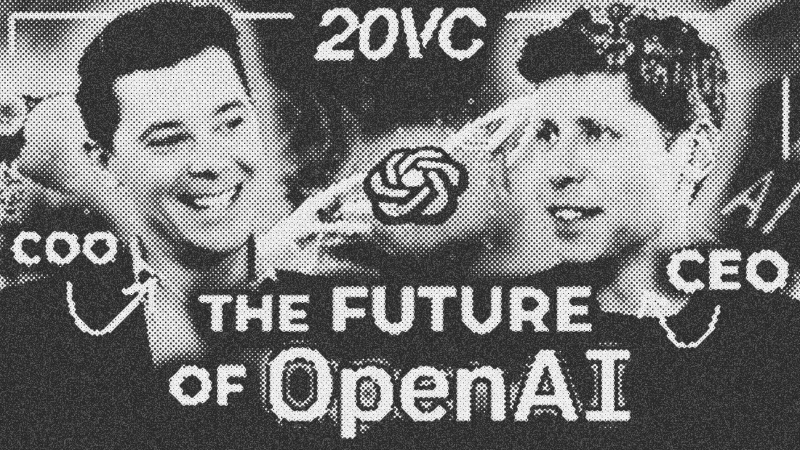
In contrast, Brad Lightcap manages the "how." He stepped into the COO role with a willingness to build out entire business functions from scratch, even when no playbook existed for selling advanced AI to the enterprise. This partnership thrives on high-bandwidth communication and a clear division of labor. Sam Altman handles the research-to-product vision, while Brad Lightcap builds the market infrastructure. They move fast because they are aligned on the global bets, allowing Brad Lightcap to make dozens of daily decisions independently without clogging the Sam Altman bottleneck. This decentralized execution is what allows the organization to maintain velocity even as its complexity explodes.
The Steamroller Problem: Startup Strategy in the Age of AGI
For entrepreneurs and venture capitalists, the most pressing question is how to build in a world where OpenAI is constantly shipping updates that can wipe out entire product categories. Sam Altman is blunt about this: if you build assuming the current model (like GPT-4) is the ceiling, you will be steamrolled. Many startups focus on fixing the "little things" or building wrappers around current limitations. This is a losing strategy because OpenAI's mission is to solve those very limitations at the base layer.
The winning strategy is to build assuming GPT-5, GPT-6, and beyond will continue on a steep trajectory of improvement. Successful founders ask themselves: "Would a 100x improvement in the underlying model make my product better or make it obsolete?" If your business benefits from the model becoming more intelligent, more personalized, and more deeply integrated into the user's life, you are safe. If your business depends on the model remaining "dumb" or limited in specific ways, you are in the path of the steamroller. The enduring value for startups will not be in the base model, which is rapidly becoming a commodity, but in the personalization and deep workflow integration that a general-purpose provider cannot replicate at scale.
Solving the Compute and Intelligence Bottleneck
The primary constraints on OpenAI's growth aren't market demand or competition; they are physical and scientific. To provide abundant, near-zero-cost intelligence to every person on Earth, the company requires a massive, coordinated effort across the entire hardware stack. This includes chips, data centers, and power. Sam Altman views this as a "whole system problem." While the cost of intelligence is falling, the demand for it is scaling even faster.
The goal is to drive the cost of high-quality intelligence so low that it transforms society. Currently, the models simply aren't smart enough to solve the world's most complex problems, such as curing cancer or accelerating scientific breakthroughs to a point where we view 2024 as "barbaric." The fix is one-dimensional: increase the underlying intelligence. This requires a relentless focus on research. Within the OpenAI culture, research drives product, and product drives sales. There is no compromise on this hierarchy. If the research fails to innovate, the business stops growing.
Enterprise Adoption and the ROI Trap
Brad Lightcap has observed a recurring mistake in how large corporations approach AI. Many enterprises attempt to force AI into existing business processes to achieve a quantifiable, line-item ROI—like cutting 20% of supply chain costs. While valuable, this approach misses the broader impact. The real return comes from the "supply of time" shift. When an employee who used to spend two days on a task now finishes in two minutes, it frees them for higher-order work.
This impact is harder to quantify on a balance sheet but is transformative when scaled across 100,000 employees. Enterprises that treat the current models as static tools are setting themselves up for failure. They should instead view AI as a rapidly evolving platform. The organizations that will win are those that set up flexible workflows capable of absorbing the next wave of intelligence as soon as it drops. Adoption isn't a one-time event; it's a continuous integration of increasing intelligence into the corporate DNA.
The Future of Growth and Talent
Scaling at this speed requires a specific type of talent. While OpenAI is currently the "hottest" company in tech, Sam Altman and Brad Lightcap are wary of hiring mercenaries. They look for mission-oriented individuals who are determined, communicative, and capable of fast iteration. Interestingly, the company skews slightly older than the typical Silicon Valley startup, particularly in its research and leadership teams. This is a byproduct of the depth required to push the boundaries of science.
Sam Altman's growth mindset has evolved as well. He admits that ChatGPT's success broke many traditional rules of growth. When you are in the midst of a once-in-a-generation technological revolution, the standard retention curves and marketing playbooks become secondary to the utility of the product itself. The future of OpenAI is one of genuine abundance. Despite the geopolitical and socioeconomic instability Sam Altman sees in the world, he remains bullish on the ability of AI to level the playing field, providing every individual with the tools to do amazing things. This isn't just a business for them; it's a mission to ensure AGI benefits all of humanity, shifting us from a world of scarcity to one of unlimited potential.
- OpenAI
- 24%· companies
- Airbnb
- 3%· companies
- Alex%20Schulz
- 3%· people
- Asana
- 3%· companies
- Brad%20Lightcap
- 3%· people
- Other topics
- 65%
Sam Altman & Brad Lightcap: Which Companies Will Be Steamrolled by OpenAI?
Watch20VC with Harry Stebbings // 53:07

20VC, hosted by Harry Stebbings, takes you inside the world of Venture Capital, Startup Funding and The Pitch. Join Harry and discover how you can attain funding for your business by listening to what the most prominent investors are directly looking for in startups, providing easily actionable tips and tricks that can be put in place to increase your chances of getting funded. The Twenty Minute VC also provides an instructional guide as to what it takes to get employed in the Venture Capital industry, with VCs giving specific advice on how to get noticed from the crowd and increasing your chances of employment. Our amazing Venture Capitalists also provide their analysis of the current technology market, providing advice and suggestions on the latest investing trends and predictions. Join us so you can see how you can get big, powerful improvements, fast.