The Ackman Playbook: High-Stakes Resilience, Market Disruption, and the Future of American Capitalism
The Architecture of a First Fund: Moxie Over Experience
Every legendary career starts with a grind that tests the soul. For Bill Ackman, the founder of Pershing Square Capital Management, the journey began with Gotham Partners shortly after leaving Harvard Business School. Raising that first $3 million wasn't a victory lap; it was a grueling marathon of 100 meetings and 94 rejections. The strategy was simple but ballsy: sell your life's track record of success when you lack a professional one.
He targeted entrepreneurs, not institutions. Why? Because builders recognize builders. People who have created their own wealth from nothing are more likely to back a young founder with intellectual intensity and a clear, even if unproven, strategy. The lesson for any founder today is clear: when you don't have a spreadsheet of wins, you sell your character, your discipline, and your willingness to walk away from safe bets like Goldman Sachs to ignite your own vision. This period also solidified the importance of choosing a partner like David Berkowitz, someone whose trust is absolute and whose judgment acts as a necessary friction to your own momentum.
The Anatomy of Failure: From Gotham to Netflix
Disruption is messy, and even the best in the game take massive hits. Ackman’s career has been defined by extreme volatility—the kind that would break a lesser spirit. The wind-down of Gotham Partners was a public "fall from grace," driven by an asset-liability mismatch. He was investing in illiquid private assets with capital that investors could pull out at short notice. It’s a structural flaw that still plagues the industry today. Experience isn't just about what you win; it's about the scars you carry from the mistakes you promise never to repeat.
Take the more recent Netflix trade. Ackman took a billion-dollar position after a 50% drop, only to dump it months later for a $400 million loss. To the outside world, it looked like a blunder. To a disciplined investor, it was a masterclass in cutting your losses when the facts change. If the thesis is broken, you don't wait for the market to agree with you. You exit. Most people fail because they are too proud to admit they were wrong. In the high-stakes world of hedge funds, persistence is a virtue, but stubbornness is a death sentence. You have to be willing to start each day with a blank sheet of paper, unburdened by the losses of the previous set.
Managing Through the Dip: The Psychological Compound Interest
When you're in a "down" period—whether it's a fund winding down or a marriage ending—the strategy is physical as much as it is mental. Ackman advocates for a rigorous routine: sleep, nutrition, and exercise. It sounds like basic advice, but when you are under the gun from the SEC or facing headlines that paint you as a failure, these are the only variables you can control. Physical strength compounds into psychological resilience.
He focuses on "making progress every day." Whether it's digging yourself out of a legal mess or rebuilding a portfolio, that incremental progress compounds at a high rate. In the United States, failure isn't the end; it’s a data point. Second-time founders are often more valuable because they’ve already paid the tuition of their first mistakes. The goal is to ensure the past doesn't disrupt the future. You don't get upset about a double fault when you're still in the match; you focus on the next serve.
The Three-Tier Banking System: A Crisis of Confidence
The collapse of Silicon Valley Bank (SVB) and Signature Bank has fundamentally altered the American financial map. We have inadvertently created a three-tier system that is as confusing as it is dangerous. In the first tier, you have the "Systemically Important" giants like JPMorgan Chase and Bank of America that enjoy an implicit government backstop. In the second tier, you have the fallen—SVB and Signature—which now have an explicit 100% guarantee on all deposits. In the third tier, you have every other regional and community bank, where anything over $250,000 is still at risk.
This is a recipe for a slow-motion run on the American economy. If business owners don't feel their payroll capital is safe, they will move it to the giants. This drain on regional banks will stop the lending that fuels small businesses and real estate. The solution isn't complicated: the government must implement a temporary, system-wide deposit guarantee until the FDIC insurance regime can be updated with higher limits and appropriate premiums. Financial stability is the prerequisite for everything else. Without it, the Federal Reserve is cranking a lever that will continue to shatter the system.
Solving Inequality: The Birthright Investment
Wealth inequality is the most significant threat to the long-term stability of the American experiment. The gap exists because assets compound while wages merely grow. To fix this, we need to turn every citizen into an owner from day one. Ackman proposes a "Birthright" account: every baby born in America receives roughly $6,500 in a tax-exempt account invested in an index fund. By age 65, that account would be worth $1 million without the individual ever adding a cent.
This isn't just about money; it’s about giving every citizen a stake in the success of capitalism. It costs roughly $20 billion a year—a rounding error in the federal budget—but it changes the psychology of the nation. Beyond this, the tax code needs a surgical overhaul. Gimmicks like "like-kind exchanges" for real estate and the ability to borrow against appreciated stock without triggering a taxable event allow the ultra-wealthy to avoid contributing their fair share. We need smart tax policy that encourages innovation while closing the loopholes that favor the asset management class over the builders.
Vision 2028: The Search for a CEO-President
The political landscape is begging for a disruptor who actually understands how to build. Ackman’s vision for the future involves a leader with a track record of global business success and geopolitical savvy—someone like Jamie Dimon. We need a version of a business leader who can navigate the complexities of China, the war in Ukraine, and the internal fractures of social media-driven polarization.
Looking toward the next decade, the outlook for America depends on whether we can move past "black swan" crises and start creating "white swans" through proactive leadership. Whether it’s solving the Russia conflict or retooling our defense stocks, the country needs to be run with the efficiency of a high-growth startup rather than a stagnant bureaucracy. As for Ackman, he’s not ruling out a move into the arena. When the day job of managing billions gets boring—which it hasn't yet—the next logical step is to bring that same aggressive, analytical, and disruptive mindset to the national stage.
- Bank of America
- 4%· companies
- Bill Ackman
- 4%· people
- China
- 4%· places
- David Berkowitz
- 4%· people
- Donald Trump
- 4%· people
- Other topics
- 80%
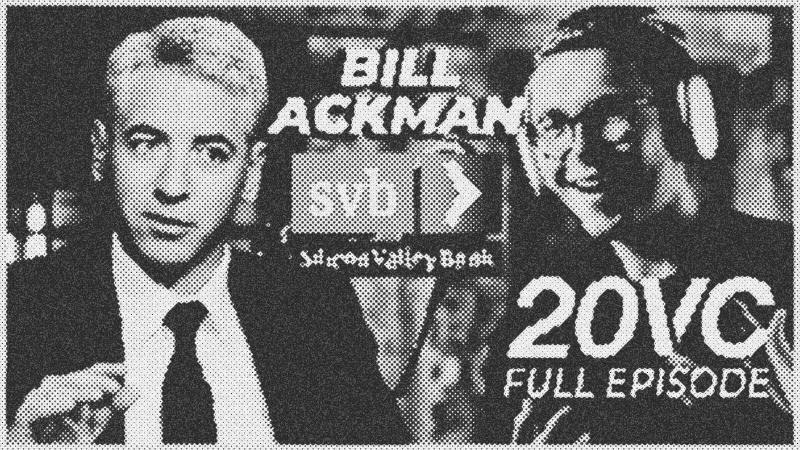
Bill Ackman: SVB Collapse, Biden vs Trump, How I Lost $400M on Netflix, Bill's 10-Year Long
Watch20VC with Harry Stebbings // 1:06:55

20VC, hosted by Harry Stebbings, takes you inside the world of Venture Capital, Startup Funding and The Pitch. Join Harry and discover how you can attain funding for your business by listening to what the most prominent investors are directly looking for in startups, providing easily actionable tips and tricks that can be put in place to increase your chances of getting funded. The Twenty Minute VC also provides an instructional guide as to what it takes to get employed in the Venture Capital industry, with VCs giving specific advice on how to get noticed from the crowd and increasing your chances of employment. Our amazing Venture Capitalists also provide their analysis of the current technology market, providing advice and suggestions on the latest investing trends and predictions. Join us so you can see how you can get big, powerful improvements, fast.