Empirical Adaptations of the Wheel: A Contemporary Case Study of Terrestrial Traction
The human impulse to conquer terrain, to enhance mobility across unforgiving surfaces, echoes through millennia. From the rudimentary sledges of early hominids to the sophisticated pneumatic tires of the industrial age, the quest for superior terrestrial traction remains a persistent thread in our technological narrative. This inquiry examines a modern exhibition of this drive: the application and assessment of 'Reaper Wheels' on a four-wheeler, along with the testing of various other wheel shapes, as presented in a recent contemporary account.
The Pursuit of Unconventional Mobility
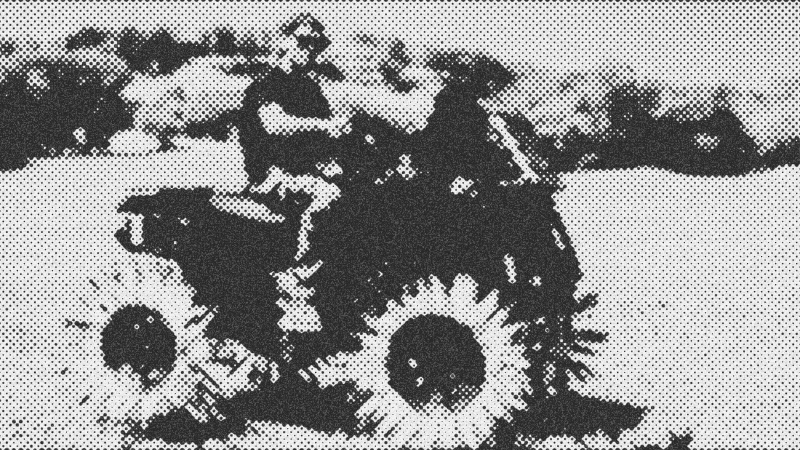
The core of this exposition centers on a demonstration of extreme engineering, focusing on what is described as the 'world's most aggressive tread pattern'—the 'Reaper Wheels.' These are not mere aesthetic choices; they represent a bold, perhaps even audacious, attempt to redefine the parameters of off-road vehicle performance. The account details an empirical process wherein multiple, distinct wheel shapes are fitted and subsequently tested, each offering a unique interaction with the ground. This systematic, albeit informal, experimentation provides direct observations on the efficacy of varied designs. A notable environmental component is the introduction of the 'LEAKY LAGOON water park,' which serves as an unconventional, yet telling, testbed for these mechanisms, simulating challenging hydrological conditions.
Observations on Ingenuity and Method
What truly captivates about this exposition is the raw, unvarnished spirit of empirical investigation. We observe a direct, hands-on approach to problem-solving, a methodology that, while lacking the formal rigor of academic research, yields immediate and tangible results. The demonstration of the 'Reaper Wheels' effectively illustrates a powerful principle: extreme conditions often necessitate extreme solutions. The successful navigation of challenging terrain, particularly within the simulated environment of the 'Leaky Lagoon,' speaks to the profound impact of specialized engineering on mobility. Each distinct wheel shape, in its turn, contributes to a rich, if qualitative, dataset concerning the mechanics of grip and propulsion.
However, a scholar must also note the inherent limitations. The absence of precise measurements or controlled variables prevents a quantitative analysis, rendering the observations primarily anecdotal. We are presented with a spectacle of performance rather than a detailed engineering report. Furthermore, the inclusion of commercial endorsements, such as the promotion of 'ALCOLO,' while reflective of contemporary economic models, distracts from the pure scientific inquiry, momentarily shifting focus from mechanical principles to market dynamics. This intertwining of exhibition and commerce is a distinct feature of modern experimental narratives.
Echoes of Ancient Expeditions
One cannot observe the testing of these 'aggressive tread patterns' and 'multiple wheel shapes' without drawing parallels to earlier periods of human ingenuity. Consider the challenges faced by ancient engineers in designing chariot wheels for diverse battlefields, or the specialized wheels of agricultural implements intended to traverse muddy fields. The underlying questions are identical: how to maximize friction, distribute weight, and maintain propulsion in difficult environments. This modern endeavor, though utilizing advanced materials and power systems, is fundamentally a continuation of that ancient quest. It mirrors the trial-and-error processes that led to the refinement of the potter's wheel, the water wheel, and the fundamental cartwheel—each an adaptation to specific environmental and functional demands.
A Document of Contemporary Problem-Solving
This account offers a fascinating glimpse into a contemporary manifestation of human problem-solving and mechanical innovation. While it departs significantly from the structured methodologies often favored in formal engineering, it nevertheless documents a vital, often visceral, form of empirical inquiry. For those interested in the dynamic interplay between human ingenuity, mechanical adaptation, and environmental challenge, this demonstration serves as an intriguing, if unconventional, primary source. It underscores the enduring human desire to push boundaries, to test limits, and to conquer the physical world through inventive application of force and design. We are reminded that the drive to innovate, to make things 'work better than you think,' is a constant across all epochs.
- ALCOLO
- 25%· product
- LEAKY LAGOON water park
- 25%· location
- multiple wheel shapes
- 25%· product
- Reaper Wheels
- 25%· product
Fourwheeler on Reaper Wheels (It Works Better Than you Think)
WatchWhistlinDiesel // 12:36

Are you tired of clicking on a deceivingly clickbaited video only for it to be someone doing the same boring crap you saw last week? Yeah me too. Thats why i never waste time uploading a stupid boring video. OK maybe they are stupid lol. Enjoy There's a lot more on Instagram www.instagram.com/whistlindiesel SERIOUS BUSINESS INQUIRIES ONLY: [email protected]