Beyond the Degree: Reimagining Education for a Skill-Based World
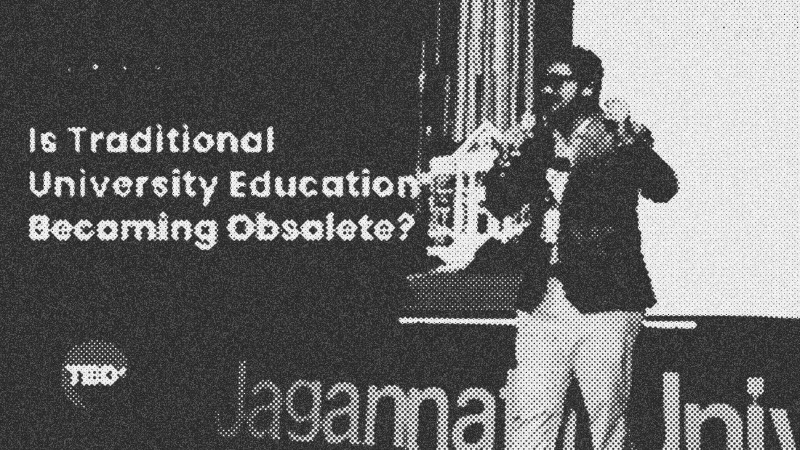
Abu Owazed Shah Sowmik addresses a critical question: why do we still attend universities? While the aims may be to learn, build a future, or discover oneself, a significant number of graduates feel lost, unemployed, and unskilled. Sowmik, drawing from his experiences as a student and entrepreneur, challenges the traditional university model, suggesting that the university of the future is not a university at all.
The Shifting Landscape of Education
Sowmik reflects on his initial hopes entering Dhaka University, contrasting them with the reality of a system that feels academic but lacks skill orientation. He notes that the world is rapidly shifting toward a skill-oriented paradigm, leaving universities struggling to keep pace. The core issue is that while the job market has become increasingly competitive, the traditional education system remains largely unchanged.
Echoes of the Past
The speaker points out that the concept of a university is thousands of years old, with the classroom structure remaining stagnant. While digital boards may have been introduced, the fundamental approach to education has not evolved to meet the demands of the modern world. Meanwhile, social media is filled with success stories of individuals who are freelancing, building businesses, and taking risks outside the traditional academic framework.
The Modern Student's Dilemma
Many students continue to follow traditional pathways, yet other avenues exist. Sowmik emphasizes the importance of learning from others' mistakes, recalling a senior with excellent academic results who struggled to secure a job due to a lack of practical experience. He argues that the current culture overly emphasizes memorization of formulas and theories, which does not translate to success in the industry.
The Rise of AI and Accessible Knowledge
Sowmik highlights the transformative power of artificial intelligence, noting how tools like Gemini and ChatGPT can provide instant assistance and knowledge. He also emphasizes the accessibility of learning through platforms like YouTube, where anyone can acquire new skills and knowledge without needing permission or formal enrollment. He advocates for a purpose-driven approach to education, where individuals focus on developing skills relevant to their desired future, rather than solely relying on their chosen major.
Dismantling Outdated Paradigms
The speaker challenges several outdated beliefs: that information is scarce, that teachers are the sole source of knowledge, and that degrees are passports to success. With the advent of the internet and AI, information is abundant, and individuals can learn from various sources. While teachers remain valuable, they are no longer the only source of knowledge. Degrees, while still holding some value, no longer guarantee employment in a competitive job market.
Envisioning the University of the Future
Sowmik envisions a university that is decentralized, self-driven, and project-based, with students selecting courses based on their interests and goals. He stresses the importance of mentorship and skill-focused education. He suggests that universities should integrate with tech ecosystems and offer distance learning programs, citing examples from Harvard and the University of London. Sowmik champions the idea of capability over credentials, asserting that skills and practical experience are more valued in the industry than academic achievements alone.
The Power of Personal Initiative
Ultimately, the future of education lies in personal initiative and continuous learning. Sowmik encourages students to read, experiment, build, collaborate, and learn from failure. He concludes that the university of the future is not a physical place but a mindset, a network, and a mission. It is about what you do, not just your department or degree. It is about building a portfolio of work that demonstrates your capabilities and curiosity.
Embracing the Future of Learning
Sowmik's vision of the university of the future is one where individuals take ownership of their education, focusing on skills and practical experience over traditional academic achievements. By embracing new technologies and adopting a self-driven approach, students can prepare themselves for success in a rapidly changing world.
- Abu Owazed Shah Sowmik
- 7%· person
- Abuadomik
- 7%· person
- Amazon
- 7%· organization
- Apple
- 7%· organization
- ChatGPT
- 7%· technology
- Other topics
- 64%
The University of the Future is Not a University | Abu Owazed Shah Sowmik | TEDxJagannath University
WatchTEDx Talks // 22:12

TEDx is an international community that organizes TED-style events anywhere and everywhere -- celebrating locally-driven ideas and elevating them to a global stage. TEDx events are produced independently of TED conferences, each event curates speakers on their own, but based on TED's format and rules. For more information on using TED for commercial purposes (e.g. employee learning, in a film or online course), please submit a Media Request here: https://media-requests.ted.com.