Beyond the Bachelor Pad: 6 Practical Ways to Refine Your Home
Your home is the outward expression of your inner life. When you change your home, you change your life. This isn't just about aesthetics; how you organize and furnish the spaces you inhabit has a tangible, scientifically proven effect on your health, mood, and general outlook. If your current living situation feels flat, sterile, or like a temporary holding cell, it is time to shift your perspective. By applying a few intentional principles, you can transform a generic space into a sanctuary that reflects who you are and supports how you actually live.
Kill the Overhead Lights
Lighting is the most impactful element of interior design. You can own high-end furniture and a perfect color palette, but bad lighting will make the room look like absolute dog shit. The first rule is to stop relying on overhead fixtures—often called "cleaning lighting" because they should only be on when you're scrubbing the floors. Instead, aim for four to nine different light sources per room to create depth.
Focus on a mix of three categories: general, task, and accent. Task lighting, like a reading lamp, must be functional, while accent lighting serves as the "personality hire" that makes everything else pop. Crucially, pay attention to color temperature. Most people choose bulbs that are too cool, making their living room feel like the inside of a refrigerator. Stick to bulbs around 2,700 Kelvin with a high CRI (Color Rendering Index) of 90 or above. This mimics the warmth of candlelight and keeps your skin from looking green.
Master the Vertical Dimension
Many people accidentally only decorate the bottom third of a room because that's where the floor is. To break this cycle, you must work in three dimensions. Adding verticality can be as simple as installing higher shelving or a tall bookshelf. Curtains are another secret weapon, but most people get them wrong. To create an optical illusion of a larger space, hang your curtain rod at least six inches higher than the window frame and extend it a foot out on each side. The fabric should barely kiss the floor—if they are four inches too short, it looks like your windows are wearing high-water pants.
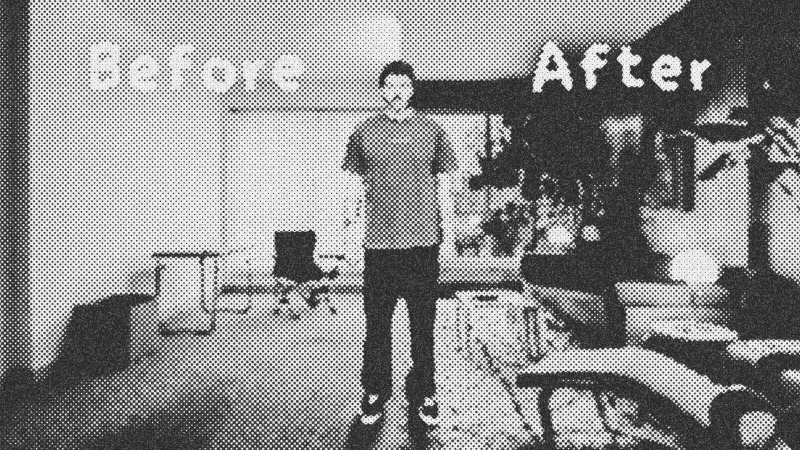
Wall art is the final piece of the vertical puzzle. A common mistake is hanging art based on the wall height rather than the human experience. The focal point of your art should be exactly 57 inches from the floor to meet the average eye level. Also, put your posters in a frame. Even a cheap frame from a garage sale provides a level of intentionality that a bare poster simply cannot match.
Prioritize Materials Over Color
Before you obsess over a color scheme, look at your materials. If every surface is synthetic, the room will feel lifeless. Aim for a foundation of organic materials: wood, linen, wool, bamboo, and cotton. These textures create a sense of familiarity and warmth because humans have lived alongside them for millennia.
Inorganic materials like stone, metal, and glass add strength and grounding, but overdoing them can make a home feel like a haunted hospital. Synthetics like acrylic or plastic certainly have their place, especially in mid-century designs, but they should be used as accents rather than the primary theme. A single clear acrylic chair is a bold vibe; an entire room of plastic feels like a waiting room.
Furnish the Action, Not the Room
Stop trying to "decorate" and start furnishing for function. If you aren't sure where a lamp goes, place it where you actually sit to read. This functional approach removes the intimidation factor of design. One critical rule: stop hanging your TV near the ceiling. It belongs at eye level, mounted flat against the wall.
Consider the command position, a concept where you sit or sleep in a way that feels secure. You should be able to see the entrance of the room without being directly in front of it. Subconsciously, having your back to a door creates uneasiness. Similarly, optimize the flow of the room. If you have to walk through a conversation zone just to get to the closet, your furniture placement is failing you. Keep conversation areas within a 10-foot diameter to ensure the space remains intimate and useful.
Conclusion
Ultimately, every item in your home should be either practical, beautiful, or personal. If it doesn't serve a purpose, look stunning, or tell a story about who you are, it is just generic clutter. Your home shouldn't look like an Airbnb; it should look like you. Start by cleaning up the mess, hiding your cords, and lighting a candle. When you treat your space with respect, it returns the favor.
- Femke
- 14%· people
- Frida Ramstad
- 14%· people
- Interior Design
- 14%· products
- LED Bulbs
- 14%· products
- Lord Kelvin
- 14%· people
- Other topics
- 29%
Interior Design for Boys
WatchSpeeed // 23:20

Cars. Life. Technology. www.speeed.co Business Inquiries: [email protected] Other Inquiries: [email protected]