The Physics of Rotation: Why Liquid and Solid Bottles Race Differently
A Counterintuitive Contest
Physics often defies common sense, and few examples demonstrate this as clearly as a simple race between two identical containers. When placing a bottle of liquid water and a bottle of solid ice on an incline, most observers assume the result is a toss-up. Both have the same mass and shape, yet the way they distribute and consume energy during a descent varies wildly. This experiment, famously presented by Destin Sandlin of Smarter Every Day, reveals the hidden forces of Rotational Inertia and fluid dynamics.
The Burden of Rotational Inertia
The solid ice bottle faces a significant hurdle: it must rotate its entire mass. In physics, Rotational Inertia represents an object's resistance to changes in its rotation rate. Because the ice is frozen to the container, every molecule must gain angular velocity for the bottle to move forward. This process consumes a large portion of the potential energy provided by gravity, converting it into rotational kinetic energy rather than linear speed. The solid bottle effectively battles its own distribution of mass as it struggles to accelerate down the ramp.
Fluid Shear and Internal Friction
The liquid water bottle operates under a completely different set of rules. Unlike the solid ice, the water inside doesn't necessarily have to spin at the same rate as the plastic shell. This introduces the concept of Fluid Shear. As the bottle begins to roll, only the thin layer of liquid in direct contact with the walls moves immediately. While this reduces the initial Rotational Inertia load, it creates internal friction. This friction generates a tiny amount of heat, effectively "stealing" energy from the system's motion.
The Final Verdict
Despite the energy lost to Fluid Shear, the liquid bottle typically wins the race. It avoids the massive energy tax required to spin a solid core. Because the bulk of the water remains relatively stationary rather than rotating rapidly, more potential energy is available to be converted into forward, linear velocity. Understanding these mechanics helps us appreciate how internal composition dictates the behavior of objects in motion, turning a simple backyard race into a masterclass in classical mechanics.
- Rotational Inertia
- 50%· physics
- Destin Sandlin
- 17%· people
- Fluid Shear
- 17%· physics
- Smarter Every Day
- 17%· tv shows
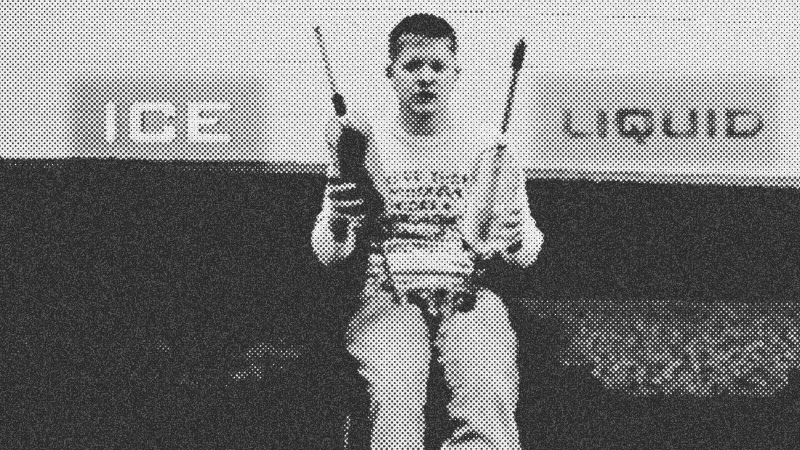
Downhill Rotation Race - Smarter Every Day 13
WatchSmarterEveryDay // 1:21

I explore the world using science. That's pretty much all there is to it. Watch 2 videos. If you learn something AWESOME, please subscribe if you feel like I earned it. Contact: http://www.smartereveryday.com/contact. I currently get lots of correspondence so please forgive me if I'm unable to reply. I mean well, but want to focus on being a better Dad.