Agate Freimane warns founders against chasing peak valuations during fundraising
The Strategic Marriage of Profit and Purpose
Transitioning from the 100-hour work weeks of Morgan Stanley to the high-stakes world of venture capital requires more than just a shift in schedule; it demands a fundamental rewiring of how one perceives value. Agate Freimane, General Partner at Norrsken VC, argues that the era of viewing impact as a "side hustle" or a philanthropic add-on is over. For modern startups, impact must be the engine, not the exhaust.
At Norrsken VC, the investment thesis centers on a non-negotiable one-to-one correlation between impact KPIs and Topline revenue. This isn't about window dressing or ESG reports that gather dust. It is about building businesses where the core model is so inextricably linked to solving a global challenge that killing the impact would effectively kill the company. This "dark green" approach—investing predominantly in climate tech but remaining open to health and education—challenges founders to build solutions where every dollar of revenue signifies a measurable step toward a better world.
Moving from Risk Assessment to Radical Potential
The move from investment banking to VC is often a jarring experience for the analytically minded. While banking trains professionals to look backward at historical data and extrapolate risks, venture capital requires the opposite: an obsession with potential. You are meeting founders when they are at the 1% mark of their journey, and your job is to envision the 99% that hasn't happened yet.
This shift requires what Agate Freimane calls "big guts." It’s the ability to stop asking "What could go wrong?" and start asking "What if this works?" In the world of Norrsken VC, this mindset is the filter through which every pitch is viewed. If the answer to "what if this works" doesn't involve systemic change or the displacement of a legacy, carbon-heavy industry, it simply isn't ambitious enough for the current climate.
The Trap of Charisma and the Power of Grit
Experience is a brutal teacher, and in the VC world, mistakes are usually carved from falling for the wrong things. Agate Freimane reflects on how early in her career, she—like many investors—was often blinded by founder charisma. It is easy to back the person who can "sell ice to Eskimos," but those are frequently the investments that fail. Charisma is an external tool; execution is an internal engine.
Today, the focus at Norrsken VC has shifted toward "obsession, grit, and an insane sense of urgency." Successful founders act as magnets, pulling in top-tier talent and advisors through sheer gravitational force. They don't just talk; they execute with a depth that survives the inevitable downturns of the startup lifecycle. When the hype fades, only the founders with true grit remain standing.
Why Valuation Greed Can Sabotage Your Future
One of the most common and damaging mistakes founders make is the pursuit of the highest possible valuation during a fundraise. Driven by ego or vanity, founders often attempt to max out their price without considering the long-term implications. Agate Freimane warns that setting the bar too high leaves zero room for error.
Venture capital is a game of momentum. It is significantly harder to raise a subsequent round when your valuation has only increased by a marginal 25% because you over-optimized the previous round. Investors want to see a "Tale of Two Cities"—a clear, massive jump in value driven by milestones reached. By overpricing today, you are essentially shooting yourself in the foot for tomorrow, making the next fundraise a struggle against gravity rather than a celebration of growth.
Cultivating the Confidence to Admit Ignorance
A pivotal moment in Agate Freimane's career came from a mentor at Morgan Stanley named Marion, who challenged her to seek out the most complex, "hairy" projects rather than the safe ones. This taught her that confidence isn't about knowing every answer—it’s the belief that you can figure it out.
In the startup ecosystem, this translates to radical honesty. Founders and investors alike must study their own egos and be willing to say, "I don't know, but I will learn." By separating the rational brain from the emotional ego, leaders can make decisions based on reality rather than pride. Ultimately, building a unicorn is about the journey, not just the destination. If you don't enjoy the process of solving the problem, the end goal will never be enough to sustain you.
- Agate Freimane
- 24%· people
- Norrsken VC
- 19%· companies
- Morgan Stanley
- 10%· companies
- Barack Obama
- 5%· people
- Brickvest
- 5%· companies
- Other topics
- 38%
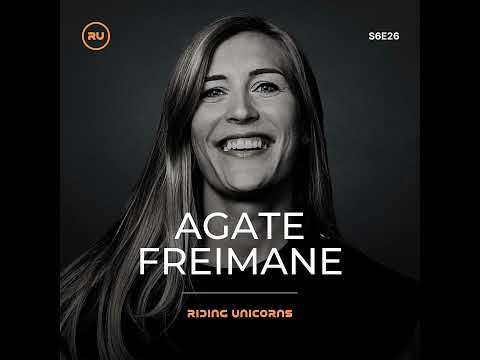
Agate Freimane, General Partner @ Norrsken VC
WatchThe Riding Unicorns Podcast // 29:33

A podcast featuring the world's best minds from venture and startups. Hosted by James Pringle & Hector Mason.