Strategic Resilience: Navigating the Bank of England's February 2026 Rate Decision
The Fine Margin of Prudence
The Bank of England recently concluded its February 2026 Monetary Policy Committee (MPC) meeting with a decision that epitomizes the current state of economic transition. By maintaining the bank rate at 3.75% in a razor-thin 5-4 vote, the committee signaled a profound internal debate between fostering growth and extinguishing the final embers of inflationary pressure. For the long-term investor, this split is more than just a tally; it is a clear indication that every upcoming meeting is now 'live,' with policy direction hanging on the most recent data prints.
Andrew Bailey and the majority chose a path of cautious observation. While they acknowledge that inflation is likely to hit the 2% target by the spring of this year, they remain wary of 'mechanical' falls. Much of the recent disinflation stems from energy price caps and the fading effects of previous tax measures rather than a fundamental shift in domestic price-setting behavior. True financial resilience requires looking past these surface-level fluctuations to understand the structural forces at play. Sustainable wealth management relies on this same principle: distinguishing between temporary market noise and the underlying economic reality.
Decoding Box B: The Heterogeneity of Wage Growth
A centerpiece of the February 2026 Monetary Policy Report is an analytical masterpiece found in 'Box B,' which examines the 'heterogeneity in wage-setting behavior among UK firms.' This research utilizes machine learning to move beyond traditional sector categories like 'retail' or 'manufacturing.' Instead, it clusters companies by how they set pay. This is critical for understanding the transmission of monetary policy. If we do not understand the lag between interest rate hikes and wage adjustments, we cannot accurately forecast when inflation will truly be tamed.
This analysis identifies four distinct groups, but the most influential for current policy is Group One: the 'Bargaining' firms. These large employers and public sector entities operate on multi-year or annual cycles, meaning their current wage demands are backward-looking. They are effectively fighting last year's inflation battle today. This creates a 'sticky' services inflation that refuses to budge even as energy prices fall. For the prudent planner, this means recognizing that while headline figures look optimistic, the cost of services—a dominant part of the UK economy—remains under pressure. It explains why a cut today felt premature to the majority of the MPC; they are waiting for these backward-looking wage cycles to finally catch up to the reality of falling prices.
Shifting Sands: The Dovish Pivot
While the headline rate remained unchanged, the internal spectrum of the MPC has shifted noticeably toward the left. In December, the committee felt more balanced between hawks and doves; today, even those who voted to 'hold' sound increasingly open to future easing. Catherine L. Mann, often one of the more hawkish voices, noted that while she voted to hold to avoid over-weighting mechanical inflation falls, the time for a cut is clearly drawing closer.
On the other side of the fence, the four members who voted for an immediate 25 basis point cut to 3.5% are prioritizing a different risk: the danger of keeping policy restrictive for too long. They see a loosening labor market where unemployment has ticked up to 5.1% and job vacancies are thinning. This divide highlights the fundamental challenge of wealth preservation in a shifting environment. There is no 'neutral' move; there is only a choice of which risk to accept. The minority believes the risk of economic stagnation now outweighs the risk of an inflationary rebound. For investors, this signaling suggests that a March cut is highly probable, provided the next two inflation prints do not deliver a shock.
Implications for Mortgages, Savings, and Fixed Income
The immediate impact of a 'hold' decision often feels stagnant, but the market's reaction tells a different story. Because the tone of the meeting was interpreted as 'dovish,' we saw a subtle fall in yields across the UK Government Bonds market. For those looking to remortgage, this is a reassuring sign. Fixed-rate mortgage pricing is driven by these long-term market expectations rather than the overnight bank rate. As the market pulls forward its expectations for future cuts, we expect to see mortgage providers slowly improve their offerings.
Conversely, for the disciplined saver, the era of peak 'easy' returns is drawing to a close. While competition for deposits remains healthy, easy-access rates will begin a gradual drift downward as the terminal rate—the point where the Bank of England believes interest rates are neither stimulative nor restrictive—is projected to settle around 3.25%. My advice to clients in this position remains constant: lock in longer-term rates now if you have excess cash that is not required for your immediate liquidity needs. Prudence demands capturing these yields before the cycle turns fully.
The AI Catalyst: A New Frontier for UK Services
Looking beyond immediate policy, we must consider the structural evolution of the UK economy, particularly the role of Artificial Intelligence. While some market participants reacted with panic to news from firms like Anthropic—fearing that AI platforms will cannibalize the UK's dominant services sector—I take a more optimistic view focused on sustainable growth. The UK is fundamentally a service-exporting nation. If AI can enhance efficiency in legal, financial, and professional services, it acts as a massive tailwind for margin growth and productivity.
We have seen recent volatility in stocks like RELX as investors grapple with the disruption AI brings to data analytics and publishing. However, history shows that firms that successfully integrate transformative technology emerge stronger. Increased productivity is the only long-term cure for the 'sticky' wage inflation discussed in Box B. If firms can produce more with less, they can sustain higher wages without passing those costs on to consumers as higher prices. This is the 'goldilocks' scenario for the UK economy: technology-driven growth that allows for lower interest rates without reigniting inflation.
Strategic Diversification in a Volatile World
Finally, we must address the broader portfolio context. The recent 'rotation' from high-flying US tech growth toward more defensive sectors and value-oriented markets like the UK serves as a reminder that no trend lasts forever. While the S&P 500 has been the star of the last decade, high valuations and political uncertainties regarding the Federal Reserve independence make a diversified approach essential.
True wealth management is about building a portfolio that can withstand various economic 'weather.' This includes holding a core of global equities, but also recognizing the value in 'boring' defensive sectors like healthcare and consumer staples, which have recently shown green shoots of recovery. Whether you are looking at Frontier Market ETFs or domestic UK banks, the goal should always be a portfolio matched to your specific risk capacity. As we look toward the March MPC meeting, the focus should remain on clarity of purpose and the patient cultivation of assets. The road ahead may be data-dependent, but a disciplined strategy remains your best defense against uncertainty.
- Andrew Bailey
- 8%· people
- Anthropic
- 8%· companies
- Bank of England
- 8%· organizations
- Catherine L. Mann
- 8%· people
- February 2026 Monetary Policy Report
- 8%· publications
- Other topics
- 62%
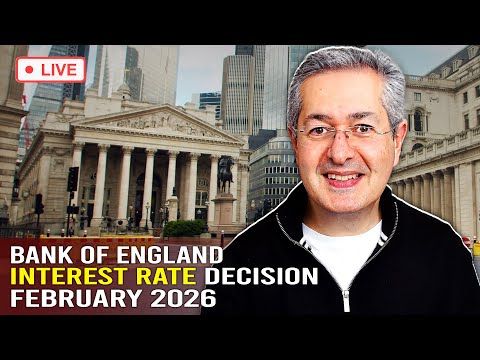
Bank of England Interest Rate Decision February 2026 - My Take
WatchPensionCraft // 1:01:16

My name is Ramin Nakisa and I started PensionCraft in 2016 as I felt strongly that I wanted to teach people how to invest well for themselves so they could stop making costly mistakes and losing their money through having to pay unnecessarily high fees. Before starting PensionCraft, I worked in investment banking as a strategist and I was a frequent contributor on CNBC and Bloomberg TV. I have written two books about finance and investment: one for professional investors and one that explains how to buy and sell volatility using exchange-traded products. I publish a new video on YouTube every Saturday and you can join me for a live Q&A on the 1st Thursday of every month at 7pm UK time. If you want to learn how to become a better investor then why not join our friendly membership at pensioncraft.com?