Pat LaFrieda turns commodity meat into $270 million luxury brand
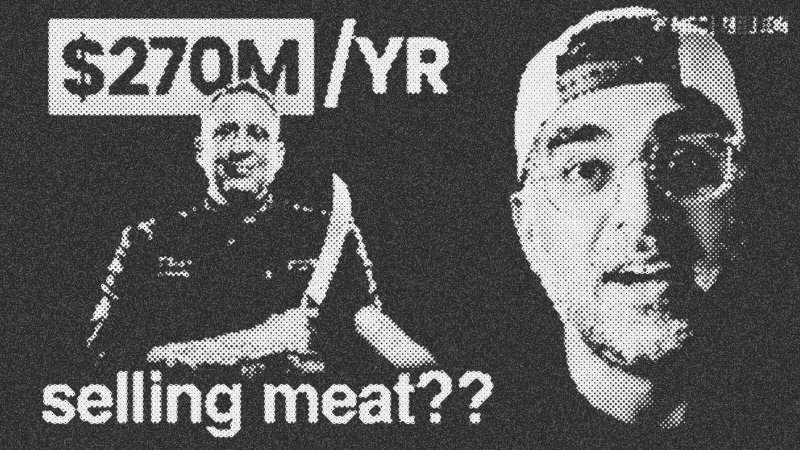
The butcher who built a $270 million meat empire
Most people look at a butcher shop and see a low-margin commodity struggle. Pat LaFrieda Jr. saw an opportunity to disrupt the entire supply chain of New York dining. The story of Pat LaFrieda Meat Purveyors is a masterclass in shifting from a generic service provider to an essential, branded partner. For decades, the business was a standard family operation, surviving on thin margins and local loyalty. By the late 1980s, the company was actually dying as massive distributors like Sysco began squeezing independent players out of the market.
When Pat LaFrieda Jr. entered the business against his father’s wishes, he didn't just cut meat; he engineered custom solutions for celebrity chefs. He identified that the high-end restaurant world was moving away from generic ingredients toward specific, story-driven sourcing. By creating exclusive, NDA-protected burger blends for figures like Mario Batali and Danny Meyer, Pat LaFrieda Jr. transformed a raw material into a proprietary asset. This strategy culminated in the Shake Shack partnership, where he secretly developed pre-formed patties—a move his traditionalist father considered blasphemous—to meet the needs of fast-casual scalability. Today, the business is so critical to the food supply that it holds a presidential mandate as an essential service, generating $270 million annually.
Musk’s Idiot Index and the war on cost-plus models
Innovation often starts with the realization that you are being overcharged for incompetence. Elon Musk popularized a mental model he calls the Idiot Index. The calculation is simple: take the total cost of a finished part and divide it by the cost of its raw constituent materials. If the ratio is astronomical—say, a $5,000 valve made of $50 worth of steel—you are paying a massive "idiot tax" for someone else's inefficient manufacturing process. This single metric drove the vertical integration of SpaceX, allowing them to bypass traditional aerospace contractors who were comfortable with 100x markups.
This logic extends to the defense industry, which historically operates on a cost-plus model. In this environment, contractors are paid their costs plus a fixed percentage of profit. This creates a perverse incentive: the more expensive and slow a project is, the more the contractor earns. Palmer Luckey built Anduril Industries to smash this paradigm. By operating on a product-based model—investing their own R&D and selling finished solutions at competitive prices—Anduril Industries aligns its incentives with the taxpayer. This is the difference between a legacy incumbent and a disruptor: the legacy firm manages a contract, while the disruptor builds a superior product.
Nick Sleep and the power of shared economies
While most investors chase complex algorithms, Nick Sleep achieved legendary status by identifying a single, durable strategy: Scale Economies Shared. Looking at companies like Costco and Amazon, Nick Sleep noted that they didn't use their growing scale to increase profit margins. Instead, they took the savings from their operational efficiency and gave them back to the customer in the form of lower prices. This creates a virtuous cycle of customer loyalty and volume that eventually builds an impenetrable moat.
Nick Sleep famously concentrated his fund into just a few positions, including Berkshire Hathaway, because he valued the "quiet" approach to business. He argued that massive advertising budgets, like those seen at General Motors, are often a tax paid for having an unremarkable product. If you have to shout to be heard, your product likely isn't doing the talking for you. This philosophy suggests that the most durable businesses are those that focus on the fundamental value exchange rather than the razzle-dazzle of Madison Avenue marketing.
The Kingmaker Strategy for market dominance
If you aren't the biggest player in an industry, the fastest way to the center of the network is to become the arbiter of status. This is the Kingmaker Strategy. By creating awards, rankings, or highly publicized lists, you position yourself as the authority that others must court. Jason Calacanis utilized this in the early days of the New York tech scene by creating the "Silicon Alley 100." He intentionally manipulated rankings to spark controversy—placing a known power player at number four instead of number one—to force them to engage with his publication to understand who was "beating" them.
This model is exemplified by JD Power, which turned consumer surveys into a billion-dollar licensing and research business. They didn't just tell car companies they were doing a bad job; they sold them the research on how to get higher on the list. This creates a dual revenue stream: research fees from those who want to improve and licensing fees from those who want to brag about their ranking. Whether it’s the Webby Awards for the internet or a niche ranking for senior living facilities, the business of status is one of the most scalable and resilient models in existence.
Investing in the next generation of hacker outcasts
There is a massive untapped opportunity in identifying and nurturing "outlier" talent before they reach the traditional institutional radar. The modern high-potential teenager doesn't always look like the valedictorian or the class president. They are more likely to be found hacking Tesla firmware, dominating high-stakes gaming servers, or running complex grey-market ecommerce operations. These are the misfits who are world-class at things that high school social hierarchies deem "low status."
A strategic network designed to "see" these kids and bridge the gap between their specialized skills and real-world business value could be a significant trajectory-shifter. By providing mentorship from founders who were once weirdos themselves—like the creators of Airbnb—you can redirect that obsessive energy toward solving massive problems. The goal is to build a brand that celebrates the hacker ethos, creating a golden window of influence for 12-to-19-year-olds who possess the audacity and logic to build the next generation of industry-defining companies.
- Nick Sleep
- 12%· people
- Pat LaFrieda Jr.
- 12%· people
- Anduril Industries
- 8%· companies
- Airbnb
- 4%· companies
- Amazon
- 4%· companies
- Other topics
- 60%
The one calculation Elon runs everything on (it made him trillions)
WatchMy First Million // 1:01:24

two guys, talking about business. we've done it (sold our companies), and now we talk about new ideas, opportunities, and investments. hosted by Shaan Puri & Sam Parr -- produced by Hubspot. sometimes we bring on guests ranging from billionaires to stay at home moms who've got side hustles that are bringing in $10k a month. we like to have fun, and talk about business stuff.