Musk uses 'idiot index' to strip costs from SpaceX rockets
The $270 Million Premium Beef Empire Built on Handshakes
Most people look at commodities and see a race to the bottom. They think the only way to win is to slash prices, squeeze margins, and pray for volume. They are wrong. If you are the absolute best at what you do, capital has a funny way of finding you. Look at Pat LaFrieda. He took a dying family-owned meat business and turned it into a $270 million-a-year premium powerhouse.
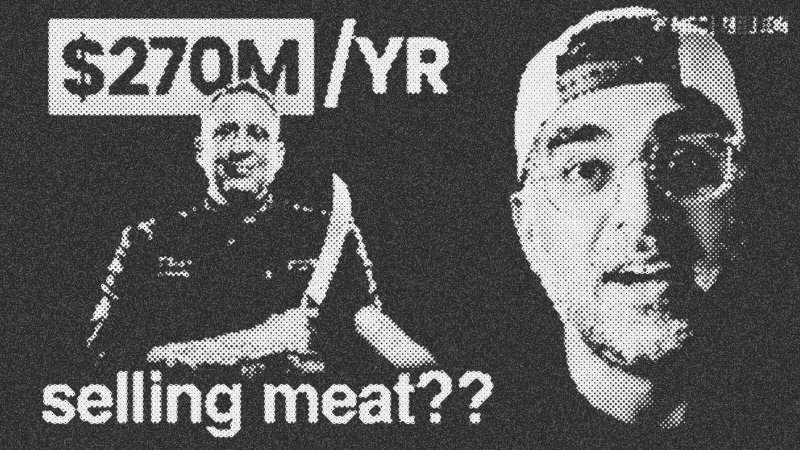
In 1994, Pat LaFrieda Meat Purveyors had 44 customers, five employees, and two butchers. The company was on the brink of death, bleeding customers to corporate distributors like Sysco. The father explicitly warned his son away from the business, telling him he would be rubbing pennies together forever. Instead of running, Pat Jr. jumped in. He realized that selling meat as an unbranded commodity was a death sentence.
He decided to build a brand out of a steak. He took a bet on an unknown chef named Mario Batali, giving him premium cuts on credit when nobody else would. When Batali became a celebrity, he paid that loyalty back, splashing the LaFrieda name across his menus. Next came Danny Meyer, who wanted a custom patty for a little hot dog stand mutation called Shake Shack. Pat Jr. rebelled against his traditionalist father, secretly formulating pre-formed patties to accommodate Meyer’s fast-casual speed requirements. Today, they operate the largest dry-aging facility in the world, holding $10 million worth of meat on any given night. They did not win by being cheap. They won by being indispensable.
Unveiling the Raw Math Behind Elon Musk's Idiot Index
When Elon Musk looks at a complex machine, he does not ask what the market charges for it. He runs a calculation he calls the "idiot index." This index is the total cost of a finished product divided by the cost of its raw, basic ingredients. If you are buying a specialty valve for $5,000, and the raw copper, steel, and aluminum on the London Metals Exchange cost $50, you have an idiot index of 100. That means you are paying a massive premium because you do not know how to fabricate the part yourself.
Idiot Index = [Total Finished Product Cost] / [Raw Ingredient Market Value]
Musk realized the aerospace industry had the worst idiot index of any sector on earth. Contractors were routinely markup-pricing components by 100x or more. By identifying these absurd spreads, SpaceX bypassed traditional supply chains, manufactured components in-house, and dropped launch costs by orders of magnitude. The exact same playbook applied to Tesla. It is not genius; it is ruthless first-principles logic combined with the audacity to build what others buy.
Palmer Lucky Explodes the Pentagon's Cost-Plus Racket
This same structural inefficiency plagues the defense sector. Traditional defense primes like Lockheed Martin operate on a "cost-plus" model. The government pays them whatever it costs to build a weapon, plus a guaranteed percentage on top as profit. This model creates a perverse incentive. If a contractor reduces their costs, they actually make less money. If they drag their feet and run up bills, their absolute profit rises.
Palmer Luckey, the founder of Anduril Industries, saw this gap and attacked it. After selling Oculus VR to Facebook for billions, Luckey noticed Silicon Valley’s top talent was spent building ad-tech algorithms and addictive feeds. Meanwhile, national defense was left to sluggish, non-innovative monopolies.
Anduril entered the market under a commercial model: they invest 100% of their revenues back into research and development, build the best possible hardware and software with their own capital, and then sell finished products to the government at fixed, competitive prices. They mirror the scaling tactics of Amazon, which convinced public markets to let it reinvest all profits for two decades to build an unassailable infrastructure moat.
Nick Sleep and the Quiet Magic of Scale Under-Sharing
While venture capitalists chase loud headlines, legendary investor Nick Sleep built one of the most successful funds in history by doing the exact opposite. Alongside Warren Buffett and Charlie Munger, Sleep championed the concept of "scale-efficiencies shared." Most companies get big and use their scale to squeeze customers for higher profits. Elite companies do the reverse: they pass their cost savings back to the consumer in the form of lower prices.
Sleep’s fund, Nomad Investment Partnership, crushed the market by holding just a few massive, concentrated positions: Costco, Amazon, and Berkshire Hathaway. These businesses share a humble, quiet strategy. They do not blow money on aggressive brand advertising. Instead, they treat low prices as their primary customer acquisition engine. Every time they find a way to save a dollar, they hand it back to the customer, building a viral loyalty loop that no competitor can touch. Advertising is often the tax you pay for having an unremarkable product.
Winning the Kingmaker Game via Manufactured Prestige
If you want to place yourself at the very center of any industry, you do not need to ask for permission. You just need to create the scoreboard. This is the "kingmaker move." By creating an award, a list, or an exclusive event, you instantly assert authority over a market.
Look at James David Power, who founded J.D. Power & Associates in 1969. He started by surveying car buyers to see if they actually liked their vehicles. Once he compiled the data, he turned it into an award. Suddenly, auto manufacturers were desperate to rank at the top. J.D. Power monetized this desperation by selling research on how to climb the rankings and licensing the use of their trophy logo in commercials. What started as a family survey business eventually sold for hundreds of millions of dollars.
This strategy is highly replicable. You can run this playbook in senior living, localized accounting, or tech. If you build the platform that celebrates the winners, you become the person everyone in that ecosystem has to know.
- Amazon
- 5%· companies
- Anduril Industries
- 5%· companies
- Berkshire Hathaway
- 5%· companies
- Charlie Munger
- 5%· people
- Costco
- 5%· companies
- Other topics
- 76%
The one calculation Elon runs everything on (it made him trillions)
WatchMy First Million // 1:01:24

two guys, talking about business. we've done it (sold our companies), and now we talk about new ideas, opportunities, and investments. hosted by Shaan Puri & Sam Parr -- produced by Hubspot. sometimes we bring on guests ranging from billionaires to stay at home moms who've got side hustles that are bringing in $10k a month. we like to have fun, and talk about business stuff.