The SaaS Apocalypse and the Gutting of the Washington Post
The Trillion-Dollar Software Sell-Off
The software industry, long the golden child of the public markets, is grappling with a sudden, violent revaluation. Over the last seven days, an index tracking software stocks shed nearly $1 trillion in value. This isn't just a market correction; it is a structural crisis of confidence. The catalyst was a seemingly minor product update from Anthropic—new legal tools for its Claude co-worker agent. However, the market interpreted this as a death knell for legacy software. Investors immediately dumped shares of LegalZoom, Thomson Reuters, and Intuit, fearing that generative AI will automate the very tasks these expensive subscriptions were built to manage.
This "SaaS Apocalypse" represents a pivot from growth-at-all-costs to extreme skepticism. Even companies reporting stellar earnings, like Service Now, have seen their market caps hammered. The fundamental tension lies between those who believe AI will replace existing tools and those who see it as an enhancer. Nvidia CEO Jensen Huang remains a vocal dissenter, arguing that AI will utilize existing software rather than reinventing the wheel. For now, however, capital is rotating out of the once-dependable tech basket and into defensive consumer staples at the fastest pace on record.
The Death Sentence for the Washington Post
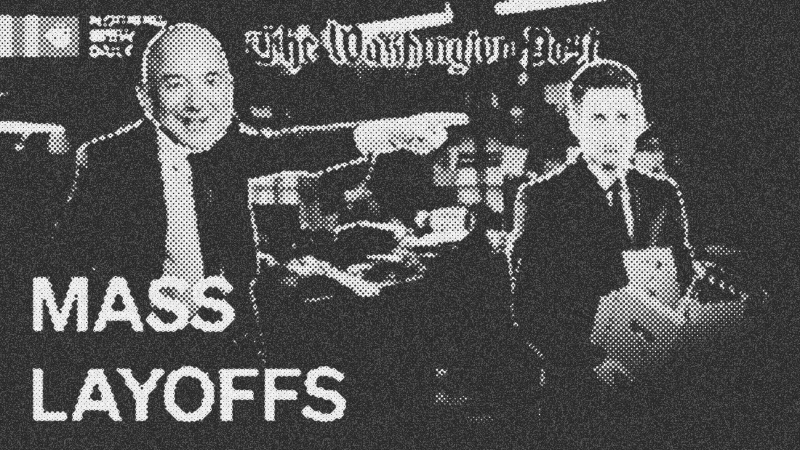
Jeff Bezos bought the Washington Post in 2013 with the promise of a digital-first resurrection. Thirteen years later, the storied paper has announced mass layoffs, cutting one-third of its total staff. The newsroom is a shadow of its former self, with the book section shuttered and the international desk hollowed out. While leadership claims this cull is a path toward a leaner, politics-focused future, the data suggests a series of profound strategic failures.
Under Bezos, the Post failed to diversify its revenue streams, unlike the New York Times, which built a resilient "bundle" of games, lifestyle content, and news. The Post's digital traffic has halved in recent years, and the paper lost 250,000 subscribers following Bezos's decision to block an endorsement of Kamala Harris. It is a stark reminder that even the deepest pockets in the world cannot save a media outlet if the editorial strategy becomes disconnected from its core audience.
Prediction Markets and the Super Bowl Surge
The upcoming Super Bowl is serving as a massive stress test for prediction markets like Kalshi and Polymarket. Over $161 million has been wagered on event contracts for the big game on Kalshi alone, dwarfing last year's volume. These platforms market themselves as a more transparent, peer-to-peer alternative to traditional sportsbooks like FanDuel.
Yet, the sheen of transparency is wearing thin. Critics argue these markets are vulnerable to manipulation, particularly in "mention markets" where bettors wager on specific words or phrases spoken during the broadcast. When a CEO or an announcer can move the market with a single sentence, the line between betting and insider trading blurs. Furthermore, recent data suggests the median prediction market user loses money at a significantly higher rate than those using traditional gambling apps, raising questions about the long-term sustainability of the "wisdom of the crowds" model.
The DoorDash Revolution and Skillcations
Macroeconomic shifts are also manifesting in American lifestyle habits. Food delivery has transitioned from a pandemic necessity to a permanent cultural fixture. Three out of every four restaurant orders are no longer eaten at the restaurant. While critics point to this as evidence of financial irresponsibility—with some individuals spending 20% of their salary on delivery—the trend signals a deeper shift in how consumers value their time.
Simultaneously, we are seeing the rise of the "skillcation." Travelers are moving away from passive relaxation in favor of workshops and hobby-based trips. Airbnb and hotel chains like Hilton are pivoting to meet this demand, offering everything from falconry to advanced photography. It is a peculiar intersection of productivity culture and leisure, where the modern worker feels the need to "level up" even while they are supposedly off the clock.
Market Realities and the Path Forward
We are witnessing a Great Rebalancing. From the tech sector's AI jitters to the media industry's struggle for relevance, the old playbooks are being shredded. Google continues to defy gravity with $400 billion in annual revenue, but even it must spend at unprecedented levels on chips and data centers to maintain its lead. Whether you are an investor, a journalist, or a consumer, the message is clear: the status quo is a liability. Adaptability is no longer a luxury; it is the only form of insurance that matters in a volatile global economy.
Jeff Bezos’ Washington Post sheds one third of its staff
WatchMorning Brew Daily // 26:15

Morning Brew Daily, a daily talk show that covers the latest news on business, the economy, and everything else, with Neal Freyman and Toby Howell. Witty, informative and everything you need to start your day. Available on all podcasting platforms and Youtube. Listen to the podcast here: https://link.chtbl.com/MBD Follow us on Twitter: https://twitter.com/mbdailyshow Follow us on Instagram: https://www.instagram.com/mbdailyshow/ Follow us on TikTok: http://www.tiktok.com/@mbdailyshow Sign up for the Morning Brew Newsletter: https://www.morningbrew.com/daily/subscribe?utm_campaign=mbd_yt&utm_medium=multimedia&utm_source=youtube