The Developer's Guide to Starting a Business Without Failing
Breaking the Development Abstraction Layer
Most developers operate behind a protective barrier. We write code, it gets merged, and eventually, money appears in a company's bank account. This is the development abstraction layer. It is a comfortable lie that suggests engineering is the only hard part of a business. When you decide to become a founder, this layer evaporates. You are suddenly responsible for product strategy, marketing, sales, and devops simultaneously.
Transitioning from employee to owner requires more than just a git push. You have to realize that engineering is often the easiest part of the stack to solve. The real challenge lies in finding someone who cares enough to pay for what you built. If you attempt to jump straight from a day job to a complex Software as a Service (SaaS) model, you are likely to drown in the sheer volume of skills you need to learn at once.
The Stair-Step Method to Entrepreneurship
Instead of launching a massive subscription platform on day one, adopt the stair-step method. This approach, popularized by Rob Walling, suggests you should cut your teeth on smaller, simpler products first. Start with something free. If you cannot get 25 people to star a GitHub repo or subscribe to a newsletter, you lack the marketing and product skills required to sell a high-ticket SaaS plan.
Once you have mastered the art of grabbing attention, move to a one-time purchase. Info products, like the highly successful ebook by Adam Wathan titled Refactoring to Collections, are excellent "step one" products. They teach you about sales and payment processing without the complexity of recurring billing or high-availability infrastructure. Finally, look for built-in distribution. Platforms like the Shopify App Store or the iOS App Store handle the "finding customers" part for you. It is much easier to sell to a crowd already in a purchasing mood than to scream into the void of the open internet.
Identifying High-Value Problems
Developers frequently pick terrible ideas because they build for themselves without considering business logic. To succeed, you need a template that works. One of the best strategies is to find an existing tool that people already pay for and make a version that "sucks less." Tuple succeeded by offering a remote pair programming tool that was simply better than Zoom or Google Meet for developers.
Another goldmine for ideas is the internal tools you use at work. If your company spent engineering hours building a custom dashboard for the marketing department, that is objective proof that the problem has value. You can also look for "side products" that emerge during other projects. Slack famously began as an internal chat tool for a gaming company. Tailwind CSS was a throwaway framework Adam Wathan used while streaming his work on a different SaaS project. Often, the thing you built to help you do the "real" work is actually the product the market wants.
The Golden Rule: Sell to Businesses, Not Consumers
Individual consumers are the worst customers. They will share a single Netflix account to save nine dollars. If you raise your price by two dollars, they will complain on social media. Businesses, however, operate on a different scale of reality. When a company like Shopify has a multi-billion dollar payroll, spending $100,000 on a tool that makes their developers 1% more efficient is a rounding error.
Target rich businesses in tech-forward regions like the US. These organizations are conditioned to buy software to solve problems. Avoid low-margin industries like restaurants or yoga studios. You want customers who view software as an investment, not a painful cost center. If you see competitors in a space, do not be discouraged. Competition is a signal that there is a market. Check their support forums, find what people hate about them, and build the solution to those specific frustrations.
Stop Coding and Start Validating
The biggest mistake a developer can make is retreating into a "coding cave" for nine months before talking to a single customer. You must validate your idea before you write a single line of CSS. Read The Mom Test to learn how to ask questions that don't invite people to lie to you.
You should even consider selling vaporware. If you cannot sell the dream of a perfect piece of software, the real version won't sell either. Tuple collected thousands of dollars in stripe charges before the product was even finished by offering early access and a seat at the table for roadmap decisions. This provides immediate cash flow and, more importantly, objective proof that your idea has legs.
Conclusion: Build a Lifestyle, Not a Job
Becoming a founder is about more than just revenue; it is about the people you work with. Avoid the trap of the "solopreneur" unless you enjoy loneliness. Find co-founders you vibe with and peers who are on the same journey. Attend niche events like MicroConf to build a network of people who can share off-the-record advice about what is actually working. If you bootstrap your company and focus on solving real business problems, you can build a high-leverage lifestyle that far surpasses any day job. Stop thinking like a coder and start thinking like a business owner.
- Adam Wathan
- 12%· people
- Tuple
- 12%· companies
- Google Meet
- 6%· products
- iOS App Store
- 6%· products
- Joel Spolsky
- 6%· people
- Other topics
- 59%
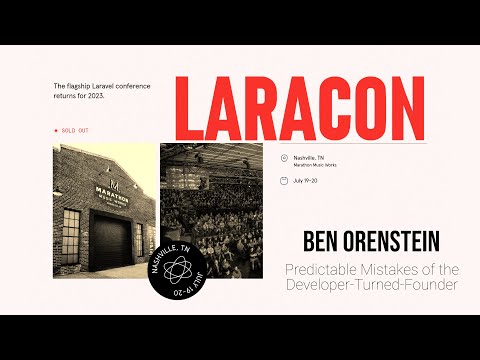
Ben Orenstein "Predictable Mistakes of the Developer-Turned-Founder" - Laracon US 2023 Nashville
WatchLaravel // 33:39

The official YouTube channel of Laravel, the clean stack for Artisans and agents. We will update you on what's new in the world of Laravel, from the framework to our products Cloud, Forge, and Nightwatch.