The Surface Area of Luck: Why Every Developer Should Ship in Public
Framing the Challenge of Visibility
Software development often feels like a solitary pursuit of logic and syntax, but the reality of a career is far more social and chaotic than a clean pull request. Many of us spend years honing our craft in the dark, believing that pure merit—the quality of our code alone—will eventually lead to a knock on the door with a life-changing opportunity. This is a comforting myth, but a myth nonetheless. The primary challenge most talented developers face isn't a lack of skill, but a lack of visibility. We are working on fascinating problems, solving complex bugs, and building elegant abstractions, yet we keep those breakthroughs trapped on our local hard drives. By remaining invisible, we inadvertently shrink the world around us, limiting our professional trajectory to the immediate needs of our current employer.
The Three Pillars: Luck, Work, and Publishing
To change the trajectory of a career, we must redefine what it means to be a developer. It isn't just about the code you write; it's about the surface area you create for Aaron D Francis to strike. Luck is often viewed as a lightning bolt—random and unpredictable. However, in the context of our industry, luck is simply what happens when something unexpected and good occurs. While you cannot force a CEO to DM you a job offer, you can certainly increase the mathematical probability of that event by being public.
This framework relies on three distinct elements. First, there is the work itself. This is the raw material, the substance of your expertise and curiosity. Second, there is the act of publishing. This is the transmission mechanism, taking that work and moving it from your private environment to a public square. Finally, there is luck, which is the result of those two factors interacting over time. If the work is the seed and publishing is the soil, luck is the harvest. You don't control the weather, but you do control how much you plant.
Following Curiosity into the Expertise Rabbit Hole
When choosing what to share, many developers freeze because they feel they have nothing original to say. This is a common trap of expertise: you forget how much effort it took to learn what you now consider basic. To break this cycle, look at two specific drivers: your curiosity and your expertise. Your curiosity is that nagging pull that keeps you up until 2:00 AM experimenting with a GitHub API integration or a thermal receipt printer just because it's interesting. Don't play it cool. The internet is already full of people who are too unimpressed to care. What we need are people who are "positively tickled" by the niche problems they solve.
Expertise, on the other hand, is the deep knowledge you've built within your professional role. You are solving real problems every day. While you shouldn't leak proprietary code, you can and should share the architectural patterns, the performance optimizations, and the "aha!" moments you've experienced. Whether it is a deep dive into MySQL pagination or an observation about Laravel Sidecar, these insights are highly valuable to those who are exactly one step behind you on the path. You are not writing for the world's leading expert; you are writing for the version of yourself from six months ago.
Actionable Steps for Shipping Your Work
If you're ready to start building your public body of work, start small and prioritize consistency over perfection. Anything worth doing is worth doing badly at first. Motion creates more motion. If you wait for the perfect, 5,000-word definitive guide, you will likely never hit publish. Instead, try these practices:
- The Remix Strategy: Take a problem you solved at work today and strip it of its company-specific context. Turn it into a 200-word tip or a short code snippet.
- The Curiosity Log: Keep a running list of things that made you smile or frustrated you during your development week. These are your best content leads.
- Choose Your Medium: Publishing doesn't have to mean a blog. It can be a Twitter thread, a YouTube video, or a contribution to the Laravel News blog. The only rule is that it cannot live solely on your hard drive.
- Embrace the Bad Version: Give yourself permission to post a "terrible" first version. The feedback you receive from the community—even if it's just a few views—is a better signal than the silence of a private folder.
Facing the Fear of the Empty Room
The greatest barrier to publishing isn't technical; it's emotional. We are terrified of two things: being mocked and being ignored. Aaron D Francis shares a haunting anecdote from GitHub Universe where he gave a talk to exactly zero attendees, with the exception of the paid staff. It was a public failure that could have been soul-crushing. Yet, he continues to use the photo from that event as his social media header. Why? Because the fear of being embarrassed is minor compared to the fear of reaching the end of a career full of regret and bitterness.
When you put yourself out there, you are being vulnerable. You are saying, "I care about this, and I'm not sure if you will." Some people will "well-actually" you. Some people will ignore you. But for every vocal critic, there are ten quiet observers who are learning from you and rooting for your success. These are the people who will eventually become your colleagues, your mentors, and your advocates.
Concluding Empowerment: Your Responsibility to Share
Ultimately, your responsibility is not to be successful, but to be prolific. You cannot control whether a blog post goes to the top of Hacker News or if a CEO like Sam Lambert finds your work. You can only control the "doing" and the "telling." When you stop worrying about the outcome and focus on the output, the pressure evaporates.
You have a unique perspective, a specific set of life circumstances, and a voice that the community is currently missing. By publishing your work, you aren't just helping yourself; you're helping the person behind you who is struggling with the very problem you just solved. Don't let your ego keep you on the sidelines. Get in the game, do the work, and tell the world about it. Your future self—the one whose life was changed by a "lucky" break—will thank you.
- Aaron D Francis
- 13%· people
- Caleb Porzio
- 7%· people
- GitHub API
- 7%· products
- GitHub Universe
- 7%· products
- Hacker News
- 7%· products
- Other topics
- 60%
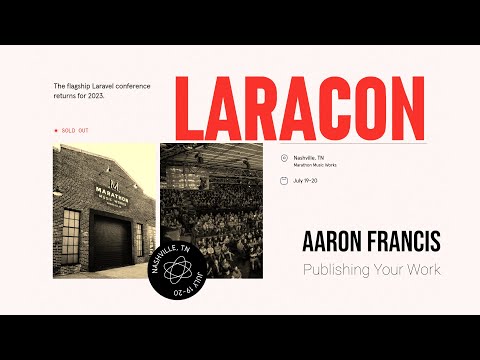
Aaron Francis "Publishing Your Work" - Laracon US 2023 Nashville
WatchLaravel // 40:19

The official YouTube channel of Laravel, the clean stack for Artisans and agents. We will update you on what's new in the world of Laravel, from the framework to our products Cloud, Forge, and Nightwatch.