Laravel benchmark reveals bulk native inserts beat Eloquent by 20,000%
The performance gap in high-volume seeding
Inserting a million rows isn't just a database task; it's a test of architectural efficiency. While Eloquent offers a developer-friendly syntax, its overhead becomes a massive bottleneck at scale. Every model instance triggers events, observers, and timestamp generation. For a standard users table, standard Eloquent inserts crawl at roughly five rows per second, primarily due to the CPU-intensive nature of password hashing. Without optimizations, seeding a million users would theoretically take over 50 hours.
Comparison of five database strategies
To optimize this, we look at five distinct approaches within the Laravel ecosystem:
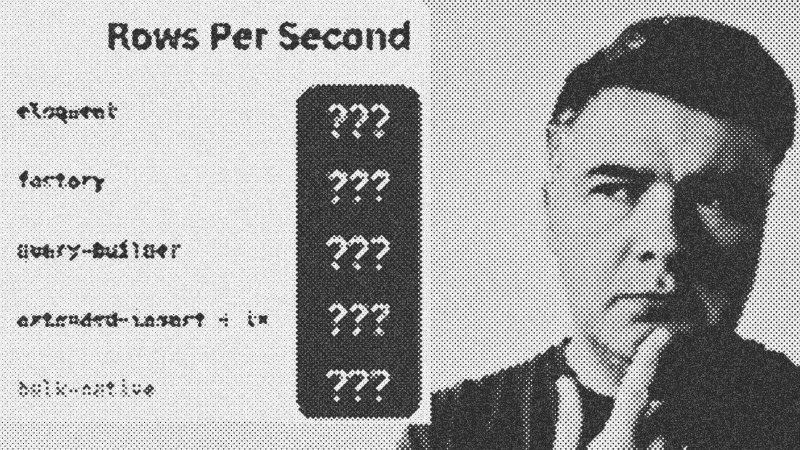
- Eloquent Individual Creates: High overhead; triggers all model logic.
- Model Factories: Uses static properties to avoid re-hashing passwords, boosting speed significantly.
- Query Builder with Transactions: Bypasses model logic entirely for direct SQL execution.
- Extended Insert Statements: Bundles multiple records into a single
INSERTquery. - Bulk Native (SQL Load File): The absolute winner, hitting 100,000+ rows per second by bypassing the application layer entirely.
Prerequisites and Key Tools
Before implementing these benchmarks, ensure you are comfortable with PHP and the Laravel framework. You will need:
- Laravel Framework: The core environment for Eloquent and Query Builder.
- MySQL: The primary relational database used for these benchmarks.
- Artisan Command Line: To run the seeding benchmarks.
Code Walkthrough: Optimizing with Streaming
To prevent your server from crashing due to memory exhaustion, use a streaming approach. Instead of loading a million-row array into memory, you process data in chunks and flush the buffer.
// Using chunks and buffer flushing to keep RAM usage low
foreach ($rows->chunk(1000) as $chunk) {
    DB::table('users')->insert($chunk->toArray());
    // Force the memory to clear by resetting the buffer
    $this->emptyBuffer();
}
This method keeps memory usage around 500MB regardless of total row count, whereas non-buffered approaches can easily scale to several gigabytes and trigger an Out-of-Memory (OOM) error.
Syntax Notes and Best Practices
When using Laravel factories, remember that the password field is often defined with a static assignment. This means the first record hashes the string, but every subsequent record reuses that hash, saving thousands of seconds in CPU time. Always use database transactions when performing bulk inserts with the Query Builder; wrapping 1,000 inserts in a single transaction is exponentially faster than 1,000 individual commits.
- Eloquent
- 23%· products
- Laravel
- 23%· products
- Digital Ocean
- 8%· companies
- GitHub
- 8%· companies
- Laravel Forge
- 8%· companies
- Other topics
- 31%
Insert 1M Rows to MySQL Laravel DB: 6 Ways (Benchmarks)
WatchLaravel Daily // 9:55
