Laravel Daily audit tool uses AI to hunt for architecture debt
Overview of AI-Driven Structural Audits
Software development often feels like a constant battle against entropy. As projects grow, architectural patterns that once seemed logical can become liabilities. Laravel Daily has introduced a specialized AI skill designed to automate the heavy lifting of code reviews. This tool isn't just looking for syntax errors; it's auditing the high-level structure of your repository to ensure it adheres to professional standards. By integrating this into tools like Claude Code, developers can get immediate feedback on whether their controllers are becoming too "fat," if business logic is leaking into templates, or if they are missing opportunities for Laravel's advanced features like Laravel.
Prerequisites and Environment Setup
To implement these AI skills, you should have a firm grasp of the Laravel framework and a basic understanding of Markdown for defining skill parameters. You will need an environment capable of running AI agents, such as Claude Code or Codeex. These tools require an active Anthropic API key or a similar subscription to handle the token usage during the deep scan of your codebase.
Key Libraries and Tools
- Claude Code: A terminal-based AI assistant that uses sub-agents to explore repositories in parallel.
- Codeex: An alternative AI agent platform that focuses on fast, summarized output.
- Livewire: A full-stack framework for Laravel that often presents unique structural challenges for AI to analyze.
- Filament: An admin panel builder where the audit often identifies candidates for PHP Enums.
Walking Through the Audit Findings
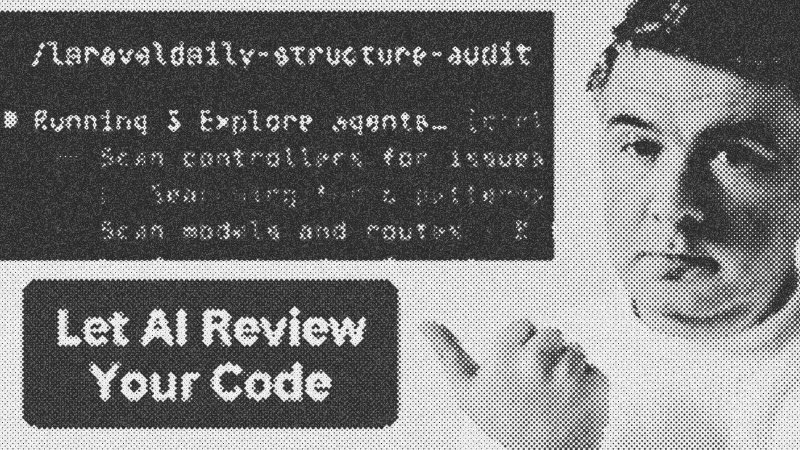
When you run a command like laravel-daily-structure-audit, the AI parses your directory and cross-references it against a predefined skill.md file. In practice, the AI might flag a controller for containing raw database transactions that should be extracted into Service Classes or Actions. For instance, if a DB::transaction block spans 50 lines, the AI suggests moving that logic to a dedicated service to improve reusability and testability.
Another common finding involves Duplicate Logic. The AI often detects identical slug-to-ID resolution across multiple controllers. The fix involves refactoring that logic into a global helper or utilizing Laravel's native Laravel to let the framework handle the lookup automatically.
Syntax Notes and Best Practices
- Enums over Strings: The audit frequently targets hardcoded strings (like subscription statuses), recommending PHP Enums for better type safety.
- Policies for Authorization: Instead of using
abort_unlessdirectly in controllers, the tool advocates for Laravel, centralizing authorization logic. - Blade Cleanliness: It flags PHP blocks inside Blade templates, pushing developers to keep presentation layers separate from business logic.
Tips for Reducing False Positives
AI is not infallible. A "fat controller" flag might be a false positive if the logic is highly specific and non-reusable. You should treat the audit results as a conversation starter for your team rather than a set of mandatory changes. Use the AI to spot patterns you might have missed during a manual review, but always apply your own context before initiating a refactor.
- Laravel
- 30%· products
- Claude Code
- 15%· products
- Codeex
- 10%· products
- PHP Enums
- 10%· products
- Anthropic
- 5%· companies
- Other topics
- 30%
My laraveldaily-structure-audit AI Skill: Review of the AI Code Review
WatchLaravel Daily // 16:49
