Gabbard warns unelected cabal of 'woke warmongers' runs the White House
The shadow government and the illusion of elected authority
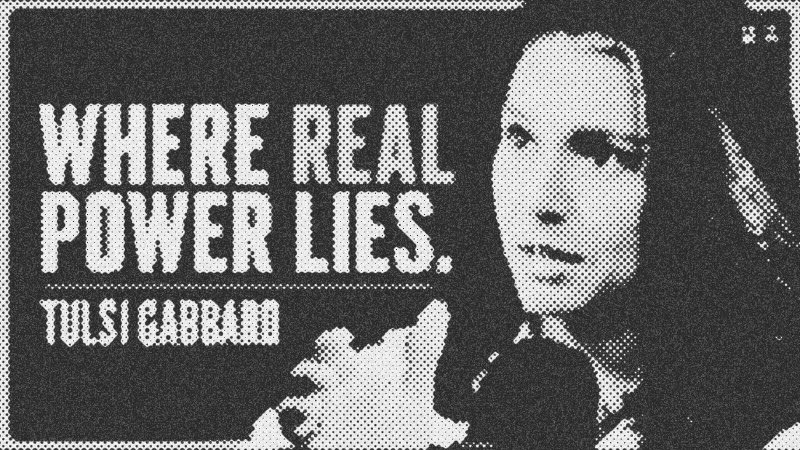
The fundamental promise of a democracy is that power resides with the governed, exercised through representatives chosen at the ballot box. However, Tulsi Gabbard argues that the United States has drifted into a troubling reality where the faces on the campaign posters are merely figureheads for a permanent administrative and military-industrial complex. This "cabal," as she describes it, consists of Democratic Party figures, billionaires, and media allies who derive their authority not from votes, but from their ability to control the resident of the White House.
According to Tulsi Gabbard, the infamous debate performance by Joe Biden served as a rare moment of clarity for the public, exposing the fact that the president has not been the primary decision-maker. This power vacuum is filled by unelected bureaucrats and seasoned political operators like Barack Obama, Hillary Clinton, Antony Blinken, and Jake Sullivan. These individuals represent a national security state that thrives on crisis and perpetual conflict, using war to expand government authority and erode civil liberties. The tragedy of this system is the loss of accountability; when the person calling the shots never has to stand for election, the consent of the governed becomes a relic of the past.
The war machine and the cost of interventionism
At the heart of the establishment's grip on power is the Military-Industrial Complex. Tulsi Gabbard, a serving soldier and veteran, highlights a disturbing disconnect between the politicians who beat the war drums and the reality of the battlefield. Many leaders see war as a first resort rather than a last, driven by pressure from defense contractors who profit from the expenditure of taxpayer billions and human lives. This "war-mongering" faction is bipartisan, including figures like Nikki Haley within the Republican Party, who maintain their influence through massive donor networks.
The disconnect of the political class
Politicians often visit war zones for high-gloss photo opportunities, donning helmets and vests for twelve-hour stays before returning to air-conditioned jets. Tulsi Gabbard contends that these leaders rarely perform the due diligence required to understand the second and third-order consequences of regime-change wars. This lack of responsibility has led to twenty years of counterproductive interventions that have undermined national security while enriching a small circle of elites. The true cost is borne by the families of service members and the American taxpayer, while the administrative state uses the state of emergency to justify taking away constitutional freedoms.
The threat of a Harris presidency
Tulsi Gabbard expresses particular concern regarding Kamala Harris as a potential commander-in-chief. She posits that Kamala Harris is a "calculating" figure who would feel an immediate need to exert military strength to prove her capability. This fragility makes her easy to manipulate by the same interests that have driven the United States toward the brink of conflict with Russia, China, and Iran. For Tulsi Gabbard, the choice in the upcoming election isn't merely about personality, but about choosing between a candidate who will bend the knee to the establishment and one, like Donald Trump, who has shown a willingness to ignore the traditional Washington playbook.
Media manipulation and the erosion of digital freedom
The digital landscape has become a primary battlefield for control over information. Tulsi Gabbard points to the recent TikTok bill as a dangerous expansion of executive power. While the bill was sold under the guise of national security, it contains provisions that allow the president to designate any business an "agent of a foreign adversary" without a clear path for appeal. This sets a precedent where platforms like X, owned by Elon Musk, could be targeted if they refuse to comply with government censorship demands.
The role of X during the Trump assassination attempt
The utility of X was demonstrated following the assassination attempt on Donald Trump. While legacy media outlets like CNN and MSNBC initially reported "popping sounds" or a "fall," X provided real-time iPhone footage from the ground. This transparency countered the narrative-shaping of the FBI and corporate news, which later attempted to cast doubt on whether Donald Trump was actually hit by a bullet. Tulsi Gabbard argues that without independent platforms, the public would be entirely dependent on a media machine that operates as the PR arm of the Democratic Party.
The failure of the two-party system
The struggle of Robert F. Kennedy Jr. highlights the structural barriers to breaking the duopoly. Between legal challenges to ballot access and a mainstream media blackout, independent voices are systematically suppressed. Tulsi Gabbard notes that the system is designed to prevent a viable third party from ever challenging the status quo. However, the rise of long-form podcasts and decentralized media is creating a more informed voter base that is increasingly skeptical of the narratives provided by Washington DC.
The cultural assault on family and faith
Beyond policy and war, there is a deeper shift in how the Democratic Party view the foundational units of society: religion and the family. Tulsi Gabbard observes a growing antagonism toward Christianity and Catholicism, citing Kamala Harris' past scrutiny of judicial nominees for their religious affiliations. The goal, she suggests, is to replace God with the government as the ultimate authority in people's lives.
The degradation of the nuclear family
This same impulse drives policies that undermine parental rights. In California, laws promoted by Gavin Newsom seek to exclude parents from decisions regarding their children's medical and gender transitions. This reflects a belief within the Democratic Party that the state is a better guardian of children than their parents. By attacking the nuclear family and traditional values, the administrative state seeks to remove the private buffers that protect individuals from total government control. Tulsi Gabbard, who was homeschooled, emphasizes that the right of parents to choose their children's education and upbringing is a core component of American liberty that is currently under siege.
The path to reclaiming democracy
Despite the "dysfunction" and the presence of "idiots all the way up," Tulsi Gabbard remains hopeful. She encourages citizens to look past the "yogurt lid moments"—the realization that the people in power are fallible and often incompetent—and recognize their own agency. Reclaiming the country requires more than just voting; it requires becoming a critical thinker who refuses to accept legacy media scripts at face value.
The qualifications for leadership are not Ivy League degrees or decades of service in a corrupt system, but a grounded sense of purpose and motivation to serve. Tulsi Gabbard urges the nearly half of the country that does not vote to engage, noting that staying home is itself a political action that allows the current establishment to remain in power. The future of United States depends on whether the governed will withhold their consent from the unelected cabal and return the government to its intended role as a servant of the people.
- Tulsi Gabbard
- 25%· people
- Democratic Party
- 8%· organizations
- Donald Trump
- 6%· people
- Kamala Harris
- 6%· people
- X
- 6%· products
- Other topics
- 49%
You Won’t Believe Who’s Really Running the Show - Tulsi Gabbard
WatchChris Williamson // 1:55:43
