Hussey: most people stay in bad relationships two years too long
The Architecture of Relationship Paralysis
We often treat the decision to leave a relationship as a singular event—a lightning bolt of clarity that strikes when things get "bad enough." But as Matthew Hussey observes, the reality is far more insidious. Most individuals find themselves trapped in a state of chronic indecision, lingering at the edge of a cliff without ever taking the leap. This paralysis isn't accidental; it’s a sophisticated psychological trap built from status quo bias, sunk cost fallacies, and an underlying fear that our personal "stock price" has plummeted during our time away from the dating market.
The challenge lies in the staggering difference in "activation energy" required between staying and leaving. Staying requires almost nothing; it is the default setting of our lives, even when that life is defined by quiet desperation. Leaving, however, demands a Herculean effort. It involves the untangling of finances, the explanation to social circles, and the confrontation of a profound, visceral heartbreak. We choose the familiar misery of a lukewarm connection over the daunting, high-energy requirement of change. We tell ourselves "not today," effectively pushing the cliff edge further into the distance until years have evaporated in a relationship that we knew was over long before it officially ended.
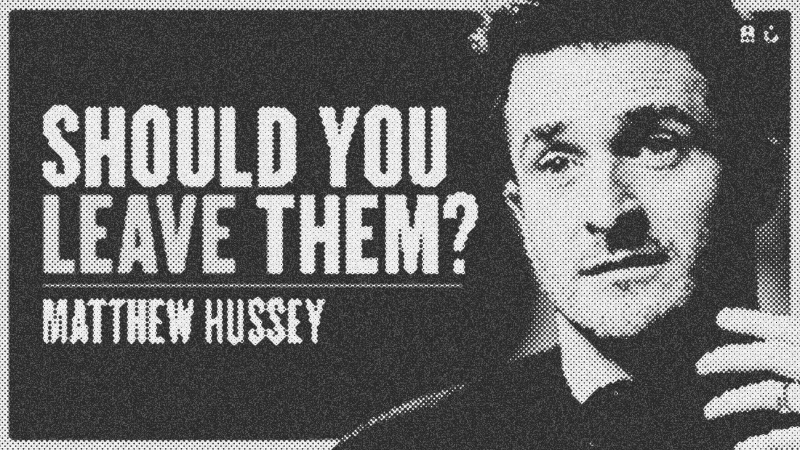
Why Chaos Mimics the Feeling of Connection
One of the most dangerous neurobiological tricks we play on ourselves is the conflation of chaos with chemistry. When a relationship is unpredictable—filled with highs that feel like victories and lows that feel like threats to our survival—our nervous system remains in a state of sympathetic arousal. We aren't resting in love; we are surviving it. This creates a powerful addiction to relief. When an inconsistent partner finally sends a sweet text or offers a scrap of validation, the sudden drop in cortisol and the spike in dopamine feel like euphoria.
We mislabel this relief as "passion" or "magic." In reality, it is the same mechanism that keeps a gambler at a slot machine: variable rewards. If a partner were terrible 100% of the time, leaving would be easy. But they are wonderful 10% of the time, and it is that 10% that acts as the hook. Matthew Hussey warns that we must stop imbuing this neurochemical whiplash with "karmic existential value." Just because someone is "sparky" doesn't mean they are special; it often just means they are high-energy or charming with everyone they meet. True intimacy is parasympathetic—it is a rest, not a chase. If your relationship feels like a perpetual pursuit, you haven't arrived at a partnership; you've joined a marathon with no finish line.
The Five Questions of Radical Self-Honesty
Breaking the cycle of relationship paralysis requires moving from the emotional centers of the brain to the analytical. Chris Williamson references a series of diagnostic questions designed to cut through the fog of romantic justification. These aren't just queries; they are mirrors reflecting the reality of your situation. First, if someone told you that you were exactly like your partner, would you take it as a compliment? This gets to the heart of character alignment. Second, are you fulfilled or simply less lonely? There is a profound difference between a partner who adds to your life and one who merely occupies the space where your fear of solitude lives.
Further, we must ask if we can be unapologetically ourselves or if we are constantly performing a version of ourselves to keep the peace. If you are in love with your partner’s "potential" rather than the person standing in front of you today, you are dating a ghost. Finally, the most sobering question of all: Would you want your future or imagined child to date someone exactly like your partner? We often tolerate treatment for ourselves that we would find abhorrent if directed at someone we loved unconditionally. This question removes the ego from the equation and forces us to look at the relationship through the lens of objective value and safety.
Reclaiming the Lost Self and the Inner Child
The most tragic "inheritance" of a long-term, dysfunctional relationship is the loss of the self. To survive in an environment that doesn't fully accept us, we fold ourselves into increasingly cramped and unnatural shapes. We stop doing the things we love, we silence our intuition, and we adopt the values of our partner to minimize friction. Over time, the person we were at the start of the relationship is replaced by a "bodyguard"—a defensive version of ourselves armed with hyper-vigilance and fear.
Healing requires recognizing that this bodyguard, while useful for survival, is not the leading edge of our growth. Many high-achievers apply the skill of resilience—the ability to endure hardship—to their personal lives, essentially "toughing it out" in a relationship that is destroying them. But resilience in a toxic context is just self-sabotage rebranded. True growth involves listening to the part of us that predates the survival mechanisms: the inner child who just wanted to have fun and feel safe. We must become the "superhero" to our younger selves, protecting that vulnerability rather than allowing it to be bruised by a partner who doesn't see our worth. Leaving isn't just about exiting a room; it’s about reclaiming the right to exist in our natural shape.
The Illusion of Scarcity and the Trap of Ego
Ego plays a paradoxical role in our refusal to leave. Sometimes we stay because we believe we are with someone "special" or "out of our league," and our ego tells us that securing this person is a redemption of our own insufficiency. We think, "If I can just make them love me, I will finally be enough." This turns the relationship into a trophy rather than a partnership. We become so busy trying to win the person that we never stop to ask if they are actually good for us.
On the other side of this is the fear that "this is the best I can get." This logic is rooted in profound scarcity and low self-esteem. We compare the miserable connection we have now not with a future healthy relationship, but with the terrifying prospect of being alone in a "war zone" dating market. Matthew Hussey argues that the proper comparison is not with a hypothetical better person, but with the happiness you can generate for yourself in your own company. You are choosing a miserable coupling over a satisfactory singleness because you don't trust your own ability to thrive without a witness. When you increase your self-value, the "scarcity" of bad partners ceases to be a threat.
Embracing Vulnerability as the Ultimate Power Move
There is a cultural tendency, especially among men, to view emotional restraint as strength and vulnerability as a liability. However, this is a hollowed-out form of stoicism. True courage is not the absence of feeling; it is the willingness to feel everything and speak your truth even when it’s terrifying. The person who suppresses their emotions isn't strong; they are fragile, unable to carry the weight of their own internal experience without breaking.
In relationships, vulnerability is the only path to genuine connection. If you are afraid to open up because you might be judged or "icked," you are effectively hiding from your partner. If they are turned off by your truth, it isn't a sign that you should have stayed silent; it’s a sign of a fundamental lack of compatibility. You cannot find the person who can hold you in your wholeness if you are constantly presenting a fragmented, "safe" version of yourself. Vulnerability acts as a filter, straining out those who cannot handle your depth and clearing the way for those who will see your sensitivity not as a weakness, but as a unique and beautiful pairing with your strength.
- AG1
- 4%· products
- Alfred%20Adler
- 4%· people
- Anxiously%20Attached
- 4%· books
- Barry%20Michaels
- 4%· people
- Beth%20Macy
- 4%· people
- Other topics
- 81%
The Relationship Mistake That Wastes Years - Matthew Hussey (4K)
WatchChris Williamson // 1:50:02
