Manson: most life problems are simple actions laden with emotional neuroticism
The Scarcity Mindset and the Cost of Tolerating Difficulty
Many of us find ourselves trapped in cycles of emotional exhaustion, not because our problems are fundamentally complex, but because we lack the resolve to enforce basic boundaries. Mark Manson observes that a significant portion of the distress requiring professional intervention could be alleviated if individuals simply tolerated fewer toxic behaviors from those around them. We often mistake the complexity of our emotional reaction for the complexity of the solution. The action—leaving a bad relationship or stopping a phone call—is remarkably simple. The emotional attachment, the fear of karmic retribution, and the neuroticism we layer on top are what create the fog.
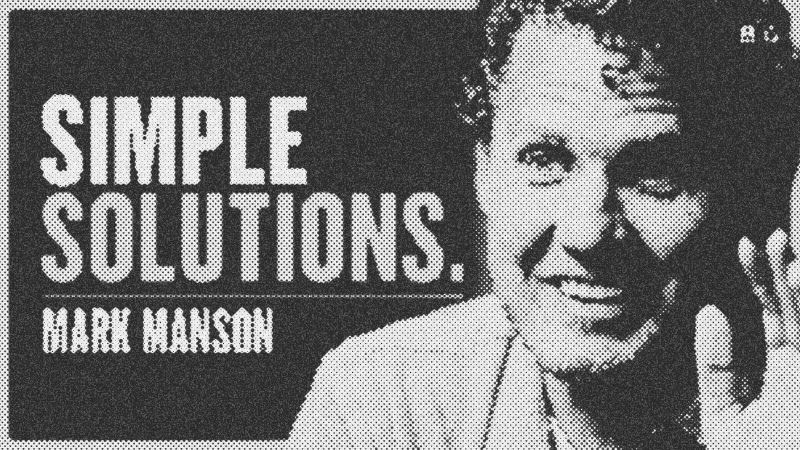
At the heart of this struggle is a scarcity mindset regarding human connection. We fear that if we excise a dysfunctional friend or partner, we will be left in a permanent vacuum. This fear is a psychological illusion; the world is abundant with people. When you clear space by removing someone who drains you, you create the necessary vacuum for a healthier individual to eventually enter. Without that clearing, you remain subjected to the whims and poor behavior of others, effectively choosing to live in a state of self-imposed psychological hostage-taking.
Why Serving from an Empty Cup Backfires in Relationships
There is a common misconception that total self-sacrifice is the hallmark of a loving relationship. However, trying to nurture others when your own self-worth is depleted is a recipe for resentment and failure. The paradox of healthy connection is that you must have a solid, satisfied relationship with yourself before you can truly contribute to another. When your self-esteem is lodged in the minds of others—a state of codependency—the prospect of setting a boundary feels like psychological suicide. You feel that if they are not okay, you cannot be okay.
This manifest most clearly in what Mark Manson calls the "running scorecard." Unhealthy relationships are defined by a constant internal tally: "I did this for you, but you didn't do that for me." The existence of the scoreboard itself is the evidence of a failing connection. In a thriving relationship, two people give voluntarily because their own cups are overflowing. You shouldn't serve others from the limited contents of your cup; you serve them from the overflow that comes from being internally fulfilled. When you optimize your entire life to find a partner—killing your hobbies, your personality, and your free time—you ironically become less magnetic because you have no inherent "life" left to share.
Personal Growth is the Process of Unlearning Your Own Lies
We often view personal development as the acquisition of new secrets or complex frameworks, but it is more accurately the process of learning to lie to ourselves less. We stack narratives on top of simple, painful truths to avoid the discomfort of reality. If you feel you don't deserve respect, you might invent stories about how "all men/women are a certain way" or blame the political climate or technology. These are compensatory mechanisms designed to hide the fact that you simply aren't standing up for yourself.
Growth requires digging down through these layers of obfuscation. Many of our most persistent problems are solved by quitting, not by doing more. We stay in careers we hate or cities that drain us because we lack the bravery to admit the truth: we are no longer fired up. We use therapy or research to find out "why" we have a certain attachment style, when the simpler, more painful truth is that we just don't love our partner anymore. Moving forward requires the brutal honesty of acknowledging that we have been avoiding the adult responsibility of picking a path and setting roots.
Strategic Incompetence as a Shield Against Responsibility
Mark Manson highlights a fascinating psychological maneuver known as strategic incompetence. This is the act of remaining intentionally bad at something—or pretending to be ignorant—to avoid the responsibility that comes with competence. In domestic life, this might look like a partner being "bad at laundry" so they never have to do it. On a deeper level, people remain "ignorant" or "clueless" in their relationships because being aware would require them to address their self-worth issues or confront a toxic dynamic.
This incompetence even extends to our health. We might wrap ourselves in an identity that rejects "optimization culture" or "morning routines" not out of a genuine philosophical stance, but as a way to avoid the hard work of addressing overeating or lack of exercise. By choosing to be the "non-conformist" who doesn't care about health, we grant ourselves permission to remain stagnant. True maturity involves identifying these pockets of intentional ignorance and realizing that they are actually barriers we've built to protect our ego from the demands of change.
Confidence and Fear as Competing Predictions of the Future
Both confidence and fear are beliefs in events that haven't occurred yet. They are stories our brains—which are essentially prediction machines—tell us about what might happen. The tragedy is that we often choose the fear narrative because it offers a perverse form of social value. Being the person with "anxiety" or who is "always worried" can become a mechanism for seeking validation, sympathy, and lowered expectations from others. It is a form of fear addiction where the constant state of crisis draws attention and reassurance.
We abhore uncertainty so much that we would rather imagine a catastrophe than deal with the unknown. An imagined catastrophe provides a dark form of certainty; at least we "know" things will be bad. This prevents us from functioning in the "gray area" of life where most reality actually resides. Choosing confidence is not about knowing things will be perfect, but about being comfortable with not knowing and proceeding anyway. It is the realization that your thoughts are filters that often "molest" reality before you even experience it.
The Liberation of Being Disliked for Who You Truly Are
One of the most profound shifts in a person's life occurs when they realize it is better to be disliked for their true self than liked for a performance. When you put on a persona to gain approval, that persona is the one receiving the praise, not you. Consequently, you never feel truly seen or loved; you only feel the exhaustion of maintaining the mask. This is why many successful people feel hollow—the world is applauding the role they play, not the human being behind it.
Front-loading your identity—being your most authentic, even quirky, self early in a relationship—acts as a natural filter. If you send someone an article about Russian grammar or the mating habits of zebras and they stay, you know you have a genuine connection. If they leave, you've saved yourself years of performing. We admire people who are imperfect and comfortable with it, not those who appear perfect. Vulnerability and authenticity are magnetic specifically because they signal that a person is reliable and doesn't feel the need to manipulate others for approval.
Redefining Love as Peace Rather than Intensity
Many people mistake emotional intensity for the depth of love. They ride the roller coaster of toxic relationships, believing that the extreme highs and lows signify a "profound" connection. In reality, healthy love often feels dull and repetitive compared to the drama of toxicity. It is characterized by peace, not oscillation. You should measure a relationship by how you feel during the mundane moments—eating breakfast or checking emails—because that is what the vast majority of life is made of.
Obsession is not love; it is fear disguised as affection. When you ruminate over someone constantly, you aren't focused on their well-being; you are focused on preventing the loss of them. True love is unconditional and seeks the happiness of the other person without expecting a return. It is a byproduct of commitment, not the cause of it. You don't find the perfect person and then fall in love; you commit to a person, and through the act of commitment and navigating life's dull and difficult moments together, the love grows and settles into something durable.
Action as the Generator of Motivation and Meaning
We often wait to feel "motivated" before we take action, but the biological reality is that action generates motivation. This applies to productivity and life purpose. If you aren't naturally tired at night and excited in the morning, it's likely because you haven't found meaningful work to give yourself to. Stress doesn't usually come from doing too much; it comes from doing too little of what you actually care about. Emotion is the ultimate productivity system; when you care about a mission, you naturally work longer and think harder without needing a habit tracker or a protocol.
However, we must be careful not to use busyness as a hedge against existential loneliness. A packed calendar can be a way to avoid the terrifying silence of our own thoughts. True productivity is about choosing what you are willing to suck at so you can excel at what matters. It is about pricing in the costs of your dreams. If you want a successful company, you must price in the loss of your social life. If you want a deep relationship, you must price in the loss of total independence. Happiness is not having the most options; it is being satisfied with the choices you've made and finally stopping the search for something better.
- Mark Manson
- 18%· people
- 4000 Weeks
- 6%· books
- Alex Hormozi
- 6%· people
- APA
- 6%· organizations
- Chris Williamson
- 6%· people
- Other topics
- 59%
19 Raw Lessons You Might Need To Learn Again - Mark Manson (4K)
WatchChris Williamson // 2:11:38
