Sam Sulek rejects social media trends to preserve his raw self-belief
Why the modern pursuit of public validation is quietly eroding your inner drive
We live in an era where the boundary between our private lives and our public personas has completely dissolved. Every achievement, every meal, and every workout session is packaged, polished, and presented for immediate digital approval. When you constantly perform for an audience, you introduce an invisible observer into your life. This observer alters your psychology in ways you might not even notice. Suddenly, you no longer run, lift, paint, or write for yourself. You do it to satisfy the expectations of people you have never met. This shift from internal desire to external validation is a quiet tragedy that strips away your genuine passion.
Think about the last time you completed a difficult task. Did you feel a quiet sense of satisfaction, or did you immediately think about how to share it on your phone? When you rely on external feedback to validate your self-worth, you place your emotional stability in the hands of strangers. This loop creates a fragile mindset. The moment the praise stops or the attention shifts, your motivation collapses. You find yourself trapped in a performative cycle, chasing the next hit of validation while losing touch with the raw, intrinsic curiosity that got you started in the first place.
This psychological trap is especially evident in highly visible subcultures like bodybuilding. During a long-form conversation on Modern Wisdom, host Chris Williamson sat down with viral sensation Sam Sulek to explore the mechanics of obsessive drive and authenticity. Sulek, who has captured millions of viewers by simply filming his daily workouts, offers a refreshing counter-narrative to the highly curated world of online fitness. His approach highlights a vital truth: the most resilient form of personal drive is one that remains entirely hidden from public view. To build a mind and a body that can withstand deep challenges, you must learn to work in the dark, entirely for your own satisfaction.
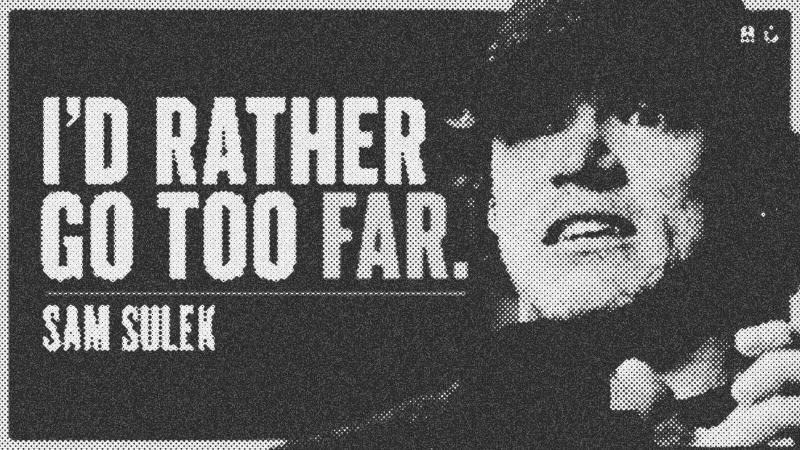
What Sam Sulek understands about the psychology of solitary obsession
There is a profound difference between being a "lifter" and being a "bodybuilder" in the traditional, performative sense. When Sam Sulek discusses his early days in the gym, he emphasizes that his obsession was never about competing on a stage or beating someone else. He wanted to get big for himself. This distinction is crucial. When your goals are entirely self-referential, your motivation is protected from external changes. You do not care if the gym is empty, if the lighting is bad, or if no one is watching. The work itself is the reward.
This mindset is deeply rooted in intrinsic motivation—the desire to engage in an activity because it is inherently satisfying. When you work out at two in the morning in a dead gym with no cameras running, you are testing the purity of your intent. Sulek recalls recording his sets solely for his own records, long before millions of people knew his name. That chip on his shoulder was not about proving something to the world; it was an internal accountability system. He wanted to see what he was capable of when left to his own devices.
When we transition from private obsession to public spectacle, the experiment changes. The introduction of an observer alters our behavior. Psychologists refer to this as the Hawthorne effect, where individuals modify their behavior in response to their awareness of being observed. Sulek admits that while having millions of viewers provides a slight layer of accountability, the workout itself must always come before the recording. If the camera dictates the workout, the authenticity of the effort dies. To maintain your edge, you must keep your core obsession sacred. You have to ensure that if the cameras vanished tomorrow, your commitment would remain completely untouched.
The danger of negotiating your standards with a digital audience
One of the most insidious consequences of the digital age is the pressure to conform to existing trends. When people decide to share their lives online, their first instinct is often to emulate what is already working. They study analytics, copy editing styles, and jump on popular trends. In doing so, they sacrifice their individuality. They trade their unique voice for a temporary boost in engagement, transforming themselves into a generic product that can easily be replaced.
This behavior stems from a fear of rejection. We desperately want to fit in, so we mask our flaws and present a sanitized version of reality. However, true connection does not come from perfection; it comes from vulnerability. When you see someone show their raw, unedited struggles, you recognize a fellow human being. This is why Sam Sulek resonated so deeply with audiences. His videos do not feature flashy transitions, dramatic music, or scripted intros. He simply sits in his car, talks to the camera as if he is speaking to a friend, and goes to lift weights. There is no distance between his real self and his on-camera persona.
When you attempt to maintain a fake persona, you carry a heavy psychological burden. You must constantly monitor your behavior to ensure you do not break character. This performative state is exhausting and unsustainable. Eventually, the mask slips, and the contrast between your public image and your private reality becomes too painful to bear. To avoid this, you must adopt a stoic approach to your self-presentation. Focus on the work, ignore the superficial metrics, and refuse to negotiate your personal standards for the sake of public approval. If people dislike your raw self, that is their concern, not yours.
Practical tools to rebuild your internal focus in a noisy world
Reclaiming your inner drive in a world designed to distract you requires deliberate action. You cannot simply wish your way into a stronger mindset; you must build habits that protect your mental peace. The following practices will help you detach from public validation and rebuild your internal focus:
Document without performing
Start tracking your progress purely for yourself. If you are working out, writing, or learning a new skill, record your sessions but do not upload them. Keep a private journal or a video folder on your phone that is completely locked away from public view. This practice teaches your brain that your efforts have value even when they are not praised by others. It restores the boundary between your personal growth and your public identity.
Apply the stoic fork to daily feedback
When you receive criticism or praise, immediately separate the input into two categories: what you can control and what you cannot. If someone leaves a harsh comment criticizing your work, look past the emotional tone and search for objective truth. If they point out a genuine flaw in your technique, accept the feedback and fix it. If their comment is simply mindless hostility, recognize it as noise. By separating the critique from the malice, you protect your self-worth while continuing to improve your skills.
Prioritize physical movement over digital consumption
We are genetically wired to move, run, and sweat. Our ancestors did not spend their days staring at screens, comparing themselves to idealized versions of their peers. When you feel anxious, overwhelmed, or insecure, turn off your phone and engage in strenuous physical activity. Physical exertion acts as a natural regulator for your nervous system. It pulls you out of your head and anchors you firmly back in your body, reminding you of your raw capability.
How to embrace the necessary boredom of long-term progress
We love to celebrate the grand, dramatic moments of success. We applaud the championship wins, the dramatic weight-loss transformations, and the sudden rises to fame. But these moments are merely the tip of the iceberg. Beneath the surface lies a massive foundation of boring, repetitive, and completely unglamorous work. True greatness is not built on sudden bursts of inspiration; it is forged in the quiet daily routines that most people find unbearable.
In his book Atomic Habits, author James Clear shares a story about the elite coaches of world-champion athletes. When asked what separated the very best from the rest, one coach noted that it came down to who could handle the boredom of training day after day, doing the exact same lifts and drills without complaining. This ability to fall in love with the mundane is the ultimate competitive advantage. When you raise your standards, you must accept that a significant portion of your journey will consist of repetitive, unexciting tasks.
Sam Sulek exemplifies this principle through his approach to his preparation. During his cutting phases, he completes hundreds of hours of low-intensity cardio, sitting on a stationary bike week after week, tracking every single calorie on a scale. He does not film these moments because they are boring to watch. Yet, he knows that this hidden work is the exact key to his success. It is like a hidden quest in a video game—the most repetitive tasks often yield the most valuable rewards. If you only work when you feel inspired, you will easily be outpaced by those who show up and complete the boring tasks regardless of their emotional state.
Step back into the driver seat of your own life
Your life is your responsibility. You cannot control where you start, how other people treat you, or the chaotic nature of the world around you. But you are entirely in control of how you respond to these challenges. When you complain about your circumstances, blame your fatigue, or retreat into self-pity, you are taking your hands off the steering wheel. You are deciding that you are a passive passenger in your own existence.
It is incredibly comfortable to play the victim. It excuses you from making an effort and protects you from the pain of failure. But this comfort is a trap. It leaves you feeling helpless, anxious, and deeply unfulfilled. True confidence does not come from a life free of obstacles; it comes from the quiet knowledge that you have the strength to survive whatever comes your way. When you choose to accept your reality, take ownership of your actions, and face your challenges without making excuses, you step back into your power.
Stop waiting for the perfect conditions, the ideal diet, or the sudden surge of motivation. The perfect moment does not exist. There is only right now, with all its messiness, fatigue, and uncertainty. Take one intentional step forward today. Work in the dark, focus on the process, and let your results speak for themselves. You have everything you need to build a life of genuine depth, resilience, and strength. Now, it is time to do the work.
- Sam Sulek
- 36%· people
- Atomic Habits
- 9%· books
- Callum Von Moger
- 9%· people
- Chris Williamson
- 9%· people
- James Clear
- 9%· people
- Other topics
- 27%
How to Get Better Every Single Day - Sam Sulek (4K)
WatchChris Williamson // 2:10:20
