Angelone warns comedians: cringe cancellation is the ultimate threat
The hum of a modern recording studio sets the scene. Two men sit across a wide table, surrounded by high-end microphones, soundproofing, and the heavy expectation of an audience looking for both laughs and existential truth. Chris Williamson, the jacked, hyper-analytical host of Modern Wisdom, sits opposite Vittorio Angelone, an Irish-Italian comedian on his first major North American tour. This is not a standard promotional stop. It is an exploration of the modern psyche, neurodivergence, and the delicate mechanics of human connection. The air is thick with the residue of travel fatigue and the sharp, nervous energy of two performers who make a living by turning their vulnerabilities inside out.
Angelone has arrived in Austin, Texas, battered by the road. His journey through America started with a chaotic run of shows in Los Angeles and New York, but it was in Nashville where the physical toll of his lifestyle caught up with him. What he initially dismissed as an exceptionally cruel, karmically unbalanced hangover quickly devolved into a terrifying medical emergency. After a casual game of pool where he decisively beat a group of locals, Angelone found himself slipping into a black hole of memory loss, uncontrollable shaking, and persistent vomiting. A trip to a sterile, strip-mall urgent care clinic confirmed the working theory: someone had slipped something into his drink. Drugged, dehydrated, and terrified, Angelone resorted to an desperate airport lifehack, booking a wheelchair assistance pass by claiming a phantom ankle injury just to survive the security lines.
The invisible mask of adult autism
This physical collapse serves as a visceral entry point into a deeper, more permanent struggle. At age 29, Angelone received an adult autism diagnosis. In the UK, seeking such answers through the National Health Service is an exercise in extreme patience, often carrying a four-year waiting list. It was only because professional autism practitioners attended his standup shows and offered private, pro-bono assessments that he was able to bypass the bureaucratic gridlock. The results of his evaluation revealed a stark psychological profile: moderate autistic traits coupled with an exceptionally high capacity for masking.
Masking is the exhausting process of consciously learning, scripting, and performing neurotypical social behaviors to fit into a world not built for you. For a professional comedian, this is not just a survival mechanism; it is the job description. Standup comedy requires a performer to repeat a story a thousand times while making it sound entirely spontaneous. It is the ultimate form of professional masking. Angelone realizes that his entire life has been governed by these prefabricated social scripts. When someone asks him a question, he does not converse intuitively; he retrieves a pre-recorded dialogue file from his brain that he knows will make the other person comfortable.
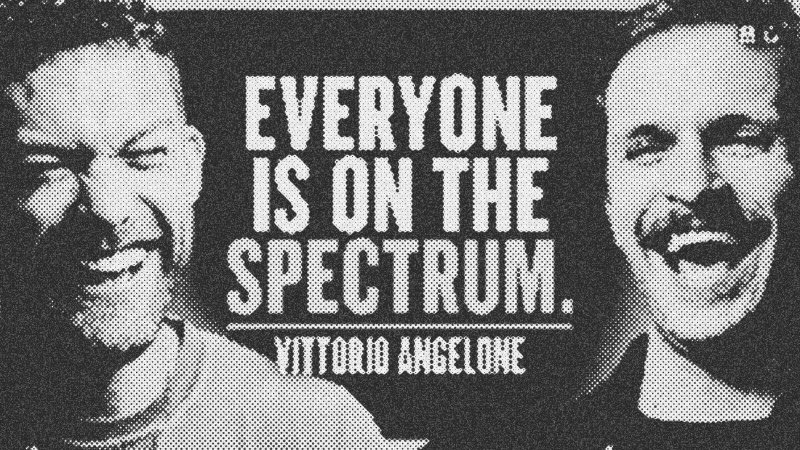
But this survival strategy comes at a massive energetic cost. The tragedy of high-functioning autism is the constant, low-grade terror of social failure. Far from being blissfully unaware of social dynamics, the masked autistic individual lives in a state of hyper-vigilance, constantly swinging punches in the dark. Angelone describes the agonizing reality of navigating interactions where he either apologizes profusely when no offense was given, or walks away proud of a conversation only to receive a devastating message the next day explaining how deeply he insulted someone. It is a persistent wake of accidental social destruction.
Reclaiming ambition in a culture of performative humility
This fear of accidental offense often forces creative minds to shrink their presence. Following a highly successful run at the Edinburgh Fringe Festival, a screen-recorded snippet of Angelone's podcast was circulated maliciously through comedian WhatsApp groups. In the out-of-context clip, he confessed to feeling the immense pressure of being labeled "the guy" of the festival. The subsequent backlash and mockery from his peers sent him into a psychological retreat. For nearly two years, he actively suppressed his natural bravado, putting a tight lid on his self-promotion and ambition in an attempt to appear safe and unthreatening.
Williamson recognizes this pattern instantly, linking it to the working-class culture of Northeast England and the wider UK, where the "tall poppy syndrome" reigns supreme. In these environments, any sign of self-belief or grand ambition is branded as having "notions." To survive, many young people reverse-engineer a form of performative humility. They aggressively downplay their achievements and goals so that others do not perceive them as a threat. This is not genuine meekness; it is a defensive shield forged from a fear of judgment.
Yet, this performative shrinking of the self is toxic to creative achievement. To promote a comedy tour or build a global media platform, a healthy level of ego is absolutely mandatory. You cannot sell out theaters with authentic self-deprecation. Angelone's journey back to creative vitality required him to study the bizarre, swaggering genius of Pete Weber, the legendary bad boy of professional bowling. Weber's infamous, aggressive outburst—shouting "Who do you think you are? I am!" at a hostile crowd—became the thematic anchor for Angelone's comedy special. By embracing the "heel turn" and accepting his own ambition, Angelone began dismantling his performative humility. He had to accept a simple, terrifying truth: he wants to be one of the best comedians in the world, and there is no polite way to say that.
Why uncoolness is the ultimate modern execution
The discussion shifts from personal ambition to the brutal ecosystem of modern internet culture. Williamson introduces the concept of the "cringe cancellation," distinguishing it from traditional cancellations based on moral or legal transgressions. A traditional cancellation occurs when an public figure commits a crime or utters a unforgivable slur. A cringe cancellation, however, is far more insidious. It is a coordinated, sometimes organic effort to make an individual's personal brand so toxic, uncool, and embarrassing to associate with that their audience abandons them out of sheer social survival.
In epidemiological terms, every cultural product has an transmission rate, or R-naught number. For a highly successful book like The Psychology of Money by Morgan Housel, the R-naught is well above one; every reader enthusiastically recommends it to multiple friends, driving exponential growth through word-of-mouth. A cringe cancellation does the exact opposite. It drives the R-naught below zero. It makes the act of consuming the content an embarrassing social liability. If telling your friends you listen to a certain podcast makes you look like an unsocialized idiot, you will quietly delete it from your library.
Comedians are increasingly weaponized as the infantry in these cultural wars. Audiences and media outlets constantly attempt to point comedians like loaded rifles at targets they wish to neutralize, hoping a viral joke will render the opponent permanently uncool. This social isolation mechanism plays directly on our deepest evolutionary fears. We are tribal creatures, and the threat of being cast out of the group for liking the "wrong" thing is a powerful tool of social compliance. When an artist falls into this spiral, any attempt to defend themselves or fight back only generates more cringe, accelerating their cultural demise.
The slow death of digital intimacy
This hyper-fragmentation of the internet has fundamentally altered why people consume media. Williamson reveals a major strategic shift in his own approach to broadcasting. After producing over a thousand episodes of Modern Wisdom filled with high-density, actionable advice on sleep, diet, productivity, and hormonal optimization, he has reached a point of information saturation. In the age of artificial intelligence, raw information has been completely commoditized. More "grind slop"—the relentless, optimization-obsessed content that commands young men to work until their eyes bleed—is not what the world needs.
Instead, there is a profound, aching loneliness sweeping through the modern population. This isolation has created a massive market for digital companionship. Audiences are moving away from structured, academic interviews and gravitating toward "hang" episodes—long, unstructured conversations where friends simply sit around, joke, and display genuine intimacy. This explains the massive, unexpected crossover appeal of male-centric comedy podcasts to female audiences. Programs like The Basement Yard, hosted by Joe Santagato, can sell out Madison Square Garden to an audience that is ninety percent women, simply because they offer a window into silly, unburdened, and affectionate male friendships.
This hunger for the unscripted and the real is also driving a quiet resurgence of interest in live, physical experiences. As deepfakes, AI-generated cat videos, and algorithmic manipulation make the digital world feel increasingly untrustworthy, the phone is beginning to give people the collective "ick." The future of culture belongs to the uncopyable. A live standup show, a sweaty music gig, or a physical community hub cannot be replicated by a large language model. Survival in the modern era requires us to step out of our highly optimized, masked digital existences and return, however clumsily, to the real world.
- 12 Rules for Life
- 10%· books
- Chris Williamson
- 10%· people
- Joe Santagato
- 10%· people
- Jordan Peterson
- 10%· people
- Modern Wisdom
- 10%· podcasts
- Other topics
- 50%
“My Autism Keeps Upsetting People” - Vittorio Angelone
WatchChris Williamson // 1:56:57
