Codex 5.3 vs. Claude Code: Why the New Contender Fails the End-to-End Test
The Quest for a Cheaper Coding Assistant
Transitioning from Claude Code to a more cost-effective alternative like Codex 5.3 is a tempting proposition for any developer. With high-tier subscription costs mounting, the promise of a GPT-based model that can handle full-stack Laravel projects is a significant draw. However, real-world application reveals a massive gap between generating snippets and managing a cohesive codebase. A deep-dive experiment using an Upwork project description as a benchmark shows that while Codex 5.3 possesses raw intelligence, it lacks the operational "common sense" required for professional delivery.
Communication Breakdown and Manual Overhead
One of the most jarring differences lies in how these tools interact with the developer. Claude Code excels at the "interview phase," proactively asking for clarifications before writing a single line of code. In contrast, Codex 5.3 buries its questions inside markdown files, forcing the developer to hunt for them and manually reprompt with answers. This workflow is fundamentally broken for those used to the seamless plan-and-execute cycles of modern agents. Instead of saving time, the developer ends up babysitting the AI through every decision point.
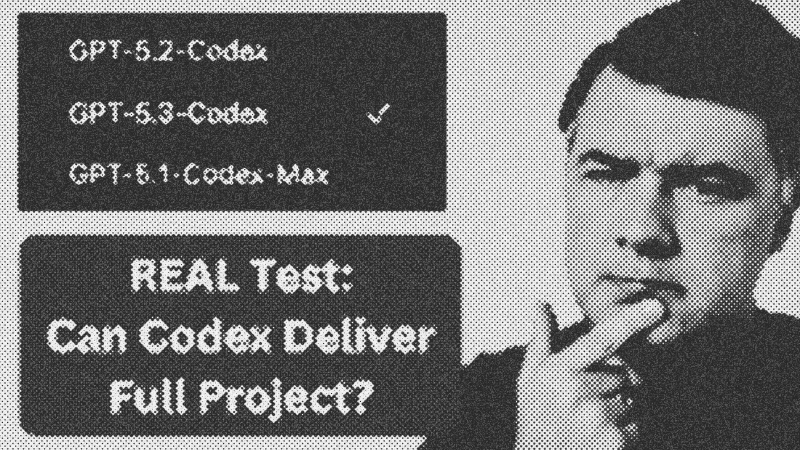
The Fatal Flaw: Narrow Testing Scopes
Quality assurance is where Codex 5.3 truly falters. During the Laravel implementation, the model frequently reported successful test runs while failing to notice that its new code broke existing features in the starter kit. It limits its vision to the specific task at hand, ignoring the broader test suite. Worse, it fails to verify critical infrastructure changes. In one instance, the model suggested database schema updates but never actually executed the migrations, leading to immediate runtime crashes during user registration. For end-to-end projects, this lack of thoroughness is a dealbreaker.
Final Verdict: Stick with Claude
Codex 5.3 is a powerful engine for narrow-scope tasks where you can feed it a specific problem and get a specific answer. But as an autonomous agent capable of delivering a full project? It isn't ready. The manual effort required to fix its oversights and double-check its "completed" tasks negates any potential cost savings. Until it learns to run full test suites and automate its own verification steps, Claude Code remains the undisputed king of the developer workflow.
- Codex 5.3
- 42%· products
- Claude Code
- 25%· products
- Laravel
- 17%· products
- MySQL
- 8%· products
- Upwork
- 8%· companies
Will I Switch to Codex from Claude Code?
WatchAI Coding Daily // 5:48

This channel is not for vibe-coders. It's for professional devs who want to use AI as powerful assistant, while still keeping the control of their codebase. My name is Povilas Korop, and I'm passionate about coding with AI. So I started this THIRD YouTube channel, in addition to my other ones Laravel Daily and Filament Daily. You will see a lot of my experiments with AI: I will try new things and share my discoveries along the way.