Kimi K2.7 Code hits seventh place on benchmark despite rising costs
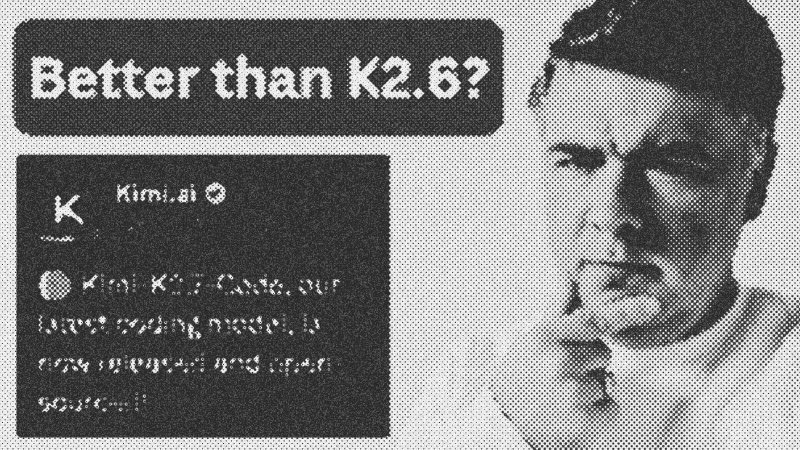
The arrival of Kimi K2.7 Code signals a significant shift in how specialized coding models handle complex, multi-step engineering tasks. While its predecessor, Kimi K2.6, performed respectably in the middle of the pack, this new iteration targets the "long-tail" of debugging. It attempts to move past simple code generation toward a more robust, iterative problem-solving approach.
Deeper reasoning at a premium price
The most immediate change in the K2.7 experience is the depth of its thought cycles. During testing on Laravel API builds and ReactJS component architecture, the model demonstrated an increased willingness to "think" for twenty seconds or more before emitting tokens. This isn't just idling; the model actively works through internal debugging loops. On a project involving an unknown third-party package, K2.7 successfully avoided N+1 query problems that tripped up Kimi K2.6, though this precision comes at three times the cost per prompt.
The leaderboard reality check
When subjected to a rigorous 20-prompt benchmark across four distinct projects, Kimi K2.7 Code secured 17 out of 20 points. This performance lands it in seventh place globally, tied with Gemini 1.5 Pro and Composer 2.5 from Cursor. While it claims the title of the best Chinese coding model currently available, it still struggles with specific framework standards like Filament interfaces, where it failed to properly implement PHP enums.
Performance versus efficiency trade-offs
Developer efficiency isn't just about code accuracy; it's about the feedback loop. K2.7 is objectively slower than the previous version, jumping from three-minute averages to five-minute durations on ReactJS tasks. The marketing claims of 30% lower reasoning token usage don't seem to translate into lower end-user costs via OpenCodeGo. For developers, the recommendation is clear: use K2.7 for complex debugging where accuracy is paramount, but stick to leaner models for boilerplate tasks to avoid unnecessary overhead.
- Kimi K2.6
- 15%· products
- Kimi K2.7 Code
- 15%· products
- ReactJS
- 15%· products
- Composer 2.5
- 8%· products
- Cursor
- 8%· products
- Other topics
- 38%
I Tested NEW Kimi-K2.7-Code with 20 Prompts
WatchAI Coding Daily // 11:37

This channel is not for vibe-coders. It's for professional devs who want to use AI as powerful assistant, while still keeping the control of their codebase. My name is Povilas Korop, and I'm passionate about coding with AI. So I started this THIRD YouTube channel, in addition to my other ones Laravel Daily and Filament Daily. You will see a lot of my experiments with AI: I will try new things and share my discoveries along the way.