Refactoring at Scale: Evaluating the Claude Code Simplify Feature
The Quest for Automatic Refactoring
Maintaining clean code remains one of the most taxing aspects of software development. Anthropic recently introduced a dedicated simplify command for Claude Code, aiming to bridge the gap between functional logic and elegant architecture. This feature doesn't just tweak syntax; it evaluates code quality, reuse, and efficiency through a multi-agent workflow. While standard LLM outputs often prioritize immediate functionality, this command attempts to mimic the secondary pass a human developer takes to polish a draft.
Multi-Agent Architecture in Action
The technical implementation of simplify involves three specialized review agents—Reuse, Quality, and Efficiency—running in parallel. These agents utilize Claude 3.5 Sonnet to perform the heavy lifting of code analysis before reporting back to a main Claude 3 Opus agent for final synthesis. In a Laravel project utilizing Livewire, this resulted in six specific architectural improvements, ranging from extracting shared form traits to converting repetitive HTML into reusable Blade components.
Performance and Economic Realities
Efficiency comes at a cost, both in time and tokens. The simplification process for a relatively small set of files took over eight minutes to complete. More significantly, a single session consumed roughly 5% of the total token limit on a high-tier $100 monthly plan. This raises questions about the practicality of running such deep-thinking agents frequently. While the suggestions—like replacing raw strings with model constants—are objectively better for maintainability, the overhead suggests this is a tool for final polish rather than continuous development.
Strategic Refactoring vs. Procedural Hack
A common critique, shared by developers like Corey, suggests that if the model is capable of writing better code, it should do so on the first attempt. However, the iterative nature of this tool mirrors the human development cycle. We rarely write the most optimized version of a feature while simultaneously solving the core business logic. By separating the "build" phase from the "simplify" phase, Claude Code ensures that the refactoring logic doesn't interfere with the initial generation of working code.
- Claude Code
- 25%· products
- Anthropic
- 13%· companies
- Claude 3 Opus
- 13%· products
- Claude 3.5 Sonnet
- 13%· products
- Corey
- 13%· people
- Other topics
- 25%
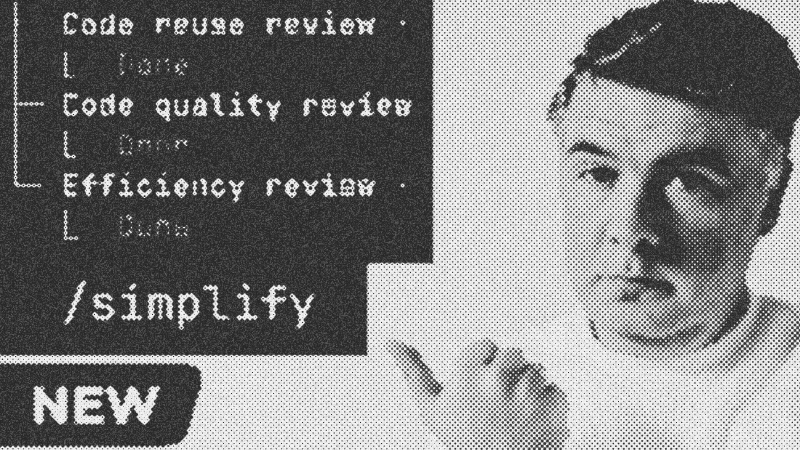
I Tried a NEW Claude Code /simplify Command to Improve Code
WatchAI Coding Daily // 7:41

This channel is not for vibe-coders. It's for professional devs who want to use AI as powerful assistant, while still keeping the control of their codebase. My name is Povilas Korop, and I'm passionate about coding with AI. So I started this THIRD YouTube channel, in addition to my other ones Laravel Daily and Filament Daily. You will see a lot of my experiments with AI: I will try new things and share my discoveries along the way.