Elena Verna says paid marketing is a first-year death trap
The trust economy replaces the feature factory
In the era of hyper-scale AI, the fundamental unit of growth has shifted from functionality to trust. For decades, startups won by shipping features faster than the incumbent. But today, Elena Verna argues that software creation has become so democratized that functionality alone is a commodity. If any developer can prompt an LLM to recreate your core feature set over a weekend, your only remaining moat is the emotional connection you build with your user. Growth is no longer a tactical optimization problem; it is a trust problem.
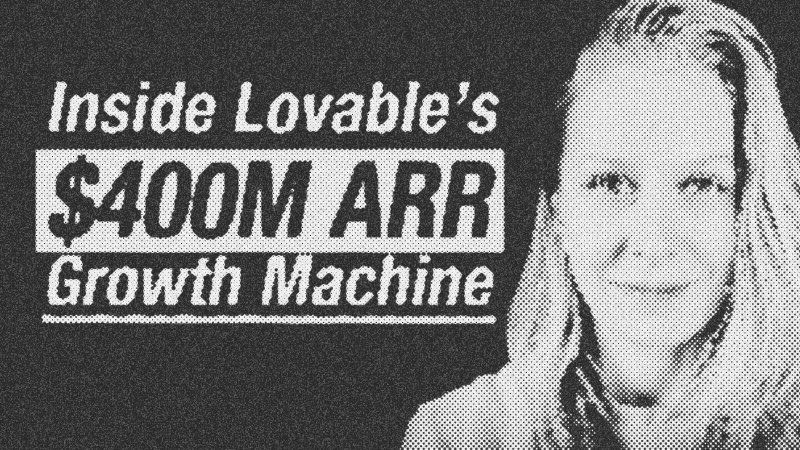
This shift demands a transition from the "Minimum Viable Product" to what Verna calls the Minimum Lovable Product. Software is now judged by the emotion it invokes. Humans naturally recoil from utilities and tools; they crave connection. As the Head of Growth at Lovable, Verna emphasizes that building a personality into the software is now the minimum bar to kickstart growth. The goal is to move beyond the base layer of functionality and security into a space where users actually vouch for the team behind the product. When functionality is ubiquitous, the "who" behind the code becomes more important than the code itself.
Paid marketing is a death trap for early startups
One of the most provocative stances Verna takes is her absolute rejection of paid marketing for companies in their first year. She labels it a death trap. Many founders, flush with venture capital, attempt to buy their way to product-market fit. Verna warns that this is essentially lighting cash on fire. Until a company has figured out stable, organic product-market fit through search, socials, or word-of-mouth, pouring money into the top of a leaky, unoptimized funnel is a recipe for a single point of failure.
Furthermore, Verna dismisses Lifetime Value (LTV) as a relevant metric for young companies. Unless a business has been operating for at least five years, it does not actually know its LTV. Founders often use hallucinated LTV numbers to justify high Customer Acquisition Costs (CAC), leading to unsustainable burn rates. Instead, the focus must be on the payback period. If you cannot recuperate your investment within three months, the system is not self-sustaining. Relying on Google or Meta for more than 50% of your growth puts you at the mercy of their earnings calls; when they need to hit their numbers, they simply jack up ad rates, and your business collapses.
The blurring of lines and the AI-native employee
The traditional silos of marketing, product, and engineering are dissolving. In Verna's view, being "AI native" means every employee must be a generalist capable of shipping. At Lovable, the expectation is radical: every single employee, including those in growth and marketing, is expected to ship code to production. Verna herself now writes copy, builds prototypes, and ships apps without engineering support. This acceleration of the "blur" allows for a level of agility that larger, compliance-heavy organizations cannot match.
This new paradigm requires a shift in hiring. While specialists like SEO experts still have a place, the most valuable assets are "jack-of-all-trades" problem solvers who can handle the kitchen sink. This autonomy extends to social presence. Verna advocates for employee-led social branding. If a founder is afraid to let their employees build personal brands because they might get poached, that founder has a cultural problem, not a marketing problem. When employees build in public, they become the most powerful, authentic marketing agents a company has. You effectively get an engineer and a marketer for the price of one.
Why subscriptions fail the AI usage reality
Monetization in the AI era is fundamentally broken. Most startups are currently passing through expensive LLM costs to their users via rigid monthly subscriptions. Verna argues that this model is a poor fit for the "bursty" nature of AI usage. Creativity and project needs are not consistent; a user might have a week of intense activity followed by a month of dormancy. Forcing these users into a recurring subscription creates friction and churn.
Lovable's success with top-ups—ad hoc purchases on top of or instead of subscriptions—proves that flexibility drives incrementality. The fear that non-recurring revenue will hurt valuation multiples is a fallacy. As LLM costs inevitably collapse and become commoditized like cloud storage, the winners will be those who evolve their models toward outcome-based monetization. If your business is still treating pricing as a taboo subject that can't be adjusted, you are waiting for a collapse that is already imminent.
The tactical return to out-of-home and community
If given an unlimited budget, Verna would not double down on digital performance ads. Instead, she looks toward the physical world and the creator economy. Out-of-home (OOH) advertising is seeing a resurgence because it captures latent majority attention in a way that saturated digital feeds cannot. However, the execution must be characterful and risky. Boring, corporate AI slogans like "collaborative cloud transformation" are invisible. Marketing must make people chuckle or provide a memory to be effective.
Community is another area where most startups fail by turning their forums into "holes of depression." When a community is used primarily as a support outlet for people whose problems haven't been solved, it becomes a dumping ground for negative sentiment. To build a real community, founders must identify their early super-users and empower them as ambassadors. This seeds the environment with positivity and inspiration rather than just troubleshooting. The goal is to create an earned channel that competitors cannot buy.
Relevancy is the only sustainable moat
In a world where OpenAI, Anthropic, and Google hold a terrifying grip on distribution, smaller players must stay top-of-mind through sheer velocity. Verna reveals that Lovable's strategy involves launching something every single day. This isn't just about shipping code; it's about constant noise. While marketing only puts its full firepower behind "Tier 1" launches every few months, the daily releases keep the product in the "habitual zone" of the user's mind.
Falling into the "forgettable zone"—the monthly or quarterly check-in—is death for a startup. You have to be a living, breathing entity that evolves in real-time. This level of activity creates a "beeswarming" effect where employees support each other's updates on social media, amplifying the brand's reach organically. The future of growth isn't found in a playbook of the past; it's found in the agency of your team to experiment, take risks, and connect with customers on a human level.
- 15%· companies
- Anthropic
- 8%· companies
- Anton
- 8%· people
- Elena Verna
- 8%· people
- Figma
- 8%· companies
- Other topics
- 54%
Elena Verna: How Lovable Launches Product & Hacks Social to Go Viral
Watch20VC with Harry Stebbings // 1:10:57

20VC, hosted by Harry Stebbings, takes you inside the world of Venture Capital, Startup Funding and The Pitch. Join Harry and discover how you can attain funding for your business by listening to what the most prominent investors are directly looking for in startups, providing easily actionable tips and tricks that can be put in place to increase your chances of getting funded. The Twenty Minute VC also provides an instructional guide as to what it takes to get employed in the Venture Capital industry, with VCs giving specific advice on how to get noticed from the crowd and increasing your chances of employment. Our amazing Venture Capitalists also provide their analysis of the current technology market, providing advice and suggestions on the latest investing trends and predictions. Join us so you can see how you can get big, powerful improvements, fast.