The Intelligence War: Inside the America's Cup Joint Reconnaissance Program
The New Era of Competitive Espionage
In the high-stakes world of elite team sports, information is the most valuable currency. For decades, the America's Cup was defined by a shadow war where teams spent millions of dollars on private spying operations, chasing rival boats in high-speed ribs to capture every flick of a rudder or curve of a wing. Ray Davies, a veteran of Emirates Team New Zealand, explains that the landscape has fundamentally shifted. The 37th edition of the Cup has moved away from the chaotic "Wild West" of private reconnaissance toward a formalized, joint program. This isn't just a cost-saving measure; it is a strategic restructuring that changes how teams develop technology and prepare for battle.
From Shadowing to Standardization
The previous model was unsustainable. Ray Davies recalls the absurdity of three different recon teams following a single boat in Auckland, creating massive fuel burns and safety hazards. In response, Dan Bernasconi proposed a joint recon program where a centralized pool of data is shared among all competitors. Now, teams no longer choose their own spies; the opposition decides who will watch them. This transparency is jarring for organizations used to extreme secrecy. There are now people from outside the inner circle standing on the forecourt as boats roll out, documenting every modification.
The Operational Workflow
The logistics of this new system are rigorous. Each team provides a chase boat for the recon crew, which includes a photographer and an observer. These individuals aren't just taking pretty pictures; they are following a specific manifest of interests. Teams use shared spreadsheets to request specific angles or components they want to see from their rivals. If a competitor rolls out a new elevator or flap, it must be declared. This formal process ensures that while the "cat is out of the bag" earlier than in previous cycles, the data is structured, high-quality, and accessible to every design department in the competition.
Analyzing the Firehose of Data
The challenge has shifted from obtaining data to filtering it. With every team being tracked daily, the volume of footage, metadata, and technical specs is staggering. Ray Davies warns that this can easily become a distraction. If a team spends too much time reacting to what they see in a rival's cockpit, they risk losing their own development trajectory. At Emirates Team New Zealand, the strategy is to distribute the workload. The rig specialists pore over mast photos, while appendage designers focus on foil geometry. It’s about maintaining a disciplined focus on your own game plan while keeping a watchful eye on the field's evolution.
The Strategic Pivot: Barcelona and Beyond
Strategy in the current cycle is heavily influenced by the move to Barcelona. Unlike the relatively flat waters of previous venues, Barcelona presents a significant sea state. Recon teams are currently obsessed with hull designs and how boats handle waves. Ray Davies points out that form stability and the ability to take off in a displacement mode amidst waves are the new frontiers. The recon data allows teams to see exactly how rivals are coping with these conditions—how long their rudders are, and how they manage the drag during takeoff. This real-time feedback loop accelerates the entire fleet's learning curve, potentially narrowing the performance gap between the top and bottom teams.
Efficiency and the Human Element
Technology has not only changed the spying game but the training game as well. The introduction of the AC40 class, powered by batteries rather than human "grinders," has revolutionized time on water. In previous years, training sessions were limited by battery life and human fatigue. Today, teams can execute 85 maneuvers in a single session without a single stop. This efficiency means that the recon footage captured is richer than ever, showing more maneuvers, more transitions, and more data points.
The Outlook for the 37th America's Cup
As we approach the competition, the joint recon program will continue to act as a leveling force. While it makes it harder to hide a "silver bullet" like the cyclors used in Bermuda, it elevates the overall quality of the racing. We are seeing a convergence in design where the boats look more similar than ever. This shifts the focus back to the sailors. When the technical margins are razor-thin, the victory goes to the team with the best execution, the sharpest tactics, and the mental resilience to handle the pressure of Barcelona. The intelligence war is no longer about who has the most spies; it's about who has the best analysts.
- Ray Davies
- 21%· people
- Barcelona
- 16%· places
- Emirates Team New Zealand
- 11%· companies
- AC40
- 5%· products
- Alinghi
- 5%· companies
- Other topics
- 42%
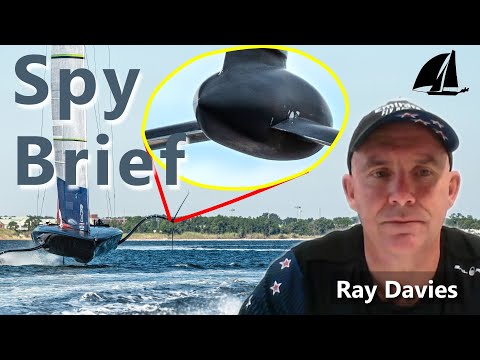
Inside America's Cup Espionage: AC legend and ETNZ spymaster Ray Davies
WatchTHE FOIL // 30:07

The Foil is a new wave of racing media. We are a fresh, all-new, proudly independent digital media brand dedicated to the sport of sail racing. Our focus is centred around the major peaks of the international sport: SailGP, the America’s Cup and the Olympic Games, plus offshore classes and events, and the diverse wider world of sailing competitions that take place around the globe. Become a member now: https://www.youtube.com/@WeAreTheFoil/join