The Battery-Powered Edge: Decoding Team New Zealand's Foil Strategy
Overview of the Auckland Tactical Landscape
Victory in high-stakes competition rarely stems from a single stroke of genius; it is the result of compounding marginal gains. Analysis of 2.5 million leaked data points from the last America's Cup reveals how Emirates Team New Zealand (ETNZ) didn't just out-sail their opponents—they out-engineered the physiological limits of their crew. While Luna Rossa Prada Pirelli showed flashes of brilliance in light air, the data confirms Emirates Team New Zealand maintained a consistent upwind VMG advantage of approximately one knot. This wasn't merely a faster hull; it was a superior integration of mechanical systems and tactical execution.
Key Strategic Decisions: The T-Foil Gambit
The most critical strategic choice was the commitment to the T-foil geometry over the more stable Y-foil designs favored by challengers. A T-foil represents a high-risk, high-reward approach. It offers a deeper immersion point and lower surface area, which mitigates ventilation and allows for extreme cant angles. However, unlike Y-foils, which offer inherent stability through the disassociation of vertical lift and leeway resistance, the T-foil is notoriously unstable. To stay foiling, the center of effort in the sails must perfectly align with the foil's generated forces. Any deviation leads to a catastrophic loss of control.
Performance Breakdown: Mechanical Workarounds
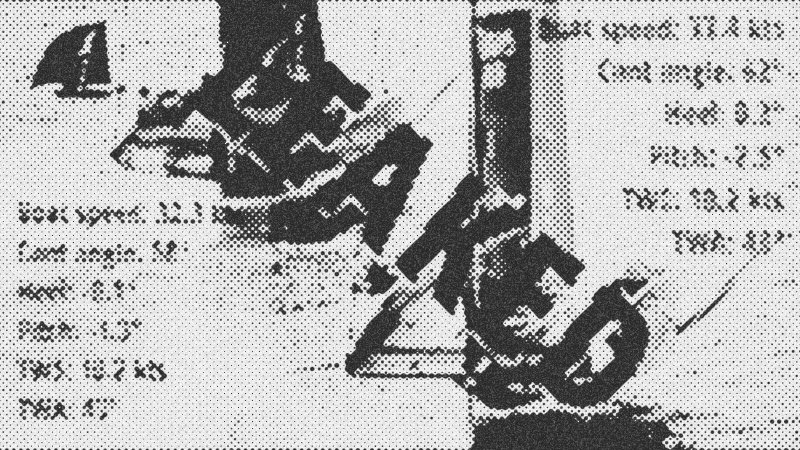
How did Emirates Team New Zealand manage a "twitchy" foil without exhausting their grinders? The data uncovers a controversial exploitation of the One Design foil cant system. While Luna Rossa Prada Pirelli adjusted their cant roughly once per minute, Emirates Team New Zealand triggered adjustments every seven seconds. By using the battery-powered cant system for active gust response rather than just deployment, they offloaded the physical burden of constant sail trimming. This preserved human energy while maintaining a knife-edge balance that challengers could not replicate through muscle alone.
Critical Moments and Future Implications
This tactical shift redefined the role of the foil from a structural component to a primary trim tool. As we look toward future competitions, the emergence of AC40 yachts—which utilize battery power for both sails and foils—suggests a return to aggressive sail trimming. However, for the human-powered AC75 class, the lesson is clear: winning requires finding every possible way to let the machine assist the man. Strategy is not just the path you sail, but how you manage the finite energy of your team.
- Emirates Team New Zealand
- 36%· companies
- Luna Rossa Prada Pirelli
- 18%· companies
- AC40
- 9%· products
- AC75
- 9%· products
- America's Cup
- 9%· tv shows
- Other topics
- 18%
Leaked America's Cup Data Reveals Controversial Team New Zealand Advantage
WatchTHE FOIL // 15:29

The Foil is a new wave of racing media. We are a fresh, all-new, proudly independent digital media brand dedicated to the sport of sail racing. Our focus is centred around the major peaks of the international sport: SailGP, the America’s Cup and the Olympic Games, plus offshore classes and events, and the diverse wider world of sailing competitions that take place around the globe. Become a member now: https://www.youtube.com/@WeAreTheFoil/join