Frictionless Fragility: The AI Doomsday Thesis and the Flight to HALO Assets
The $300 Billion Substack Ripple
Financial markets occasionally succumb to collective hysteria triggered not by hard data or earnings misses, but by narrative shifts that articulate latent anxieties. On February 25, 2026, a Substack post from Citrini Research titled "The 2028 Global Intelligence Crisis" achieved this exact phenomenon. The piece outlined a nightmare scenario where artificial intelligence leads to 10% unemployment and a total collapse of the consumer economy by 2028. The reaction was swift and disproportionate: the Dow dropped 2%, and software stocks plummeted 5%, erasing nearly $300 billion in market value. This event signals a profound fragility in investor sentiment, where creative conjecture now carries the weight of fiscal policy.
The Frictionless Economy Fallacy
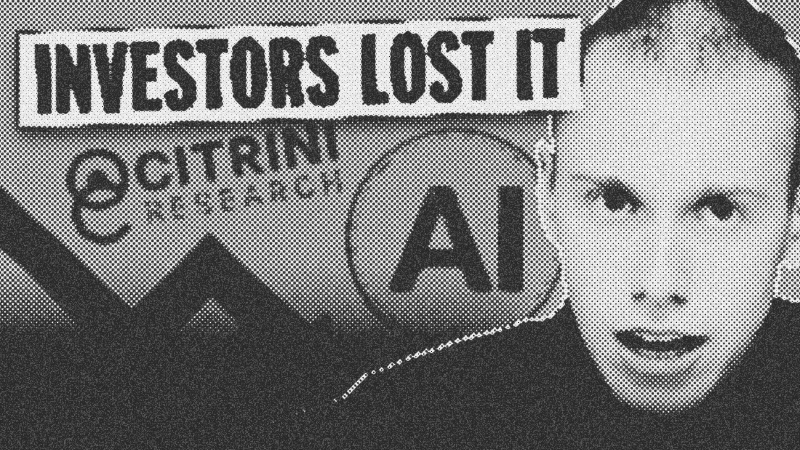
The core of the Citrini thesis rests on the idea that AI will eliminate "friction"—the logistical, legal, and administrative hurdles that currently sustain the software and services sectors. The argument suggests that if agents can handle all payments, legal filings, and scheduling, the companies currently charging for those services will vanish. However, this perspective ignores a fundamental law of economics: work expands to fill the time available. When technology removes one barrier, humans inevitably create new, more complex problems to solve.
Josh Brown, CEO of Ritholtz Wealth Management, notes that while certain jobs—like the elevator operators or knife sharpeners of the past—will disappear, the removal of constraints usually leads to an explosion in volume. A lawyer with an AI agent doesn't stop filing lawsuits; they file ten times more. The friction doesn't disappear; it migrates. The value destruction described in the viral report focuses heavily on the loss of legacy models while remaining silent on the massive value creation that occurs when productivity reaches these new levels.
The Ascent of HALO Stocks
In response to this perceived AI-driven obsolescence, a new investment paradigm has emerged: HALO (Heavy Assets, Low Obsolescence). For the past decade, the market fetishized "asset-light" businesses with recurring subscription revenue. That trend has reversed. Investors are now fleeing toward companies with physical moats that AI cannot replicate.
Physicality as a Moat
You cannot download a Diet Coke or prompt an Airplane into existence. Companies like Anheuser-Busch, Caterpillar, and Delta Air Lines represent the HALO strategy. These entities possess heavy balance sheets—factories, transmission lines, and fleets—that act as a shield against digital disruption. While Expedia might be disrupted by an AI travel agent, the physical plane remains a necessity. This shift marks the end of the growth-versus-value debate, replaced by a binary view of what is and is not disruptible by a large language model.
Private Credit and the Liquidity Gate
As equity markets churned over AI narratives, the private credit sector faced a more concrete crisis. Blue Owl Capital, a titan in the private credit space, was forced to restrict withdrawals after a surge in redemption requests. Private credit has been the "asset du jour" for institutional investors seeking higher yields and low volatility. Because these loans are not marked-to-market daily, they offer the illusion of stability. However, the lack of transparency is now colliding with a liquidity mismatch.
The Retail Contagion
The danger intensified when firms began selling these illiquid institutional products to retail investors and retirees. While an endowment can wait five years for a loan to mature, a retail investor often cannot. Robert Armstrong of the Financial Times warns that the moment a fund "closes the gates" on redemptions, it triggers a bank-run mentality. Even if the underlying loans—many of which are tied to AI infrastructure and data centers—are performing well, the perception of risk can cause a systemic freeze. This echo of 2007 suggests that the next crisis may not be a lack of earnings, but a lack of available exits.
Conclusion: Navigating the Fog
The market is currently characterized by deep apprehension and a lack of conviction. The $300 billion wipeout triggered by a single blog post is a symptom of an investment community that no longer trusts its own valuation models. While AI will undoubtedly restructure the labor market, the total collapse of the consumer economy remains a sci-fi projection rather than a data-driven certainty. Investors must distinguish between structural disruption and temporary sentiment shifts. The flight to HALO assets provides a temporary sanctuary, but the true winners will be those who recognize that while AI removes old frictions, it is already busy creating the new ones that will define the next decade of growth.
- Airplane
- 7%· products
- AMD
- 7%· organizations
- Anheuser-Busch
- 7%· organizations
- Blue Owl Capital
- 7%· organizations
- Caterpillar
- 7%· organizations
- Other topics
- 67%
Why a Doomsday AI Blog Wiped Out $300 Billion | Prof G Markets
WatchThe Prof G Pod – Scott Galloway // 32:35

NYU Professor, best-selling author, business leader and serial entrepreneur Scott Galloway cuts through the biggest stories in tech, business, and investing with unfiltered insights, bold predictions and thoughtful advice. Podcasts include Prof G Markets with co-host Ed Elson, Prof G Conversations and Office Hours with Prof G.