The China Pivot: Trade War Resilience, Medical Tourism, and the AI Frontier
The Death of the Export-Driven Dream
China stands at a precarious crossroads. While it is expected to contribute 26.6% of total global GDP growth this year—outpacing the entire G7 combined—the engine driving this expansion is sputtering. The International Monetary Fund (IMF) recently issued a stark warning: the export-led model that fueled the Chinese miracle has run its course. With growth projected to slow to 4.5%, the International Monetary Fund is urging Beijing to pivot toward domestic consumption. Yet, as global trade tensions simmer, the reality on the ground suggests a more complex dance between state mandate and market necessity.
Nearly a third of China's growth last year stemmed from net exports, bolstered by a Yuan that remains significantly undervalued. This combination has birthed a record trade surplus of $1.2 trillion, a figure that acts as both a shield for the Chinese economy and a lightning rod for Western criticism. Despite the International Monetary Fund's pleas for rebalancing, private firms facing domestic headwinds are doubling down on international markets. The shift from a manufacturing-heavy economy to a consumer-driven one is not merely a policy choice; it is a structural overhaul that Beijing seems hesitant to fully embrace.
The Supreme Court's Tactical Gift
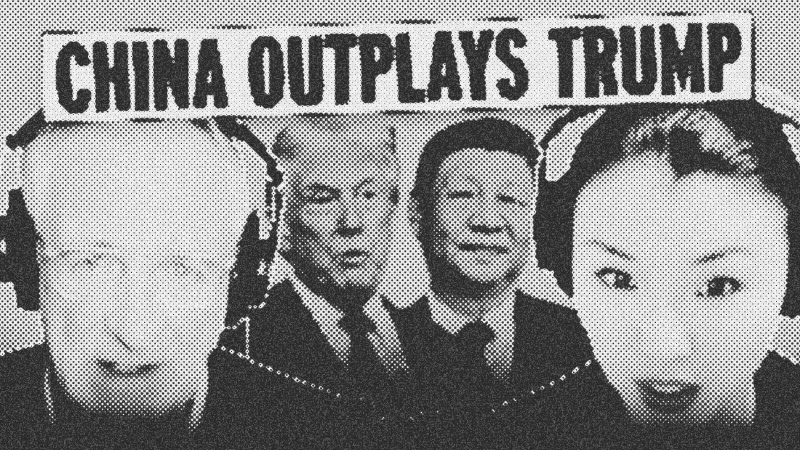
In a surprising twist of legal fate, the US Supreme Court recently reshaped the battlefield of the US-China trade war. By ruling that Donald Trump overstepped his authority in imposing sweeping global tariffs under emergency powers, the court has effectively lowered the tariff wall on Chinese goods by an average of 7 percentage points. For a country that exported over $525 billion to the United States last year, this is a massive windfall.
This ruling does more than just lower costs for American consumers; it fundamentally weakens Donald Trump's negotiating position ahead of his high-stakes April summit with Xi Jinping. If these tariffs were intended as a bargaining chip, that chip has been significantly devalued. Paradoxically, the court's intervention may actually reduce the immediate pressure on China to pivot its model. If the US market becomes easier to penetrate once again, the incentive for Beijing to force its citizens to spend more at home diminishes, potentially extending the shelf life of the export-driven strategy the International Monetary Fund finds so dangerous.
The Real Estate Anchor on Consumption
The primary obstacle to boosting domestic spending remains the cratering property market. In China, real estate isn't just an asset; it is the bedrock of household wealth. Historically, 70% of Chinese household wealth was tied to property. That figure has slipped to 60%, but not because of a healthy diversification into equities. Instead, it reflects a brutal contraction in values. When property prices fall, the "wealth effect" works in reverse. Families feel poorer, they stop borrowing against their homes, and they pull back on spending for education and healthcare.
Transactions are projected to fall another 10% to 14% this year. Consensus suggests the market won't bottom out until 2027 or 2028. Without a recovery in the sector that defines their net worth, Chinese citizens are unlikely to become the global consumers the International Monetary Fund envisions. Beijing’s refusal to provide massive policy support for the real estate sector suggests they are willing to let the bubble deflate, favoring high-tech manufacturing as the new growth engine. This strategy, however, ensures that the transition to a consumption-led economy will be long and painful.
Medical Tourism: A New Service Frontier
While traditional sectors struggle, China is aggressively carving out a niche in the global services market through medical tourism. Under the Healthy China 2030 initiative, the state is transforming regions like Hainan Island into special medical zones. These hubs offer cutting-edge treatments—from stem cell research to advanced implants—at a fraction of Western costs. Last year alone, Chinese hospitals treated 1.3 million foreign patients, a 75% jump that signals a major post-pandemic shift.
The appeal is rooted in a stark contrast to "broken" Western systems. While patients in the United Kingdom face multi-year wait times for routine tests under the NHS, they can fly to Beijing and receive a full battery of diagnostics for under $400 in a single day. This efficiency, combined with cultural exports like zuo yue zi (post-natal confinement care), positions China as a formidable competitor to established hubs like South Korea and Turkey. However, this rise brings internal friction, as Chinese citizens worry that foreigners are leapfrogging the queue in a system already stretched thin.
AI Video and the Hollywood Disruption
The most aggressive front in China’s tech expansion is Generative AI. ByteDance, the parent of TikTok, has unleashed Seedance 2.0, an AI video model that produces hyper-realistic content at a tenth of the cost of its American rivals. While Google's Veo and OpenAI's Sora are formidable, China’s ability to commoditize cinema-quality video generation poses an existential threat to Hollywood.
Major studios like Disney and Netflix are already firing off cease-and-desist letters, accusing ByteDance of treating their intellectual property as "public domain clip art." But Western legal leverage is minimal. China has largely phased out Hollywood films in favor of domestic blockbusters, leaving US studios with little retaliatory power. We are entering a "Wild West" phase where AI-generated content—often unlabeled and deep-faked—is outpacing the legal frameworks designed to control it. The year 2026 is poised to be defined by litigation, but as the technology moves at warp speed, the lawsuits may arrive far too late to save the traditional filmmaking model.
Conclusion: Navigating the Waves
China’s economic strategy is a study in calculated aggression. By ignoring the International Monetary Fund’s calls for a domestic pivot and instead leaning into high-tech manufacturing, medical services, and AI, Beijing is betting that it can outpace global headwinds. The US Supreme Court ruling provided a tactical reprieve, but the structural drag of the property market remains a formidable anchor. As the boundary between physical and digital reality blurs through tools like Seedance 2.0, the global markets must prepare for a China that is no longer just the world’s factory, but its laboratory and its film studio as well.
- International Monetary Fund
- 19%· organizations
- ByteDance
- 6%· companies
- Donald Trump
- 6%· people
- Seedance 2.0
- 6%· products
- US Supreme Court
- 6%· organizations
- Other topics
- 56%
China CAPITALIZES as Trump’s Tariffs BACKFIRE | China Decode
WatchThe Prof G Pod – Scott Galloway // 38:36

NYU Professor, best-selling author, business leader and serial entrepreneur Scott Galloway cuts through the biggest stories in tech, business, and investing with unfiltered insights, bold predictions and thoughtful advice. Podcasts include Prof G Markets with co-host Ed Elson, Prof G Conversations and Office Hours with Prof G.