The High Stakes of Volatility: Wealth, Recovery, and the Psychology of Risk
The Mirage of Fast Capital: Navigating Financial Chaos
True financial resilience rarely stems from a single, explosive event. In my years of advising clients on wealth management, I have witnessed a recurring pattern: the dangerous allure of high-velocity gains often masks a fundamental misunderstanding of risk. We see this vividly in the recent experiences shared by Togi, whose narrative involving a $2.3 million loss and a literal coin flip for a Miami home serves as a stark warning. This isn't just a story about gambling; it is an exploration of how "financial crisis mode" becomes a psychological trap that hinders sustainable growth.
When an individual operates within a constant state of urgency, the quality of their decision-making degrades. Prudence is replaced by aggression. Togi describes a spiral where a $50,000 loss led to a desperate pursuit of a "one big bet hit" to cover production costs for his Japanese game show. From a strategic perspective, this is the antithesis of sound financial strategy. By tying the survival of a business venture to the outcome of a 50/50 bet, one effectively abdicates control over their future to pure chance. Building a resilient financial life requires us to step away from the "all-in" mentality and instead focus on the thoughtful cultivation of assets that perform consistently over time.
The Real Cost of Debt and the Interest Rate Trap
One of the most revealing moments in this dialogue is the realization of the true cost of a mortgage. Togi mentioned a 9% interest rate on a $2 million property, calculating that over 30 years, he would effectively pay many times the home's value. This highlights a critical gap in financial literacy. Many high-income earners focus on the monthly payment without calculating the long-term erosion of their net worth caused by high-interest debt. Even more concerning is the scenario where one continues to pay a mortgage on an asset they no longer own due to a gambling loss.
Prudent management suggests that we must view every liability as a drag on future opportunity. Graham Stephan and Jack Selby correctly identified the "refinancing crisis" here. When you are a high-risk individual, traditional lenders retreat. This creates a secondary tax on your wealth: the inability to access favorable rates. For those in a position of high earnings but low liquidity, like Togi, the priority must be cleaning up the balance sheet. Selling underperforming or lost assets to stop the bleed of 9% interest is a foundational move in reclaiming financial health. We must ensure that our "burn rate" does not outpace our ability to replace capital, especially when that capital is being funneled into interest payments for assets that no longer serve us.
Diversification and the Myth of the Single Income Stream
Sustainable wealth is built on a foundation of diverse, optimized businesses. Togi outlines an impressive array of income sources: a supplement company called Evoir, a Snapchat revenue stream, sponsorships with YoungLA, and casino partnerships. On the surface, this looks like diversification. However, a deeper analysis reveals that many of these streams are highly correlated with a single factor: personal attention and "clout."
From a wealth management perspective, the goal is to shift from active, personality-driven income to passive, system-driven equity. Togi aspires to make $30 million a year through "manifesting" and business optimization. While ambition is a prerequisite for success, it must be paired with operational excellence. Using tools like Gusto for payroll or Shopify for e-commerce, as mentioned by Graham Stephan, represents the transition from a "one-man show" to a scalable enterprise. The risk of the "influencer economy" is that the income can be as volatile as a coin flip. By institutionalizing his brands, Togi can move from being a slave to the algorithm to being a true business owner. The focus should be on 200% margins and neuro-protective supplements like those in Evoir, but only if the back-end infrastructure—taxes, compliance, and long-term planning—is as robust as the marketing.
The Psychology of Recovery: From Addiction to Discernment
Financial health is inextricably linked to mental and physical well-being. The transition from hard drug use and steroid cycles to a focus on health optimization is a journey of reclaiming one's dopamine system. Togi discusses using high-stakes gambling as a "stepping stool" to move away from drugs, a controversial method that speaks to the extreme difficulty of addiction recovery. While I advocate for more traditional forms of risk management, it is clear that for many, the path to sobriety requires a replacement of the high-intensity stimulus they once found in substances.
Finding a spiritual anchor, such as Togi's relationship with Jesus Christ after meeting Bryce Crawford, can provide the internal fulfillment that money and "clout" cannot. In my experience, clients who have a clear sense of purpose beyond accumulation are far more likely to stay the course during market volatility. They don't react out of fear because their identity isn't tied to their bank balance. Togi's concept of "praying for discernment" is a powerful metaphor for any investor. It is the act of stepping back, seeking clarity, and waiting for the right move rather than acting on impulse. Whether you are recovering from a $2 million loss or building your first $100,000, the ability to sit quietly and wait for a sound idea is the ultimate competitive advantage.
The Authentic Self: Building a Unique Economic Lane
Modern men often suffer from a lack of originality, frequently adopting the personas of figures like Andrew Tate rather than cultivating their own unique value. Togi argues that success comes from leaning into what makes you "weird" or "autistic" in the eyes of the world. From an economic standpoint, this is the strategy of the "Blue Ocean." By creating a category of one, you eliminate competition. Clavicular, TJR, and Alex Honnold are cited as examples of individuals who became successful by obsessing over niche, often judged, interests.
When you are authentically yourself, your brand becomes a moat. No one can "mog" you—a term for physical or social dominance—if you are playing a different game entirely. My advice to anyone looking to build a resilient future is to identify the intersection of your unique skills and market demand. Don't apologize for your quirks; optimize them. As Togi suggests, the bill for regret is far more expensive than the price of trying. If you can withstand the initial judgment of the crowd, you can build a life that is not only financially lucrative but deeply fulfilling. The goal is to reach the end of one's journey without an ounce of regret, knowing that every risk taken was in the pursuit of a life that was truly your own.
- Togi
- 39%· people
- Evoir
- 6%· companies
- Graham Stephan
- 6%· people
- Alex Honnold
- 3%· people
- Andrew Tate
- 3%· people
- Other topics
- 42%
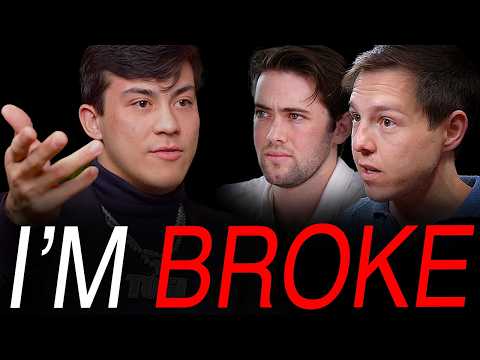
“I’m Officially Homeless!” Togi Breaks Silence On Going Broke, Losing Everything, & Starting Over
WatchThe Iced Coffee Hour // 1:54:14

All of the Iced Coffee Hour episodes posted here for your enjoyment! Podcast hosted by Graham Stephan and Jack Selby. Jack Selby: https://www.instagram.com/jlsselby/ Graham Stephan: https://www.instagram.com/gpstephan/