The Paper Trails of Cinema: Unearthing Production Ephemera
The Living Record of Unmade Dreams
Cinema history exists not only on celluloid but in the dense, overflowing binders of the production office. These artifacts, often categorized as Ephemera, represent the tactile remains of a film's gestation. Nowhere is this more poignant than in the three massive production binders for Superman Lives, the storied mid-90s project that would have united director Tim Burton and Nicolas Cage. Unlike a finished film, which presents a polished, singular vision, these binders offer a chaotic, real-time window into the "movie that never was."
Anatomy of a Production Binder
A production binder serves as the central nervous system for a film's development. In the case of Superman Lives, these volumes house everything from John Peters' merchandising strategies to the granular details of VFX planning. They contain the "wheeling and dealing" of the industry—memos regarding the hiring of costume designer Colleen Atwood and script notes from various writers like Kevin Smith and Wesley Strick. These documents reveal the functional friction of the studio system: the tug-of-war over directors' choices versus studio mandates. They prove that filmmaking is less a straight line and more an evolving negotiation of budget, personality, and technical capability.
Storyboards as Visual Flow
One of the most revealing segments of the Superman Lives archive involves the storyboards. It is a common misconception that storyboards are final design orders. Rather, as seen in the work of legends like Joe Johnston, they serve as blueprints for visual flow and shot composition. In these binders, we see Superman battling a shadowy Doomsday—a figure whose design was yet to be finalized. The focus here was rhythm and pacing, providing an assistant or producer the ability to "see" the movie before a single frame of film was exposed.
The Candid Lens of the Artisan
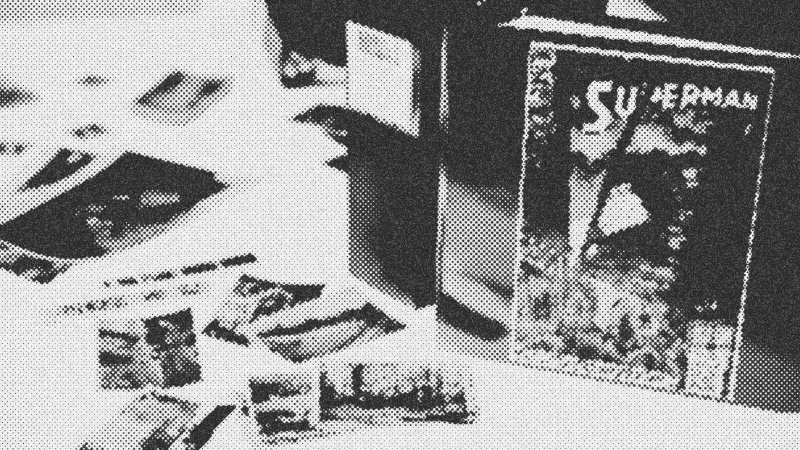
While official studio photography captures the myth, candid personal photography captures the craft. Veteran artisan Stuart Ziff, who worked on the Creature Shop teams for both Star Wars: Episode VI - Return of the Jedi and Ghostbusters, curated a collection that humanizes these titans of pop culture. His 35mm negatives and Polaroid show the "Onion Head" (Slimer) puppet in development and the Ewok actors lined up on location. These images strip away the cinematic magic to reveal real people—like Phil Tippett and Stuart Freeborn—having a beer and a cigarette while surrounded by alien prosthetics. This is the authentic heritage of the industry: the grit and labor that occur behind the camera.
Preserving the Material Culture of Film
Preserving these artifacts is essential for understanding the material science of filmmaking. When we look at a Polaroid of a clay concept for a Terror Dog, we aren't just looking at a photo; we are observing the iterative process of artisanal skill. These pieces of ephemera are the primary sources of film history. They remind us that for every masterpiece on screen, there is a mountain of paper, a shoebox of negatives, and a legion of dedicated craftspeople whose stories are written in the margins of production binders.
- Superman Lives
- 11%· movies
- Polaroid
- 7%· products
- Batman
- 4%· movies
- Colleen Atwood
- 4%· people
- Creature Shop
- 4%· concepts
- Other topics
- 70%
The Secret History of Tim Burton's "Superman Lives"
WatchAdam Savage’s Tested // 16:55

Adam Savage’s Tested is a content platform and community playground for makers and curious minds. On Tested.com, the highly- engaged Tested YouTube channel, and at conventions and events, dynamic makers share ideas and inspire each other to build their obsessions. Led by Adam Savage, the Tested team explores the intersection of science, popular culture, and emerging technology, showing how we are all makers. Adam also takes viewers behind the scenes of films, TV shows, theater, and museums, shining a spotlight on the craftspeople and artists who make the magic we all enjoy. Tested is also: Norman Chan, Joey Fameli, Josh Self, Kristen Lomasney and Thomas Crenshaw.