Adam Savage cuts Emeco Navy chair weight by 40 percent
The Aluminum Purge
Adam Savage recently put his multi-year obsessive project to the ultimate test: a side-by-side comparison with a factory-fresh Emeco 1006 Navy Chair. After drilling over a thousand holes into the iconic aluminum frame, Savage finally quantified the impact of his labor. The modification isn't just a visual stunt; it's a fundamental restructuring of one of the most durable pieces of furniture in design history. By stripping away material, Savage has transformed a "monolithic" object into something reactive and springy.
Weighing the Modification
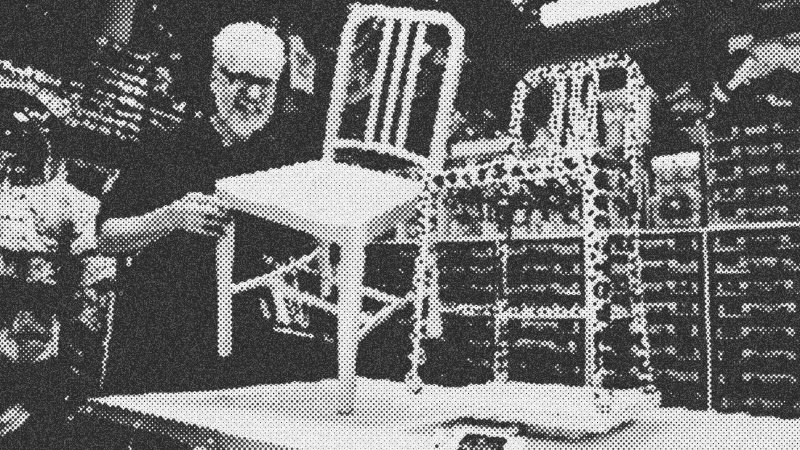
The most striking revelation comes from the scale. A standard Emeco 1006 Navy Chair weighs in at 6 pounds, 8.8 ounces. Savage’s "holy chair"—perforated until it resembles more air than metal—dropped the weight to 3 pounds, 12 ounces. While he hasn't quite reached the half-weight mark, removing nearly 3 pounds of aircraft-grade aluminum represents a massive structural shift. Interestingly, the modified chair is now roughly equivalent to the weight of the cardboard shipping box used by Emeco.
Structural Integrity vs. Elasticity
Building hardware is often a trade-off between rigidity and weight. The original Emeco 1006 Navy Chair is famous for its "77 steps" of construction, resulting in a frame that feels completely static under load. Savage’s version, however, introduces "liveliness." During a sit-down test, the modified chair exhibited visible flex and stretching. This elasticity is a direct artifact of the hole-drilling process, which breaks the continuous tension of the aluminum surface, allowing the metal to respond dynamically to the user's weight.
The Final Verdict
While onlookers are often hesitant to trust the skeletal frame, the chair remains remarkably strong. It manages to balance on the edge of structural failure without crossing it. For any DIY enthusiast, this project serves as a masterclass in the "thousand yard stare" of long-term builds: a relentless pursuit of optimization that changes the very nature of the material you’re working with. Savage has succeeded in making a legendary design literally "physically hilarious" to handle.
- Emeco 1006 Navy Chair
- 60%· products
- Adam Savage
- 20%· people
- Emeco
- 20%· companies
How Sturdy is Adam's Modified Emeco Navy Chair?
WatchAdam Savage’s Tested // 8:25

Adam Savage’s Tested is a content platform and community playground for makers and curious minds. On Tested.com, the highly- engaged Tested YouTube channel, and at conventions and events, dynamic makers share ideas and inspire each other to build their obsessions. Led by Adam Savage, the Tested team explores the intersection of science, popular culture, and emerging technology, showing how we are all makers. Adam also takes viewers behind the scenes of films, TV shows, theater, and museums, shining a spotlight on the craftspeople and artists who make the magic we all enjoy. Tested is also: Norman Chan, Joey Fameli, Josh Self, Kristen Lomasney and Thomas Crenshaw.