Forging the Future of the Past: The Engineering Behind the Pip-Boy 3000 Mk IV
The Alchemy of Prop Replicas
Cinema and gaming often rely on the suspension of disbelief, but for the artisans at The Wand Company, the goal is to make that disbelief entirely unnecessary. When Chris Barnardo walked into the workshop to showcase the upcoming Pip-Boy 3000, it wasn't just a toy he was holding; it was a masterclass in industrial design, materials science, and software engineering. Moving backward through the Fallout timeline—from the experimental Fallout 76 kits to the bespoke TV show props—the team has finally arrived at the iconic device from Fallout 3. This isn't a mere hollow shell. It is a dense, interactive computer that bridges the gap between digital asset and physical reality.
Every decision in the manufacturing of such a device is a battle between aesthetic fidelity and mass-production reality. It requires a deep dive into "cassette futurism," a design language that celebrates the bulky, tactile world of 1980s electronics. For The Wand Company, this means rejecting the thin, touch-sensitive trends of modern gadgets in favor of depressible buttons, heavy metal castings, and the distinct, high-pitched whine of a simulated CRT monitor.
Digital Souls and CRT Nostalgia
The software architecture of the new Pip-Boy 3000 represents a massive leap in complexity. Previous iterations often relied on pre-baked animations or simple image cycling. This unit, however, utilizes a more dynamic engine that allows for deep user interaction. You aren't just looking at a screen; you are navigating over 2,200 entries of perks, skills, and inventory items. The team worked directly with Bethesda to pull original game assets and recode them for this specific hardware.
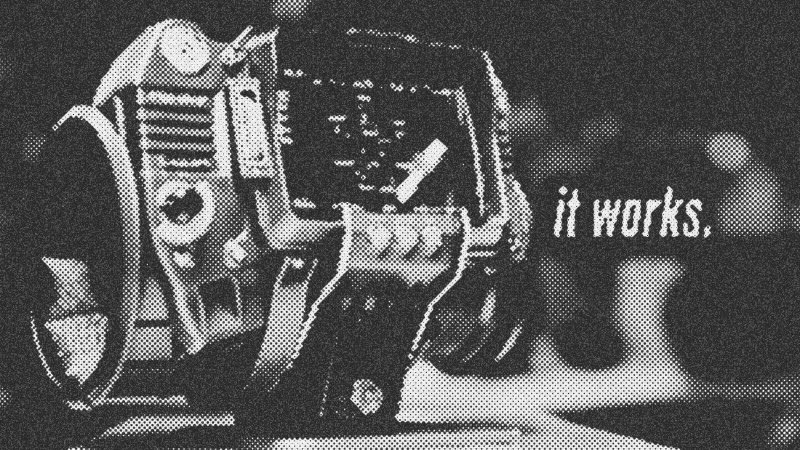
One of the most impressive feats is the simulation of ancient display technology. Since real cathode-ray tubes (CRTs) are impractical for a wearable device, the team uses a 4:3 LCD panel. To capture the "soul" of a 1950s vacuum-tube computer, they programmed subtle jitter, vertical hold glitches, and even a warm-up glow for the status lights. An onboard accelerometer adds another layer of immersion: a sharp tap on the casing can trigger a vertical sync error that requires another "percussive maintenance" whack to fix. This is the magic of prop making—programming flaws into the system to make it feel more authentic.
From CAD to Die-Cast Metal
The physical journey of a Pip-Boy begins in the digital realm of high-poly 3D models. Chris Barnardo explains that the team analyzes the virtual dimensions by measuring character models in-game, from fingertip to elbow, to ensure the scale feels correct in the real world. However, a 3D model is just a ghost until it meets the harsh requirements of a factory mold.
The front plate of this replica is a heavy die-cast metal part, a choice that gives the prop its necessary heft and durability. Creating this requires complex tooling involving "sliders"—parts of the mold that move out of the way to allow for overhangs and intricate details. When the parts emerge from the tool, they are covered in "flash"—excess metal from the high-pressure injection—which must be machined away by CNC robots. The result is a part that feels like it was forged in the RobCo Industries factories of the Fallout universe.
Materials Science and Interaction Design
Transparency is often the hardest thing to get right in manufacturing. For the screen lens, The Wand Company opted for Tritan, a high-grade polyester usually reserved for laboratory equipment and premium glassware. It offers superior optical clarity compared to standard polycarbonate, ensuring the "CRT" effect isn't muddied by plastic distortions.
Beyond the screen, the team employed "compliant mechanisms" for the button arrays. By using a single piece of molded plastic that acts as its own spring, they reduced the part count while increasing reliability. This integrated design also serves a functional purpose in the assembly line: the button array acts as a bracket that secures the LCD panel in place. If the buttons aren't there, the screen won't stay in, creating a "Poka-Yoke" (error-proofing) system that ensures no unit leaves the factory incomplete.
The Evolution of the Prototype
The article wouldn't be complete without looking at the "Works-Like, Looks-Like" samples. These intermediate steps are the most expensive part of development, often costing tens of thousands of dollars for a single unit. These prototypes allow the team to test the tactile "click" of a rotary dial or the strength of a spring-loaded hinge.
For the software developers, the team created a standalone "dev kit"—a bulky, 3D-printed enclosure that allowed programmers to work on the UI for six months before the final metal shells even existed. This parallel development is how the team managed to pack in advanced features like an FM radio that doubles as a simulated radiation sensor. By measuring the signal strength of actual radio waves, the Pip-Boy can provide a real-time radiation graph that reacts to the user's environment, blurring the line between a fictional game mechanic and a real-world scientific instrument.
Implications for the Collector Community
This level of detail signals a shift in the prop market. Collectors no longer want static statues; they want functional artifacts. By including features like a 32GB SD card slot for user customization and a machined aluminum display stand that doubles as a charging station, The Wand Company is treating the Pip-Boy 3000 as a piece of consumer electronics rather than a toy.
With a target release of June and a price point around $300, it represents a significant investment for fans. However, for those who grew up in the wastes of the Capital Wasteland, the ability to strap a piece of that history to their arm—complete with its jitters, whines, and radioactive clicks—is the ultimate realization of the filmmaking craft. It is meticulous, it is difficult, and it is a testament to the power of physical storytelling.
- The Wand Company
- 21%· companies
- Pip-Boy 3000
- 16%· products
- Chris Barnardo
- 11%· people
- Fallout
- 11%· products
- Bethesda
- 5%· companies
- Other topics
- 37%
Hands-On with The Fallout 3 Pip-Boy 3000 Working Replica!
WatchAdam Savage’s Tested // 38:57

Adam Savage’s Tested is a content platform and community playground for makers and curious minds. On Tested.com, the highly- engaged Tested YouTube channel, and at conventions and events, dynamic makers share ideas and inspire each other to build their obsessions. Led by Adam Savage, the Tested team explores the intersection of science, popular culture, and emerging technology, showing how we are all makers. Adam also takes viewers behind the scenes of films, TV shows, theater, and museums, shining a spotlight on the craftspeople and artists who make the magic we all enjoy. Tested is also: Norman Chan, Joey Fameli, Josh Self, Kristen Lomasney and Thomas Crenshaw.