Mechanical Soul: Engineering Emotion in Star Wars Droid Puppetry
The Shift from PLA to ABS Resilience
In the world of 3D printing, the choice of filament often dictates the longevity of a project. Builder Darren Moser highlights a critical lesson learned through environmental failure: the "melty" disaster of PLA in a hot car. While PLA serves well for rapid prototyping and indoor displays, its low glass transition temperature makes it a liability for droids destined for the convention circuit. Transitioning to ABS (Acrylonitrile Butadiene Styrene) provides the thermal resistance necessary for high-heat environments, though it demands more rigorous print settings and enclosure management. This shift underscores a pragmatic reality in custom hardware: the environment where the machine lives is as important as the code that runs it.
Pure Linkages vs. Servo Control
One of the most compelling aspects of the BD-1 build is the commitment to mechanical linkages over electronic servos. By relying on physical connections and hand-operated paddles, the builder achieves a level of organic fluidity that traditional programming often lacks. Servos, while precise, can feel clinical or jittery without advanced easing algorithms. Direct linkages allow the puppeteer to translate subtle human micro-movements into the droid’s posture, specifically through the ears. In droid design, ears serve as the primary emotional barometer. A slow droop or a sharp twitch conveys internal state more effectively than a complex light sequence ever could.
Modular Evolution and Internal Race Tracks
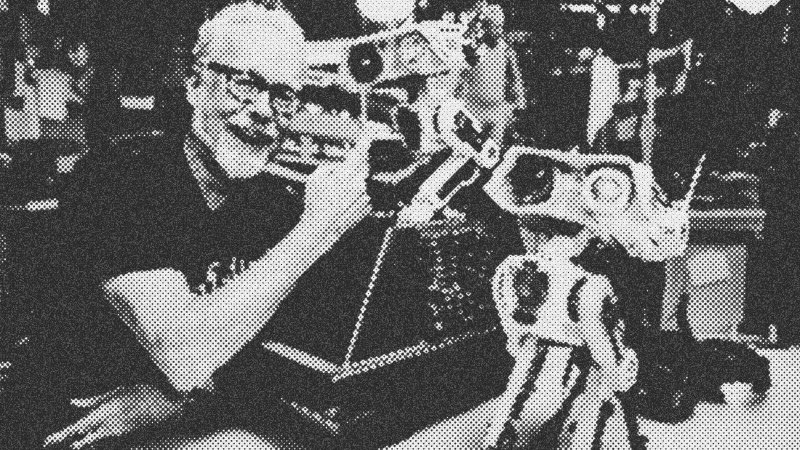
Iteration defines the success of complex assemblies. Moser utilized a modular approach, allowing specific components like the "puppet paddle" or internal gimbals to be prototyped, tested, and bolted in or out. A major upgrade in the 2.0 iteration involved the head rotation mechanism. Initially burdened by a heavy 3-inch metal lazy Susan bearing, the newer model uses a custom 3D printed raceway. This reduces weight significantly, improving the responsiveness of the head tilt. Weight management is the silent killer of puppetry; every gram removed from the end of a lever arm reduces the strain on the operator, which is essential for long-duration engagement at events like Comic-Con.
The BD-6: Integrating Complex Animatronics
Moving to the BD-6 model, the design philosophy shifts toward high-density electronics and automated movement. This droid sits atop a Mouse Droid chassis, featuring a 2020 aluminum extrusion skeleton for structural integrity. Unlike the purely manual BD-1, the BD-6 utilizes eleven internal servos controlled via Arduino and a FrSky radio transmitter. This setup introduces "secondary animation"—where the physical swaying of the base causes the droid’s legs and body to react naturally with gravity, mimicking the momentum of a living creature. This layering of active servo control over passive mechanical reactions creates a convincing illusion of life.
Community Documentation and Future Horizons
Building in a vacuum is a recipe for stagnation. The Droid Builders community serves as a vital resource for solving niche engineering hurdles, such as identifying vintage circuit boards or perfecting the gait of a bipod. Documentation through photography plays a dual role here. It allows builders to share progress on the Replica Prop Forum and serves as a diagnostic tool. By reviewing build logs, makers can catch errors—like reversed pistons—that the naked eye misses during the heat of assembly. As we look forward to future projects like a floating "Bit" from Tron, the intersection of open-source hardware and traditional puppetry continues to push the boundaries of what home-built machines can achieve.
- ABS
- 6%· products
- Adam Savage
- 6%· people
- Arduino
- 6%· companies
- BD-1
- 6%· products
- BD-6
- 6%· products
- Other topics
- 71%
Adam Savage Meets Star Wars Droid Puppets!
WatchAdam Savage’s Tested // 21:53

Adam Savage’s Tested is a content platform and community playground for makers and curious minds. On Tested.com, the highly- engaged Tested YouTube channel, and at conventions and events, dynamic makers share ideas and inspire each other to build their obsessions. Led by Adam Savage, the Tested team explores the intersection of science, popular culture, and emerging technology, showing how we are all makers. Adam also takes viewers behind the scenes of films, TV shows, theater, and museums, shining a spotlight on the craftspeople and artists who make the magic we all enjoy. Tested is also: Norman Chan, Joey Fameli, Josh Self, Kristen Lomasney and Thomas Crenshaw.