Nicholas: why raising cash on zero revenue almost killed my startup
In late 2017, Deon Nicholas had a world-class artificial intelligence engine but no real business. Armed with a computer science background and early career stints at tech giants like Meta and Dropbox, Nicholas had been tinkering with natural language processing models. He knew a massive wave of technological innovation was coming. He could feel it in his bones. But as any seasoned investor will tell you, a great technology without a desperate customer is just an expensive hobby. Nicholas found himself staring down the classic founder chasm: he was highly solution-oriented, yet entirely market-blind.
He needed a bridge from theory to reality. So, he embarked on a frantic listening tour, using the ultimate growth hack for rejected founders. Every time a venture capitalist told him "no" during early fundraising attempts, Nicholas did not just walk away. He demanded an introduction to an operator in their portfolio. This built a raw, unfiltered network of customer officers, engineering leaders, and support heads. The goal was to poke at deep corporate pain. He realized that the technology itself was merely an unlock. The real battle was identifying who would actually pay to have their hair put out.
The Oprah demo and the cold start problem
To find his ideal customer, Nicholas and his team built highly targeted, modular demos. For human resources departments, they pitched an internal employee benefit tutor. For sales leaders, they pitched a revenue-enabling assistant. But the real breakthrough happened when they spoke to heads of customer support. The reaction was visceral. Support leaders did not just politely nod; they demanded to know if the technology was real. They wanted to fire their external contractors and hand that budget directly to Nicholas. This was the unmistakable pull of product-market fit.
But proving the technology worked on arbitrary data required a touch of theater. Nicholas created what he called the "Oprah demo." The team trained their natural language model specifically on Oprah Winfrey's Wikipedia page. During meetings, they would let prospective clients pick any random topic, load the page, and watch the AI answer highly specific questions in real-time. It was magic. It gave Forethought AI the credibility to sign their first enterprise contracts. They immediately began integrating a bare-bones, text-only AI agent named Agatha directly into customer workflows.
Why you must fail seven times to win
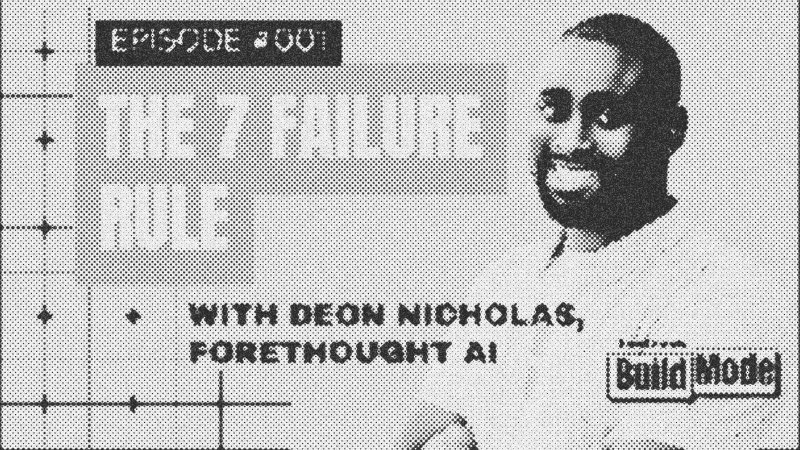
Most founders believe that if they build a beautiful product, users will magically appear. Nicholas calls this a dangerous delusion. He operates under two fundamental product rules. First, the moment you launch a new product, absolutely nobody will use it. Second, any viable product is within exactly seven iterations of finding market success. This "7-Failure Rule" is designed to strip away founder ego and eliminate anxiety. It forces teams to build for the single player before attempting to design a complex social ecosystem.
+-------------------------------------------------------------+
|                      THE 7-FAILURE RULE                     |
+-------------------------------------------------------------+
|  Iteration 1-3: Internal testing & "Oprah Demo" validation  |
|  Iteration 4-5: Paid pilot rollouts with MVP text integrations|
|  Iteration 6-7: Workflow-embedded UI and scalable deployment |
+-------------------------------------------------------------+
By treating early launches as inevitable failures, developers can focus on rapid, cheap experimentation. The objective is to do the absolute bare minimum amount of engineering work required to validate a core thesis. For Forethought AI, this meant shunning complex user interfaces. Instead, they delivered plain-text suggestions to customer service representatives via a private comment block in Zendesk. They simply measured how much of the text the representative copied and edited. If the representative used the text, the value was proven. If they did not, the team iterated.
Winning the TechCrunch Disrupt Battlefield
By mid-2018, Forethought AI had captured lightning in a bottle. They applied for the Build Mode and won a spot on the stage at San Francisco. While most founders treat the battlefield stage as a public relations crowning moment, Nicholas treated it as a brutal operational forcing function. He set a clear, non-negotiable target for his team. By the time he walked onto that stage, the slide deck had to feature at least five logos of active, paying enterprise pilots.
He wanted to prove traction, not just promise a vision. The team obsessed over user workflows, sitting alongside support agents to watch where Agatha broke down. On launch day in September 2018, Nicholas walked onto the stage with six enterprise logos. They did not just present a pitch; they proved a business model. Forethought AI walked away with the Startup Battlefield championship cup, generating a wave of industry hype that they immediately weaponized.
The dangerous high of the post-battlefield hype
With a fresh trophy in hand, Nicholas strategically engineered investor FOMO. He lined up venture meetings to hit immediately after the Disrupt announcement, sparking a bidding frenzy. Within three weeks, Forethought AI closed a nine-million-dollar Series A round. On paper, it was a massive triumph. In reality, it placed the young company in a highly precarious position. They had raised millions in venture capital with virtually zero recurring revenue.
Nicholas warns modern founders against chasing this specific brand of high-valuation rockstardom. It forces a company to aggressively sprint just to grow into its artificial valuation. While the gamble paid off for Forethought AI, the journey of catching up to those Series A metrics was grueling. They had to rebuild their engine as the underlying tech shifted beneath them, eventually raising a Series B and later expanding their executive suite as Nicholas stepped into the chairman role. True company value, Nicholas insists, is measured in customer love and enduring utility, not the size of a seed check.
- Build Mode
- 10%· podcasts
- Deon Nicholas
- 10%· people
- Dropbox
- 10%· companies
- Forethought AI
- 10%· companies
- Meta
- 10%· companies
- Other topics
- 50%
The 7-Failure Rule for Product-Market-Fit with Forethough AI Co-Founder Deon Nicholas l Build Mode
WatchTechCrunch // 45:21

TechCrunch is a leading technology media property, dedicated to obsessively profiling startups, reviewing new Internet products, and breaking tech news.