Schmidt warns startup founders that relational debt kills companies faster than tech debt
The Hidden Startup Killer Sitting in the C-Suite
Founders obsess over product-market fit, capital allocation, and code deployment. They spend sleepless nights worrying about their burn rate and whether their engineering team can ship the next release without crashing the database. Yet, the most lethal threat to an early-stage company rarely lives in the technology stack or the go-to-market strategy. It lives in the messy, unmapped space between the people who started the company.
Co-founder friction is the silent killer of hyper-growth startups. When partners fail to align, they do not just delay product releases; they build up what Ian Schmidt, strategic advisor at Trimergence, calls "relational debt." Just like technical debt, relational debt compounds quietly in the background. Every unaddressed disagreement, every vague division of labor, and every buried resentment adds to a liability that eventually comes due. If left unchecked, this liability does not just slow down operations. It tears the company apart from the inside, often resulting in explosive public failures, executive departures, and dead equity tables.
To build an exponential business, you must first scale the human beings running it. You cannot expect a clean, high-throughput organization to grow on top of a clogged, dysfunctional co-founder relationship.
Unpacking the Personal Operating System
Before you can fix a relationship, you have to understand the individuals inside it. Most executives treat business coaching as a reactive tool, a form of corporate therapy to turn to only when the house is already on fire. A systematic approach requires starting much earlier by mapping what Ian Schmidt calls the individual "personal operating system."
Your personal operating system is the hardwired set of behavioral patterns, defensive mechanisms, and emotional triggers that dictate how you lead, communicate, and react under extreme stress. It is the core kernel of who you are. This system operates automatically, often entirely out of your conscious awareness. Under the intense, high-pressure cooker of a startup, your gifts—such as an relentless drive for perfection or a hyper-focus on rapid execution—can easily mutate into massive liabilities, causing you to micromanage, lash out, or shut down.
Mapping this internal architecture requires rigorous, honest self-inquiry. Founders must identify not just their surface-level business skills, but how they actually show up in the room when things go sideways. What happens when you are triggered? Do you become hyper-critical? Do you retreat into silence? Once both founders have mapped their individual operating systems and identified their blind spots, they possess the baseline data necessary to sync their relationship and build a clean interface.
The Relational Synchronization Blueprint
Once founders have done the hard individual work, they must bring their personal operating systems together to establish explicit, written rules of engagement. This process, known as relationship synchronizing, acts as a custom noise reduction algorithm for the executive team.
Instead of relying on vague assumptions or unstated expectations, founders need to sit down in a structured, scaffolded environment and draft a physical, one-page agreement. This document is not a legal contract; it is a relational touchstone. It outlines exactly what each founder needs from the other to operate at their highest potential, how they will explicitly navigate moments when they trigger each other, and what tools they will reach for when conflict inevitably arises.
This blueprint must also establish crystal-clear boundaries around domain authority. Wobbly trust is the root cause of micromanagement. When you do not deeply understand your partner's operating system, you begin to project your own fears onto their decisions, stepping into their lane and second-guessing their strategy. Relationship synchronizing forces both partners to explicitly define who captains which domain and how they will handle disagreements in those overlapping territories. This keeps the internal communication loop clean, efficient, and free of toxic projection.
Why Clean Repair Safeguards Your Culture
Conflict itself is not the enemy. In fact, a total lack of conflict is a massive red flag. It usually points to artificial harmony, a dangerous state where founders suppress their real opinions to avoid discomfort, paving the way for groupthink and eventual explosion. Healthy, rigorous conflict is critical for stress-testing ideas and finding the best path forward. The real danger lies in failing to repair the relationship after a collision occurs.
When a leader loses their cool, makes a rash decision, or reacts defensively in front of the team, the damage is immediate. Employees are highly sensitive to executive dynamics; they watch how their leaders move, not the values painted on the office walls. If a founder leaves a toxic interaction unrepaired, they signal to the entire company that defensive, low-trust behavior is acceptable.
Effective repair is an active, strategic process. It starts with an internal 360-degree assessment: pausing to recognize the slip, identifying the behavioral pattern behind it, and taking immediate ownership. Approaching your co-founder or team to explicitly acknowledge a bad reaction and ask how it impacted them builds immense trust. It transforms a moment of failure into a powerful demonstration of emotional intelligence, reinforcing a company culture built on accountability and psychological safety.
Scale Yourself to Scale the Venture
Many founders claim they simply do not have the time to dedicate to self-awareness, relational frameworks, or morning routines. They view executive coaching as a luxury or a distraction from the real work of building a company. But this is a massive cognitive error. You cannot afford not to do this work. The time you save by avoiding toxic stalemates, messy leadership transitions, and prolonged team drama outweighs the hours spent on personal development by a factor of one hundred.
To build an exponentially growing organization, you must be on an exponential growth curve yourself. This means actively decoupling your identity from the day-to-day outcomes of your startup. When your entire sense of self is fused to the valuation or success of your venture, every business setback feels like a mortal threat. This state of constant fear limits your cognitive capacity, making you defensive, short-sighted, and volatile.
By treating your personal growth as a strategic priority, you unlock the resilience needed to lead through chaotic times. Implement a daily routine that gets you out of your head and into your body. Establish a robust support network of peer founders who understand the unique pressure of the founder journey. Most importantly, bring gratitude and appreciation into your boardroom. Seeing and hearing your people is not just good karma; it is highly effective leadership. When you upgrade your personal and relational operating systems, you create a scalable platform that will sustain your business from its early days all the way to its ultimate exit.
- Ian Schmidt
- 40%· people
- Isabelle Johannes
- 20%· people
- TechCrunch
- 20%· companies
- Trimergence
- 20%· companies
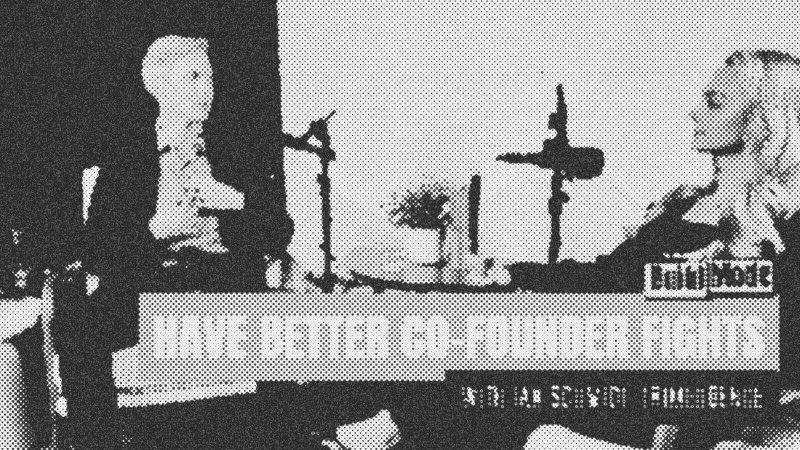
How to fight with your co-founder l Build Mode
WatchTechCrunch // 47:06

TechCrunch is a leading technology media property, dedicated to obsessively profiling startups, reviewing new Internet products, and breaking tech news.