Beyond the Desk: Engineering the Most Absurd Pencil Sharpeners Ever Built
The Mach 3 Water Jet Upgrade
There is a specific kind of magic that happens when a high-end industrial tool enters a home workshop. The arrival of the Flow Mach 200 water jet isn't just about adding a new machine; it is about fundamentally shifting the speed of iteration. This beast uses supersonic water mixed with abrasive grit to slice through four-inch thick brick or hardened steel as if they were balsa wood. Because the water jet is a five-axis machine, it can cut complex angles, making it the world’s most over-engineered pencil sharpener. By mounting a pencil vertically and tilting the nozzle, you can achieve a precise conical grind using nothing but water traveling at Mach 3. It is the ultimate testament to overkill—using 17,000 pounds of raw steel and high-pressure hydraulics to prep a writing utensil.
The Dual-Motor Razor Blade Nightmare
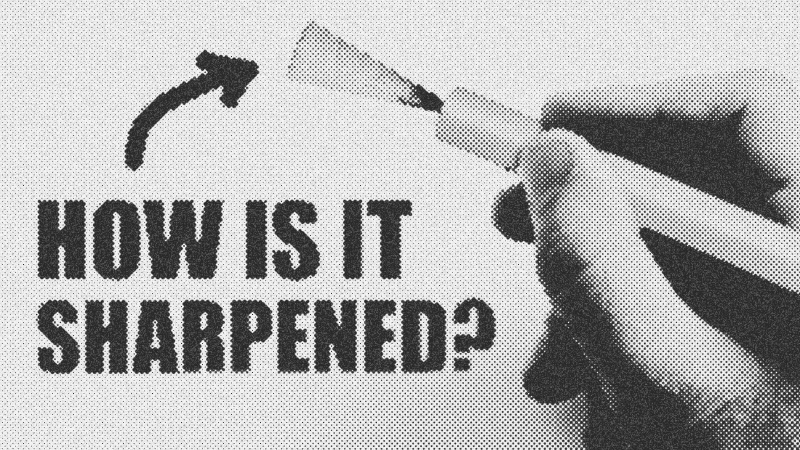
Most of us have used a pocket knife to shave down a pencil in a pinch, but automating that process introduces a host of mechanical headaches. The "Hole of Death" sharpener attempts to replicate the slicing motion of a razor blade by spinning it at high RPMs. The engineering challenge here is power delivery: if you run wires to a spinning motor, they will twist and snap instantly. The solution is a slip coupling, which allows electrical contact while the motor housing rotates freely. This build is a perfect example of how the simplest manual tasks become complex engineering puzzles once you try to remove the human element. While it produces a bold, sharp point, the terrifying hum of an exposed spinning blade makes it a tool that requires both a firm grip and a healthy respect for your own fingers.
Chainsaws and Heavy-Duty Construction
If the razor blade sharpener is about precision, the chainsaw sharpener is about pure, unadulterated power. By designing a barebones chainsaw housing around a standard chain and an overpowered motor, you create a device that literally eats wood. The secret to making this work is the guide cone, which ensures the pencil hits the chain at the correct angle. Interestingly, the blade is mounted upside down so that the teeth pull the pencil into the machine rather than kicking it back at the operator. It’s messy, loud, and ejects pencil shavings like a miniature wood chipper, yet it produces a surprisingly functional tip. It’s the kind of project that reminds you why we love DIY: because you can take a tool meant for felling trees and force it to perform office maintenance.
The Hitch-Mounted Road Sharpener
Perhaps the most ambitious project in the lineup is the hitch-mounted trailer sharpener. The concept is beautifully simple: use the friction of the road to wear a pencil down to a point. However, the execution requires a complex mechanical linkage. A flex shaft takes the rotational energy from the trailer's wheels and directs it into a dual-gearbox system. This is necessary because, at highway speeds, the wheels spin so fast they would feed the entire pencil into the asphalt in seconds. One gearbox handles the rotation of the pencil, while the second provides a 200-to-1 reduction to slowly feed the lead toward the pavement. It turns a standard truck into a mobile sharpening station, proving that with enough gearing, even the street can be a precision tool.
Explosive Force and Fluid Dynamics
Shoving a pencil into a cone using 27-caliber explosive blanks sounds like a recipe for a pile of sawdust, and initially, it was. The first attempts resulted in the explosive gases literally ripping the wood apart or forcing the graphite back into the pencil body. This build highlights the brutal reality of fluid dynamics and material strength; when you apply that much pressure instantly, wood behaves like a liquid. After several failed iterations, including a rabbit hole involving a paintball marker, the solution came down to geometry. By changing the tip's starting shape and using a plunger to distribute the explosive force, it is possible to achieve a "sharpened" state through sheer impact. It isn't practical, and it certainly isn't school-safe, but it is a fascinating look at how materials fail under extreme stress.
The Pantolathe: Artistry Through Linkages
A Pantograph is a classic mechanical linkage used to scale drawings, but when combined with a lathe, it becomes a tool for creative expression. The "Pantolathe" allows a builder to trace a large pattern with a stylus and have those movements mirrored on a much smaller scale by a cutting blade against a spinning pencil. This setup bypasses the limitations of standard sharpeners, allowing for the creation of Christmas tree shapes, perfect spheres, or even "reverse" points. This project represents the pinnacle of DIY satisfaction—taking raw design files and turning them into a machine that produces something as whimsical as a ball-point wooden pencil. It’s a reminder that hardware isn't just about utility; it’s about the joy of making a machine do something it was never intended to do.
- Brilliant
- 20%· products
- Flow Mach 200
- 20%· products
- Onshape
- 20%· products
- Pantograph
- 20%· products
- Robin Hood
- 20%· people
Six questionably legal pencil sharpeners
WatchStuff Made Here // 28:32

I've been building things for as long as I can remember. It all started when my dad exposed me to plastic model building and soldering when I was around 4 years old. That set me on a path to building increasingly complex things and becoming an engineer. My goal is to do the same for as many people as possible by exposing them to the joy of engineering, fabricating and creating things out of nothing. If I'm lucky a few people may become engineers, which would be great for the world. Engineering is awesome.