Engineering the Impossible: The Quest for the All-Center Brownie Pan
The Physics of the Brownie Boundary
Most bakers view the brownie edge as an inevitability of the baking process. It is a byproduct of heat transfer where energy migrates from the super-heated pan surface toward the cold center. This "brownie boundary" faces a harsh reality: by the time the center reaches a safe temperature, the edges have been roasting for an extra twenty minutes. The corners suffer even more, receiving energy from two sides simultaneously. To solve this, you have to rethink the geometry of heat distribution entirely. Moving beyond the traditional rectangular pan requires a deep dive into thermal conductivity and mechanical engineering to ensure the entire mass of batter cooks at a uniform rate.
Iterative Design and Thermal Pipelines
The first attempt at a solution involved a sphere pan. Mathematically, a sphere eliminates corners, but in practice, it fails to address the core problem of heat migration time. The result is a cake-like texture rather than a dense, fudgy brownie. The real breakthrough comes from looking at the thermal properties of materials. aluminum conducts heat roughly 700 times better than brownie batter. By treating metal as a thermal pipeline, you can inject heat directly into the center of the batter. This led to the creation of the spike pan, a bed-of-nails design that bypasses the slow migration of energy through the batter.
Custom Tooling and Process Optimization
Building a high-precision baking instrument requires more than just a standard workshop. To monitor the machining process, I engineered a custom air knife to keep the camera lens clear of chips and coolant. Furthermore, observing the bake inside a 350-degree oven necessitated a specialized camera enclosure. Using a Form 4L 3D printer and high-temperature resin, I created an air-cooled "spacesuit" for the camera. This allowed for real-time data collection on how the spikes affected internal temperatures. The data revealed that the spike pan allows the center to track the edge temperature almost perfectly, though it requires lower overall temperatures and shorter bake times to prevent over-drying.
Mechanical Solutions for User Accessibility
A pan with hundreds of fixed spikes is a nightmare to clean and impossible to de-pan. The solution is the Iron Maiden Pan, a complex assembly featuring 272 retractable spikes. Engineering this presented two major hurdles: leaking and racking. While many would assume O-rings are necessary for every spike, the high viscosity of brownie batter allows for a tight-clearance mechanical seal without additional gaskets. To prevent the pan from jamming—a phenomenon known as racking—I implemented a lever-action mechanism with roller cams and linkages. This ensures the pan lifts perfectly level on its guide rods, allowing the user to retract the spikes and serve a perfectly uniform brownie with a single motion.
Quantifying Success with a Mechanical Mouth
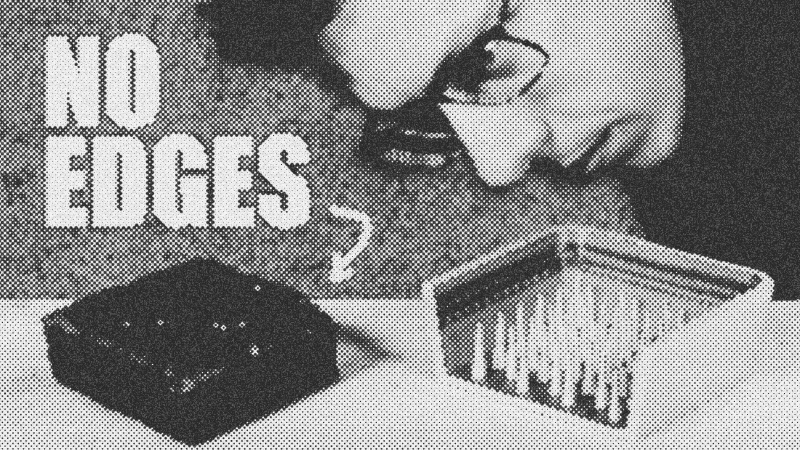
Subjective taste tests only go so far. To prove the efficacy of the edgeless pan, I built a mechanical mouth. This device uses a motor, a razor blade, and a load cell to measure the exact force required to cut through the brownie. A standard edge shows a massive spike in force on the top and bottom crusts, whereas a center piece shows a constant, low-force profile. The data confirmed that brownies from the Iron Maiden Pan exhibit a uniform force profile across the entire piece. We have successfully engineered the "edge" out of existence, proving that even a kitchen staple can be optimized with enough machining and thermal analysis.
Baking brownies from the inside out
WatchStuff Made Here // 23:21

I've been building things for as long as I can remember. It all started when my dad exposed me to plastic model building and soldering when I was around 4 years old. That set me on a path to building increasingly complex things and becoming an engineer. My goal is to do the same for as many people as possible by exposing them to the joy of engineering, fabricating and creating things out of nothing. If I'm lucky a few people may become engineers, which would be great for the world. Engineering is awesome. If you're interested in sending me something: P.O. Box 78470 Charlotte, NC 28271