The Engineering of Jaws: Inside the 80,000-Pound Explosive Nutcracker
From Concrete Nails to Nutcracking
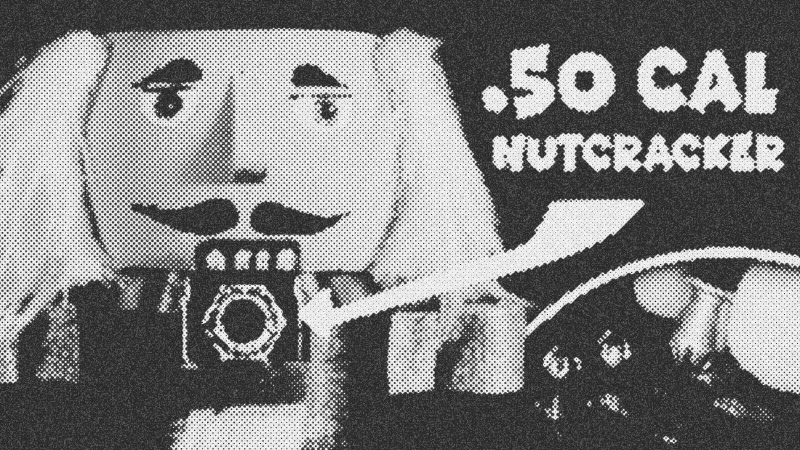
Building a machine that generates 15,000 times the force of a standard kitchen tool requires more than just a bigger lever. In fact, Jaws, a custom-engineered, powder-actuated nutcracker, abandons the lever entirely. The core technology stems from Powder Loads, specifically the red-tipped blanks typically used in construction to drive steel nails into solid concrete. By capturing the high-pressure gas expansion from these blanks, a small-scale explosion transforms into a controlled mechanical strike. While a previous iteration—an explosive baseball bat—utilized a .50 caliber piston, this machine scales the internal diameter to 2.0 inches, effectively increasing the potential crushing force by a factor of ten. This jump in scale moves the project from a simple gadget to a serious exercise in pressure vessel engineering.
Stress Calculations and Material Limits
When dealing with internal pressures capable of generating 80,000 pounds of force, the primary engineering challenge is preventing the machine from becoming a pipe bomb. The stress in a cylinder increases dramatically as the piston diameter grows. To solve for safety without wasting expensive steel, one must rely on Calculus and differential equations. These tools allow a builder to analyze how stress varies across the cross-section of a pipe.
Calculations revealed that to handle the simultaneous detonation of four high-power blanks, the steel walls of the device required a thickness of at least one inch. This isn't just a guess; it's based on the yield strength of the metal—the specific point where steel deforms permanently rather than springing back. If the internal pressure exceeds this threshold, the device fails catastrophically. By calculating the cross-sectional area of the structural bolts and comparing it to the known yield strength of the alloy, an engineer can predict exactly when the machine will hold and when it will rip itself apart.
Troubleshooting the Mechanical Interface
Theoretical physics rarely survives the first trip to the machine shop without adjustments. Initial tests of the device showed a massive deficit in power, despite the math being sound. The culprit turned out to be a microscopic misalignment between the gas port of the shells and the piston intake. In high-pressure systems, even a tiny gap allows expanding gas to escape, causing a total loss of kinetic energy.
Furthermore, the high pressure actually caused the brass shells to deform and flow into the tiny tolerances of the breech, effectively jamming the mechanism. Solving this required a complete redesign of the firing chamber to bolt the components together more tightly, eliminating any room for the shells to expand. This iterative process highlights a fundamental DIY truth: fabrication is 10% cutting metal and 90% solving the problems you created in the first 10%.
Safety Mechanisms and Energy Dissipation
Safety in high-energy DIY projects requires redundancy. Because the piston moves at speeds up to 200 miles per hour, stopping it safely is as hard as launching it. A heavy-duty spring—internally referred to as "beef supreme"—acts as a kinetic buffer, subjecting the internal components to 18,000 Gs to prevent a steel-on-steel collision that would shatter the frame.
Beyond the mechanical buffers, the design incorporates a physical "safety stick" that blocks the hammer and prevents the lever from moving. More importantly, the structural bolts are designed as the weakest point in the assembly. If the pressure exceeds safe limits, the bolts will snap and vent the pressure upward, rather than allowing the main body to fragment outward. This intentional failure point is a hallmark of professional engineering, ensuring that if a machine fails, it does so in the least lethal way possible.
- Calculus
- 14%· science
- Differential Equations
- 14%· science
- Fuse One
- 14%· products
- Jaws
- 14%· products
- KiwiCo
- 14%· companies
- Other topics
- 29%
Explosive powered nut cracker vs. metal nuts
WatchStuff Made Here // 21:31

I've been building things for as long as I can remember. It all started when my dad exposed me to plastic model building and soldering when I was around 4 years old. That set me on a path to building increasingly complex things and becoming an engineer. My goal is to do the same for as many people as possible by exposing them to the joy of engineering, fabricating and creating things out of nothing. If I'm lucky a few people may become engineers, which would be great for the world. Engineering is awesome.