China's cheap open models threaten America's trillion-dollar AI bet
The Quiet Deflation of Big Tech's Crown Jewel
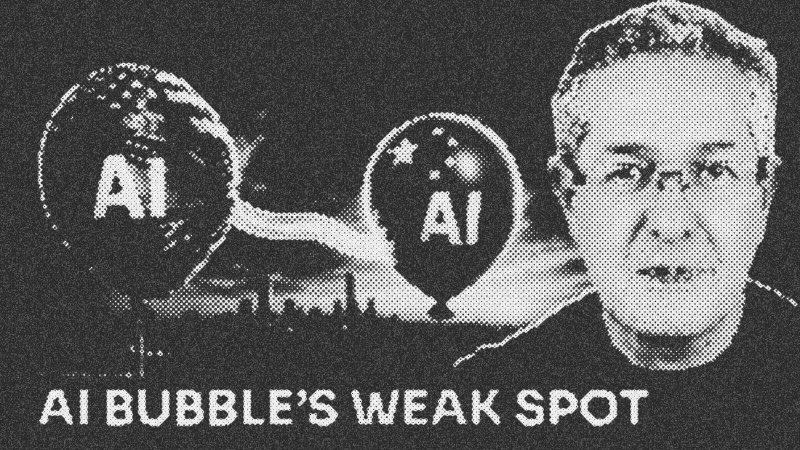
Many investors expect the artificial intelligence boom to end in a spectacular, recession-fueled market crash. A far more likely scenario is already unfolding: the quiet deflation of the US AI bubble. Instead of a dramatic pop, the market faces a steady leak of capital as cheap, open-source alternatives emerge from overseas. This shift challenges the comfortable assumption that global enterprises will indefinitely rent expensive computing power from centralized US giants.
The Cost-Quality Convergence Exploded
American hyperscalers like Microsoft, Alphabet, and Amazon are funding a colossal infrastructure buildout. Yet, Chinese open-weight models have dramatically closed the performance gap. Models such as DeepSeek, Quen, and Kimmy now trail the absolute frontier of US closed models by a mere matter of months.
The financial discrepancy is staggering. The flagship DeepSeek model costs approximately 87 cents per million output tokens. That is roughly 60 times cheaper than Anthropic's latest commercial offering. For enterprises running millions of automated queries daily, this pricing disparity transforms the fundamental unit economics of implementing AI, making proprietary US APIs increasingly difficult to justify.
Sovereignty and Local Silicon
The technological paradigm is shifting from centralized cloud renting to sovereign, on-device execution. The hardware required to run a highly capable, 120-billion-parameter model now fits comfortably on an office desk.
Modern local hardware delivers computational throughput that previously required massive, warehouse-scale supercomputers. Crucially, running models locally on enterprise hardware resolves the persistent risk of data leakage. For privacy-conscious businesses and foreign governments, keeping proprietary data on local devices is the only compliant path forward. This transition poses a direct threat to the massive cloud data centers currently under construction.
The Geopolitical Precedent
Recent regulatory interventions highlight the fragility of relying on centralized, US-hosted infrastructure. When Washington enforced export controls on Anthropic's newest models, the firm had to pull its frontier models worldwide on mere minutes of notice to comply.
This aggressive intervention sends a clear warning to international enterprises. Relying on US-hosted cloud intelligence exposes foreign businesses to overnight regulatory shutdowns. Consequently, the most valuable AI is no longer the smartest one; it is the one a business can reliably log into every Monday morning without geopolitical interference.
Navigating the Capital Realignment
This structural shift does not portend a complete dot-com-style wipeout for megacap tech firms. Giant hyperscalers possess highly diversified, deeply profitable core businesses in enterprise software, search, and retail. Instead, the risk lies in long-term equity underperformance. Big tech is pouring massive capital into infrastructure that is failing to generate matching returns.
For disciplined investors, the path forward requires patience rather than tactical trading. A broad, cap-weighted global index automatically self-corrects. As high-flying hyperscalers cool off, the index naturally reallocates capital to the hardware suppliers, energy providers, and device manufacturers capturing the decentralized value. Owning the entire industrial chain remains far safer than guessing which individual model wins.
The AI Bubble: Could China Pop It?
WatchPensionCraft // 17:45

My name is Ramin Nakisa and I started PensionCraft in 2016 as I felt strongly that I wanted to teach people how to invest well for themselves so they could stop making costly mistakes and losing their money through having to pay unnecessarily high fees. Before starting PensionCraft, I worked in investment banking as a strategist and I was a frequent contributor on CNBC and Bloomberg TV. I have written two books about finance and investment: one for professional investors and one that explains how to buy and sell volatility using exchange-traded products. I publish a new video on YouTube every Saturday and you can join me for a live Q&A on the 1st Thursday of every month at 7pm UK time. If you want to learn how to become a better investor then why not join our friendly membership at pensioncraft.com?