Seth Godin warns that waiting for permission is your safest hiding place
The Architecture of Choosing Yourself
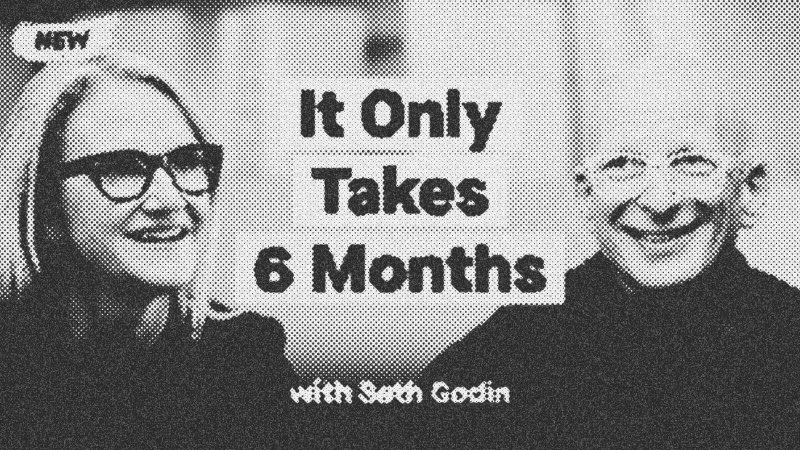
Many of us live as if we are waiting for a phone call that will never come. We spend years polishing a manuscript, a business plan, or a personal goal, yet we remain stationary. Seth Godin suggests that this state of waiting is not a passive accident; it is an intentional, albeit unconscious, choice to hide. The dominant systems of our society—from the traditional school environment to the corporate hiring process—are designed to make us wait for authorization. We wait to be picked by a publisher, a boss, or a reality show judge. This system of "waiting to be invited" creates a psychological safety net. If you aren't picked, you aren't on the hook for the results.
Breaking this cycle requires a fundamental shift in how you view agency. To pick yourself means to stop asking for a map and start drawing one. It is the realization that no one is coming to save you, and that is actually the best news you could receive. When you hire yourself, you reclaim the dignity of your own ambition. This isn't about arrogance; it's about responsibility. It’s about saying, "Here, I made this," and offering it to the world without the buffer of an intermediary's approval. The moment you stop waiting for the world to authorize your existence is the moment you actually begin to live it.
Solving Problems by Identifying Situations
A critical barrier to personal growth is the inability to distinguish between a problem and a situation. Problems have solutions, even if those solutions are uncomfortable or expensive. Situations, like the laws of physics or a past event, have no solution; they can only be accepted. Much of our mental fatigue comes from treating situations as problems we must fix, or treating problems as situations we are victimized by.
When we label a challenge as a "situation," we let ourselves off the hook. If the weather is bad, that is a situation. You cannot solve the rain. However, how you spend your day despite the rain is a problem with multiple solutions. Seth Godin emphasizes that we often use the word "but" to link our desires with our excuses: "I want to start a business, but I don't have the money." By replacing "but" with "and," we transform the excuse into a logistical reality: "I want to start a business, and I don't have the money." This shift removes the victimhood and places you back in the role of the architect. You are now looking at a set of circumstances and deciding how to navigate them, rather than letting those circumstances serve as a permanent roadblock.
The Compass of Resistance
Resistance is the internal force that keeps us from doing work that matters. It is a biological and psychological friction that appears the moment we contemplate doing something brave or original. Many people wait for the feeling of fear to disappear before they take action. This is a mistake. Resistance is not a sign that you are doing something wrong; it is a compass pointing toward the work that is most important.
If you don't feel resistance, the project likely isn't big enough to change you or the world. When resistance shows up, the most productive response is to thank it. It is a reminder that you are on the verge of growth. This internal friction is closely tied to the concept of "writer's block," which Godin dismisses as a modern fiction. There is no such thing as an inability to create; there is only a fear of creating something that isn't perfect. By acknowledging resistance as a mandatory part of the process, you stop fighting the feeling and start doing the work. You learn to "put the tired somewhere" and keep moving, just as a marathon runner accepts exhaustion as a condition of the race.
Shrinking the Audience to Expand the Impact
One of the most paralyzing thoughts is the need to reach everyone. We obsess over "going viral" or being liked by the masses. This desire for universal approval is another form of hiding. When you try to please everyone, you end up pleasing no one, and you dilute the art you were meant to make. The solution is to seek the "smallest viable audience." Ask yourself: Who is this for? What is it for? If you could only change the lives of ten people, who would they be, and what change would you seek to make?
By shrinking the target, you remove the excuse of overwhelm. You don't need a million followers to start a movement; you need a handful of people who truly care. This approach requires you to be specific and intentional. It moves you away from the trap of social media metrics and back toward the core of human connection. Whether it's volunteering at a local hospital or starting a small newsletter for five friends, the smallest unit of art is often the most transformative. It allows you to practice the act of "here, I made this" in a low-stakes environment, building the muscle of generosity and courage.
The Professionalism of Consistency Over Authenticity
In our current culture, we worship at the altar of authenticity, but Seth Godin argues that authenticity is often just a get-out-of-jail-free card for being subpar or unprofessional. When you hire a surgeon, you don't want them to be "authentic" if they are having a bad day; you want them to be consistent. Professionalism is the ability to show up and keep a promise to your audience, regardless of how you feel in the moment.
Consistency is the true path to service. It is about deciding who you want to become and then performing that role until it becomes your reality. We become what we do, not the other way around. If you want to be a writer, you write. If you want to be a leader, you lead. You don't wait to feel like a writer or a leader to begin. This doesn't mean being fake; it means being intentional. It means showing up as the best version of yourself for the people who are counting on you. By prioritizing consistency over the whims of your current mood, you build a foundation of trust with yourself and your community.
Abandoning the Perfectionist Trap
Perfectionism is not a pursuit of excellence; it is a sophisticated defense mechanism. It is the ultimate tool for procrastination because it allows you to stay in the "polishing" phase indefinitely. As long as the work isn't perfect, it's not ready to be judged, and as long as it's not judged, you are safe from rejection. To overcome this, you must adopt the mantra of "merely shipping." This isn't about producing junk; it's about meeting the defined specification and then letting the work go.
Nothing is ever truly perfect. Every great book could have been edited one more time. The goal is to meet the spec and move on to the next thing. This requires a detachment from the outcome. You offer your work as a gift, not as a transaction where the recipient owes you a specific reaction. When you stop being attached to how the world receives your work, you are finally free to do your best work. You are no longer trying to control the uncontrollable; you are simply focused on the act of creation and the generosity of the offer.
Encouragement and the Ruckus Mindset
Your life is the result of the stories you tell yourself. You can tell a story of being a cog in a machine, or you can tell a story of being an architect of change. The world is in a constant state of flux, and waiting for things to "get back to normal" is a recipe for irrelevance. This is the new normal. The only variable you truly control is your own agency.
Growth happens one intentional step at a time. It doesn't require a grand gesture; it requires a series of small, brave choices. You have the inherent strength to navigate the resistance, the fear, and the fatigue. The discomfort you feel is the sensation of your own potential trying to break through. Don't suppress it with busyness or status-seeking. Lean into it. Recognize that you are not behind; you are simply in the process of becoming.
Concluding Empowerment
Go make a ruckus. This isn't a call to be loud or disruptive for its own sake. It is a call to do work that matters for people who care. It is an invitation to stop hiding in the crowd and start standing for something. You don't need permission to lead, to create, or to change your life. You only need to pick yourself. The tools are in your hands, and the audience is waiting for someone to show up with a gift that is uniquely theirs. The most important thing you can do today is to take that first, awkward, unpolished step. The ruckus begins with you.
- Seth Godin
- 30%· people
- Arne Sorenson
- 10%· people
- Ashley
- 10%· companies
- Marriott
- 10%· companies
- Mel Robbins
- 10%· people
- Other topics
- 30%
How to Build a Life That Matters & Get What You Want Starting Today
WatchMel Robbins // 1:06:22

Mel Robbins is the creator and host of The Mel Robbins Podcast, one of the most successful podcasts in the world, and a #1 New York Times bestselling author. She has 40M followers and is known globally for practical tools on mindset and behavior change. The Wall Street Journal calls her a “billion-view podcaster,” and TIME says she gives millions “a reason to believe in themselves.” Her books are published in 63 languages. The Let Them Theory is a #1 bestseller across every major list and a top-selling book of 2025 with more than 8M copies sold. She also wrote The 5 Second Rule and The High 5 Habit, and has seven #1 Audible releases. Her company, 143 Studios, produces award-winning podcasts, books, courses, and events for partners like Starbucks, Ulta Beauty, JP Morgan Chase, LinkedIn, and Audible. She has been honored by TIME 100 Digital Voices, Forbes 50 Over 50, USA Today, Apple Podcasts, Spotify, and The Hollywood Reporter.